See on Scoop.it – Geography Education

This is clever.
See on xkcd.com
See on Scoop.it – Geography Education
Not long ago in a supermarket not so far away. Help fight the dark side of the farm. Rate the film, favorite the film, comment the film and subscribe to our …
This is horribly cheesy and from an incredibly biased perspective, but it does embody how many see the organic movement (and is quite entertaining for old Star Wars buffs like me).
See on www.youtube.com
See on Scoop.it – Social Media Classroom
Conan Heiselt on TechSmith worked with a focus group to discover what make ‘best practices’ guide for making the most engaging screencasts (videos that show a computer screen). This awesome PDF is the result.
See on assets.techsmith.com
See on Scoop.it – Geography Education
One of the great things about Twitter is that it’s a global conversation anyone can join anytime. Eavesdropping on the world, what what!
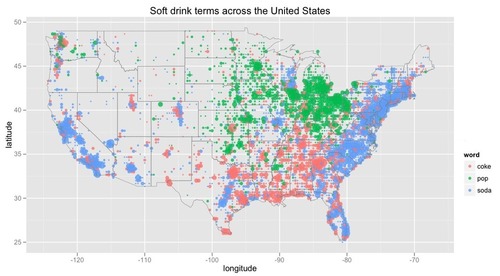
While many educators have been using http://popvssoda.com/ to show the linguistic regions in the United States, this is a similar map, with the added social media component. To map out these regions, the cartographer used the word choice on geo-tagged tweets as the data source. For another twitter, map, the following link shows which regions are most actively engaged on Twitter: http://www.huffingtonpost.com/2012/07/06/top-countries-on-twitter_n_1653915.html
What do these regions show us? What types of regions are these?
See on blog.echen.me
See on Scoop.it – Geography Education
Today was the launch for the new AP Human Geogaphy Teacher Community site administered by College Board. This new community allows for more effective discussion management and resource posting than the listerv did. You can access the community by going to http://apcommunity.collegeboard.org/
and logging in with your same user id and password that you use for accessing AP scores and such. If you, or someone you know, is not an audit-approved teacher then they are still welcome to join the community (and I quote, “all educators are welcome”). They will simply go to the same site, click on Human Geography in the drop-down box, and request to join. All membership requests will be processed as quickly as possible. I will most certainly still post the majority of my links here and at http://geographyeducation.org but hope to participate will many of you on this new site as well.
See on apcommunity.collegeboard.org
See on Scoop.it – Geography Education
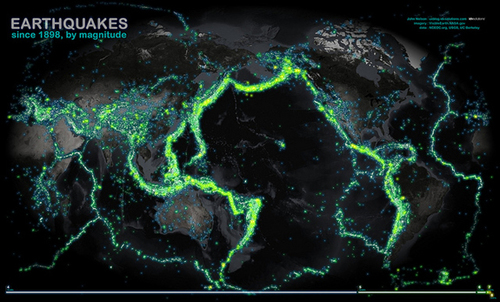
This map of all the world’s recorded earthquakes between 1898 and 2003 is stunning. As you might expect, it also creates a brilliant outline of the plates of the Earth’s crust—especially the infamous “Ring of Fire” around the Pacific Plate.
The plate boundaries are amazingly vivid in this geovisualization of the all the earthquakes over a 105 year span. How did scientist orginally come up with the theory of plate tectonics? How did spatial thinking and mapping play a role in that scientific endeavor?
See on boingboing.net
See on Scoop.it – Geography Education
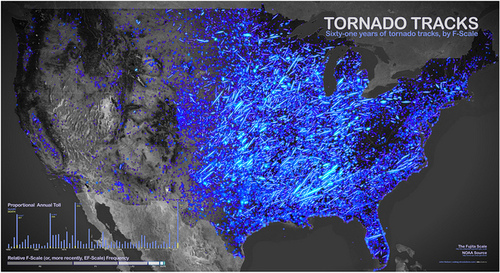
This strangely beautiful map shows every tornado to hit the U.S. between 1950 and 2011. What physical geographic factors lead to this distribution? What are the impacts of this data on human geography?
See on boingboing.net
See on Scoop.it – Geography Education
In a borough that has become a globally recognized icon of cool, residents are watching the renaissance with resentment and indifference.
Gentrification is inherently selective and consequently the impact is highly variable even among close neighborhoods. What makes one nieghborhood a candidate for gentrification? What qualities do neighborhoods of disinvestment share? Who are the ‘winners and losers’ in this process?
See on www.nytimes.com
See on Scoop.it – Social Media Classroom
After two decades in online teaching in both the corporate world and higher education, I regret to report that the grass is not necessarily greener on the other side of the network connection.
Just having the class online does not ensure it’s success. Here are a few helpful tips on what teaching style helps facilitate online learning.
See on thejournal.com







 GEOGRAPHY EDUCATION