Search

GEOGRAPHY EDUCATION

Supporting geography educators everywhere with current digital resources.

Month

July 2012

Why Students Should Learn to Write for the Public

See on Scoop.itSocial Media Classroom

“Writing is a public act,” says New York teacher Ileana Jimenez, who encourages her students to blog.


Why should we have our students publicly produce information? Writing isn’t a solitary project; it is designed to engage with other minds and distinct perspectives. 

See on blogs.kqed.org

Cambridge Ideas – How Many Lightbulbs?

See on Scoop.itGeography Education

Cambridge University physicist, David Mackay, in a passionate, personal analysis of the energy crisis in the UK, in which he comes to some surprising conclus…


This is a great video to show students the amount of energy they use, both at an individual level and at the national scale (this video is from the U.K.)  To ‘flip’ this Ted-Ed talk, visit it’s homepage at: http://ed.ted.com/on/MVwtmMV5

See on www.youtube.com

Latino boom makes Orlando proving ground for Obama

See on Scoop.itGeography Education

President Obama and Mitt Romney are set to make appearances beginning Thursday at a major gathering of Latino officials and activists…

A core component of the 2012 U.S. presidential elections will be the demographic profile of both the Republican and Democratic Parties’ power base. For most of American history, the African-American population was the largest minority second to the Caucasian minority. Since the 2000 census, the Latino population has overtaken the African-American population as the largest minority in the U.S.  How does this impact both parties?  What are the strategies of both parties to appeal from a diverse set of voters?   How does the immigration issue shape ‘identity politics?’

See on edition.cnn.com

Urban Life In The 21st Century

See on Scoop.itGeography Education

More than half of the world now lives in urban areas. In the U.S., urban dwellers make up 83 percent of the population, and it’s growing every day. What does it mean to live in a city today? What are the challenges for cities going forward?


This NPR special series, NPR cities, is an acknowledgement of what we already knew: cities are becoming increasingly important. To understand humanity in the 21st century, we need to understand cities. Included in this marvelous feature are numerous podcasts, infographics and articles about urban themes such as transportation, cultural amenities, economic and neighborhood revitalization.

See on www.npr.org

Twitter for [Geography] Teachers: Intro & Signing Up

See on Scoop.itGeography Education

“I just returned a few days ago from a great week in Cincinnati, reading AP Human Geography exams with 400 colleagues from all over the country. In our conversations during the reading, I’ve come across a number of these folks, many of them high school teachers, who are interested in using Twitter but have no idea where to start.


What I’m hoping to do in the next few entries is give a beginner’s guide to using Twitter, specifically geared toward folk who are completely lost at how to begin. I’ll also be working toward some ‘best practices’ once the basics are out of the way.” 


If you are unconvinced that you should get on twitter (#aphg), see: http://www.creativeeducation.co.uk/blog/index.php/2011/09/10-reasons-to-tweet/

See on andrewshears.com

Urban issues: Transportation and Density

See on Scoop.itGeography Education

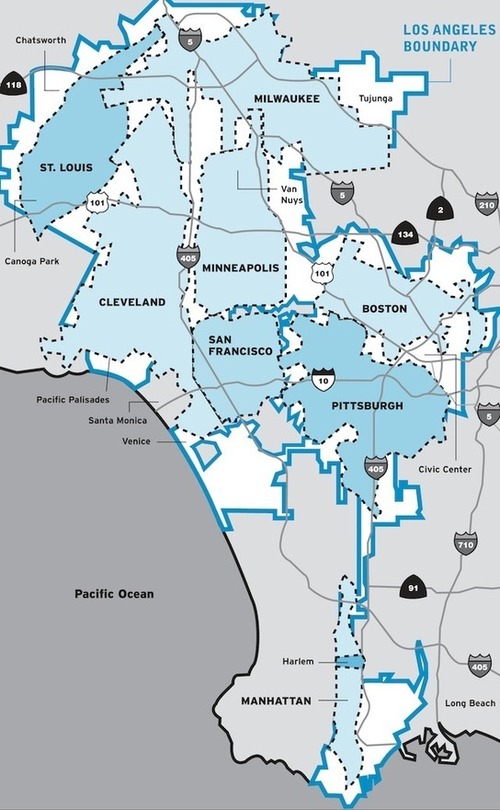
A map that has been making the rounds on the internet demonstrates how you can fit 7 major U.S. cities plus New York’s most famous borough within Los Angeles city limits.


So Los Angeles is big, but, LA’s spatial extent is in part due to it’s history with transportation (ripped out the streetcars to let the automobile and freeway take over).  How do density and transportation affect cities? 

See on laist.com

Making Cities Sing

See on Scoop.itGeography Education

In urban centers around the country, local governments are looking to attract emerging industries and the next generation of entrepreneurs.


This is a panel of urbanists who specialize in revitalizing cities and creating economically and culturally vibrant urban centers.  They focus not on public policy, but rather finding ways to implement the locally produced ideas of people from the neighborhood with an intimate knowledge of the community as well as a vested in strengthening the local networks.  They also highlight the arts, sense of place and the culture of a neighborhood as key components create attractive cities.


For another video from the Apsen Ideas Festival on urbanism (Megacities), see: http://www.aspenideas.org/session/advice-megacity   


See on www.aspenideas.org

Ten Ways Walmart Changed the World

See on Scoop.itGeography Education

On July 2, 1962 — 50 years ago today — Sam Walton opened the very first Walmart store in Rogers, Arkansas.


The Walmart business model has profoundly reshaped the economic paradigm of retail these has 50 years.  Walmart is commonly cited as a business that exemplifies the processes of globalization.  How has Walmart reshaped aspects of society such as industrial production, environmental standards, labor, urban shopping locations, the outsourcing of manufacturing and consumption? 

See on business.time.com

Immigrants Working In America

See on Scoop.itGeography Education

The U.S. is still a nation of immigrants: One in six U.S. workers was born somewhere else. Here’s where America’s immigrants come from, and what they do for work.


Of the American immigrant population, where were the workers born?  In what industries are they employed?   

See on www.npr.org

Blog at WordPress.com.

Up ↑