Search

GEOGRAPHY EDUCATION

Supporting geography educators everywhere with current digital resources.

Month

February 2014

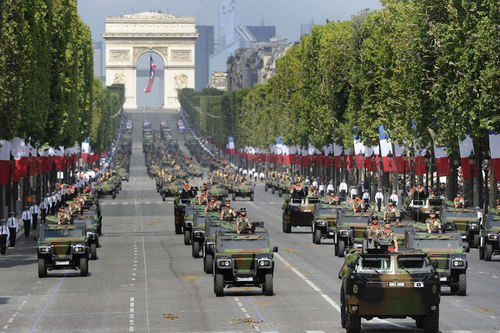
Military industrial complex: These 15 countries have the largest defense budgets

World defense spending is expected to go up for the first time in five years, thanks to China and Russia.

Seth Dixon‘s insight:

The top 3 shouldn’t come as any big surprises, but there might be a few farther on down the list though that might raise some eyebrows.  There are specific geopolitical, historic, economic and cultural rationales for each of these countries that explain why they are on this list, and discussing those reasons is a conversation would having. 

See on www.globalpost.com

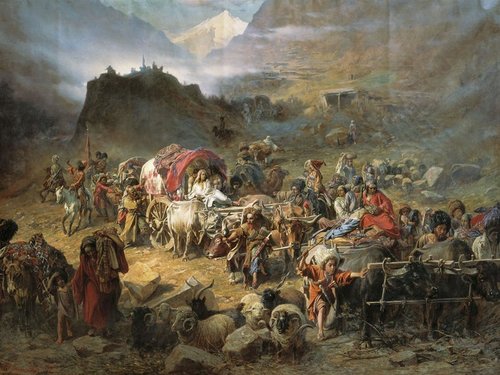
150 Years Ago, Sochi Was the Site of a Horrific Ethnic Cleansing

Czar Alexander II may have freed the serfs, but his war against the stateless people of the Caucasus cannot be ignored

The czar’s approval of this rapid expulsion of hundreds of thousands of Circassians to the Ottoman Empire resulted in an ethnic cleansing through disease and drowning as overcrowded ferries crossed the Black Sea. The Ottomans were unprepared for the influx of refugees, and the absence of adequate shelter caused even more deaths from exposure. Those Circassians who attempted to remain in the Russian Empire and fight for their land were massacred. Sochi’s “Red Hill,” where the skiing and snowboarding events will take place during these Olympic Games, was the site of the Circassian last stand, where the Imperial Russian armies celebrated their “victory” over the local defenders.

Seth Dixon‘s insight:

I mentioned this before, but it is worth repeating.  As the international spotlight in on Sochi, our students interest in the region is also heightened.  This makes it the perfect time to shine a light on parts of history that many have conveniently tried to brush aside. 

Tags: Russia. historical, colonialism.

See on www.smithsonianmag.com
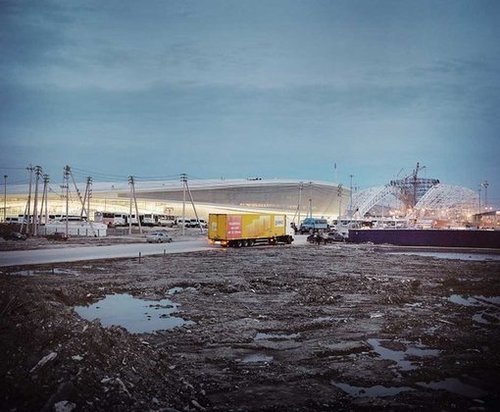
Why Sochi?

Why would Vladimir Putin want to host the Olympics in an underdeveloped place where terrorists lurk nearby? The answer is not as complicated as it may seem.

Seth Dixon‘s insight:

This article is an excellent explanation of the geopolitical significance of holding the Olympic Games in Sochi.  Additionally, here is a link from Stratfor discussing the shifting foreign policy concerns of the United States towards and in Russia. 

Tags: sport, political, conflict, devolution, Russia.

See on www.nybooks.com

Drain the Great Lakes


This represents less than 10% of the Terragen CGI created for “Drain the Great Lakes”, a TV documentary made for MSP, National Geographic Channel & Discovery Canada by 422 South in Bristol, UK. I created all the Terragen landscape work over a period of 7 months in 2011.”

Seth Dixon‘s insight:

What would the Great Lakes region look like if the lakes were drained?  This visualization is a tremendous exploration into hypothetical geographies. This video has been added to the the interactive map, Place-Based Geography Videos.

Tags: physical, environment, water, visualization.

See on www.youtube.com

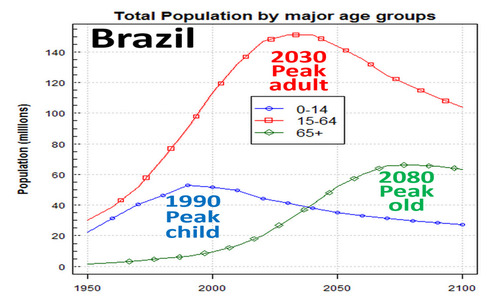
World Population Prospects

Seth Dixon‘s insight:

The United Nations Department of Economic and Social Affairs produces easy-to-use population charts and graphs (including population pyramids).  This image (courtesy of Hans Rosling) shows the impending changes on Brazilian society based on changing fertility rates. How is this chart an example of population momentum and of the Demographic Transition Model? 

Tags: population, demographic transition model, declining population, models, Brazil.

See on esa.un.org

Shifting post-colonial economic geographies

“Changes in relationships can be hard to take. The economic bond between Latin America and Spain, its biggest former colonial power, is shifting as the region’s economies mature. Despite some ruffled feathers, the evolution is positive.  After two decades in which Spain amassed assets worth €145 billion ($200 billion) in Latin America, last year was the first in which Latin American companies spent more on acquiring their Spanish counterparts than the other way around.”

Seth Dixon‘s insight:

I am hesitant to use the term post-colonial since there are theoretical constructs that use that term to embody cultural hegemonic power structures.  I’m simply using it to mean “after colonialism” because the power paradigm is shifting to the former colonies. 

TagsLatin AmericaSouth America. economic, development, Spain, historical, colonialism.

See on www.economist.com


Cultural Critique of the #SochiProblems Meme

” #SochiProblems is more of an embarrassment for America than it Is for Russia….So this is my plea: @SochiProblems, whining journalists and social media fiends, have just a bit more respect for Russians when ridiculing what is to you the Olympics and what is to them everyday life. Their government might have just spent $51 billion on possibly the most corrupt Olympic games ever, but most of them are just along for the ride.”

See on www.policymic.com

Mapping Where People Run

“Inspired by a 2011 project that mapped popular running routes in a few European cities, Nathan Yau at FlowingData has done the same for 22 major cities, including 18 in the U.S.   To make these maps, Lau simply grabbed public data from the exercise-tracking app RunKeeper. While these visualizations are not representative of all runners in a city, they do offer useful information on urban spaces. For one, we see that people really do love running near water and in parks.  Here’s a selection of Yau’s work. See the rest here.”

See on www.theatlanticcities.com

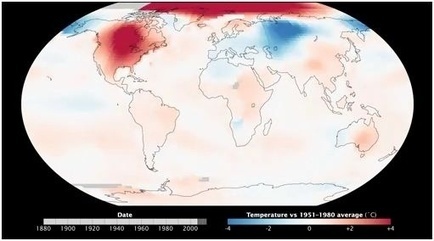
Watch the Earth Warm Since 1880

“It can be difficult to conceive of the long process that’s led the world to having its nine hottest years on record all after 2000. That’s why it’s nice that NASA has generated this nifty animation, which shows temperature abnormalities for every month of the past 13 decades. Watch reddish warm zones spread over the globe as time rolls past, like a virulent fever covering the body of a sick host.”

See on www.theatlanticcities.com

Blog at WordPress.com.

Up ↑