See on Scoop.it – Geography Education
This a visually stunning video with clips compiled from the Discovery Channel’s series “Planet Earth.”
See on www.youtube.com
See on Scoop.it – Geography Education
This a visually stunning video with clips compiled from the Discovery Channel’s series “Planet Earth.”
See on Scoop.it – History and Social Studies Education
Nancy Duarte analyzes Dr. Martin Luther King Jr.’s famous “I Have a Dream” speech using principles from her book, Resonate.
Today is the 49th anniversary of this famous speech, arguably the most important speech in American history. May we remember his message forever.
See on vimeo.com
Here is the full original speech:
See on Scoop.it – Geography Education
Canadian artist Jon Rafman is an unusual photographer – he explores Google Street Views and takes screenshots of the most incredible sights here.
See on www.demilked.com
See on Scoop.it – Regional Geography
Gaza’s problems in water and electricity, education and health will only get worse over the coming years unless remedial action is taken now, a senior United Nations official warned today.
The United Nations is playing a larger role in the reagion by asking for more humanitarian aid for Gaza and a change in the political status quo.
See on www.un.org
See on Scoop.it – Geography Education
“A Cameroonian boy shows the recycled parts used to construct a toy RC car.”
I originally found this video on one of the coolest websites ever: http://www.afrigadget.com/ ; The website seeks to show people “solving everyday problems with African ingenuity.” While the developed world lives in a commercial, disposable society, Africans often need to maximize the useablity of all objects. The solutions they come up with can show students that it is not all doom and gloom in Africa, an represent a triumph of the human spirit.
See on www.youtube.com
See on Scoop.it – Geography Education
Landesa partners with governments and local NGOs to ensure the world’s poorest families have secure land rights, which develops sustainable economic growth and improves education, nutrition, and conservation…
Globally speaking, women are the primary agricultural workers yet rarely own land.
See on www.landesa.org
See on Scoop.it – Geography Education
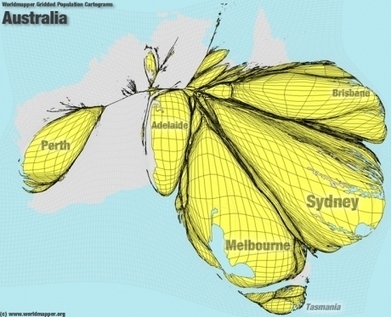
I found these cartograms from an article in the Telegraph and was immediately impressed. The cartograms originated here and use data from the Global Rural-Urban Mapping Project as to create the int…
This series of cartograms shows some imbalanced populations (such as the pictured Australia) by highlighting countries that have established forward capitals. Question to ponder: Do forward capitals change the demographic regions of a country significantly enough to justify moving the capital?
See on sperglord.wordpress.com
See on Scoop.it – Geography Education
Ever wonder how charitable the people are who live in your area? It turns out that lower-income people tend to donate a much bigger share of their discretionary incomes than wealthier people, according to a new study.
Questions to ponder: What are some reasons that Providence RI is the ‘least charitable’ metropolitan area in the United States according to this data? Why is the state of Utah ranked as the ‘most charitable state?’ Why are the bottom 3 states all in the New England region?
See on www.npr.org