Search

GEOGRAPHY EDUCATION

Supporting geography educators everywhere with current digital resources.

Author

sethdixon

I am a geography professor at Rhode Island College.

The business of US food aid – interactive

See on Scoop.itGeography Education

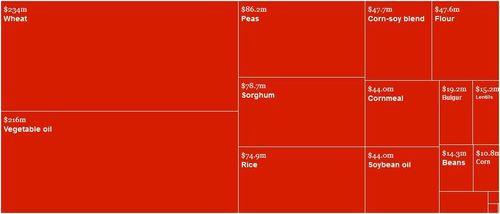
Nearly $1bn was spent last year buying wheat, sorghum and other products for the controversial US ‘in-kind’ food aid programmes.   Over 40 companies sold food aid last year

But big agribusinesses are not the only ones winning US food aid contracts. Over 40 companies sold nearly 1.8m tonnes, or $1bn worth, of food aid last year.

Some have developed entirely new product lines, specifically to sell as overseas food aid. Others have fought to get their products on the list of eligible commodities, which includes items such as canned pink salmon and dehydrated potato flakes.

Didion, a private, family-owned company headquartered in Wisconsin, has developed a special line of corn-based food aid products. Last year it was the government’s top supplier of corn-soy blend, a fortified food of choice for the UN’s World Food Programme.  What Crops are being donated?  To which countries?  From which companies?  The answers lie in this interactive feature.

See on www.guardian.co.uk

The business of US food aid – interactive

See on Scoop.itGeography Education

Nearly $1bn was spent last year buying wheat, sorghum and other products for the controversial US ‘in-kind’ food aid programmes.   Over 40 companies sold food aid last year

But big agribusinesses are not the only ones winning US food aid contracts. Over 40 companies sold nearly 1.8m tonnes, or $1bn worth, of food aid last year.

Some have developed entirely new product lines, specifically to sell as overseas food aid. Others have fought to get their products on the list of eligible commodities, which includes items such as canned pink salmon and dehydrated potato flakes.

Didion, a private, family-owned company headquartered in Wisconsin, has developed a special line of corn-based food aid products. Last year it was the government’s top supplier of corn-soy blend, a fortified food of choice for the UN’s World Food Programme.  What Crops are being donated?  To which countries?  From which companies?  The answers lie in this interactive feature.

See on www.guardian.co.uk

Amarnath: Journey to the shrine of a Hindu god

See on Scoop.itRegional Geography

Each year, Hindu devotees make a pilgrimage to the sacred Amarnath Cave, one of the most revered Hindu shrines, near Baltal, Kashmir, India.


With 46 stunning images, this is a great visual glimpse into the a traditional pilgrimage deep into the Himalayas.   

See on www.boston.com

How to Create Your Own Textbook — With or Without Apple

See on Scoop.itSocial Media Classroom

Aggregation, curation, creation: A step-by-step guide to creating your own textbook — and involving your students along the way.


Textbooks are fantastic compilations of educational resources.  Online publishing of resources is now much more accessible to professors and teachers that  want to craft their own course resources.

See on blogs.kqed.org

Map of America’s Hispanic population

See on Scoop.itGeography Education

In the race to the White House, no ethnic group is more prized than Hispanics. President Obama ended deportations for some young undocumented immigrants, and the Romney campaign is vetting Sen.


This interactive map feature combines to interesting variables (at the county level): the percentage of the total population that is Hispanic, and the 2008 presidential election.  Analyze your local area and a few counties as well.  What connection exists between the two variables?  How come?  What are some exceptions to these general patterns?

See on www.slate.com

A Nation Of Meat Eaters: See How It All Adds Up

See on Scoop.itGeography Education

Americans eat more meat than almost anyone else in the world, but habits are starting to change. This may be in part because of health and environmental concerns. We explore some of the meat trends and changes in graphs and charts.

Often we hear about the dietary impact of meat consumption at the personal scale, but what are the environmental impacts of heavy meat consumption on a global scale?  Not all meats have the same environmental impact (beef is much less environmentally efficient than chicken, pork or turkey).   As globalization has spread, American cultural preferences have changed worldwide taste preferences.  As the global population rises, the impact of meat consumption is now a major environmental concern.

See on www.npr.org

Understanding Poverty in the United States

See on Scoop.itGeography Education

Analysis of poverty in the USA: poor children rarely hungry; poor often have cable TV, air conditioning, a computer, and larger homes than non-poor Europeans.


This is an interesting series of bar graphs, pie charts and other data sets, all showing helping us to contextualize the life of the poor.  How is ‘being poor’ in the United States distinct from poverty in other regions of the world?  Is it fair to distinguish between the two?  How do you define poverty?  Is it a universal standard that is the same everywhere or is it a relation measure compared to others within the community? 

See on www.heritage.org

Gerrymandering 101

See on Scoop.itGeography Education


This video is a good primer to show before the ReDistricting Game (http://www.scoop.it/t/geography-education/p/2214122954/the-redistricting-game ).

See on www.youtube.com

The ReDistricting Game

See on Scoop.itGeography Education

This is an interactive way to teach the importance of the redistricting process.  Mapmakers (and geography) are crucial to the process.  This game shows students how the process can be manipulated and if you understand local demographics and voting patterns, subtle shifts in the district borders can swing elections.  This is a great way to teaching gerrymandering and how political cartography can be.     

See on redistrictinggame.org

Blog at WordPress.com.

Up ↑