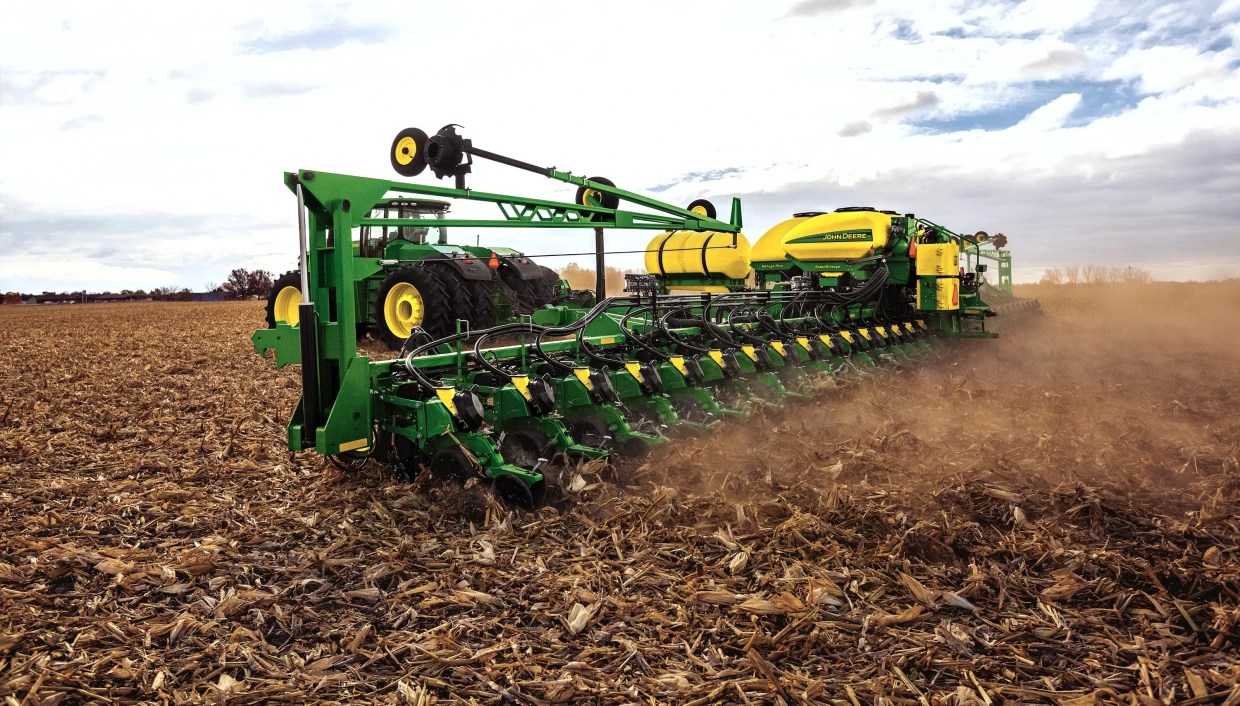
All 15 machines are probably too much too show in one sitting, but try one or two relevant to your students.
The individual machines that are shown in this video aren’t so important to our geographic inquiry, but the scale and the scope of mechanization on the agricultural sector is absolutely the point here. Agricultural production has increased exponentially (dare I say geometrically?) since the Industrial Revolution and machines (and increasingly sophisticated machinery) are the reason why. Our collective capacity to grow grow more food has many reverberating implications, and I’ll mention a few of them here:
Population growth has never faced the feared Malthusian limits.
The prices of most commodities (relative to the time in takes to earn the money) has dropped in the last few decades.
Less land is used for agriculture now than 20 years ago (Our World in Data).
One of the reasons for the importance of the uniform agricultural landscape (i.e.-evenly spaced rows) is that the mechanization process requires a degree of precision that only works with a highly uniform landscape. The vast majority of these machines rely of fossil fuels and not so easily replaced with commercial electric vehicles given their power requirements and need to be away from recharging stations.
Every New Year, I look forward to seeing this list. I love seeing this since small, incremental improvements that are norm rarely make the news, but unrepresentative catastrophes gobble up the headlines. FutureCrunch put together a list of 99 positive stories that they see as representing human progress but that don’t get much publicity. They categorize these stories into six categories:
Human Rights
Conservation
Global Health
Decarbonization
Development
Animals
These stories all focus on global progress that occurred in the year 2022. Gradual, small improvements aren’t new: here are the FutureCrunch lists of 99 good stories from 2021, 2020, and…you get the point. Every year there are setbacks, but the incremental gains are the main trend. For my students, do some added research on some of these 99 stories of 2022 that interest you.
Assignment:
Identify 6 changes that surprised you and explain why you found the new information surprising. Bonus points for exploring a story from each of the listed categories. Label them A-F.
How do these stories impact your perspective or worldview?
Post-script: While preparing this post about an article on the positive, surprising news, unsurprisingly, I stumbled upon its exact opposite, a New Year’s Day.
We are filled with negativity in social media that is often intended to exacerbate partisan divides and stoke animosity. This is nothing new, but at the start of a New Year, a symbolic chance for rebirth, seeing 60 minutes interview Paul Ehrlich was disheartening for me (he’s both a long-discredited doomsday prophet but also a Stanford ecologist that the media loves since his message taps into our primal, existential fears that drives engagement).
Ehrlich’s interview is from 3:00 to 5:00 in the above clip.
This article from Human Progress is an excellent, quick rebuttal to the positions advanced by Ehrlich in the interview. Over 50 years of horrendous predictions that shows that his environmentalism prioritizes alarmism and activism over data and intellectual integrity. Saying that the world is getting better (as I did in my TEDx talk) isn’t just optimism, it’s a recognition of reality. Sure, there are real, profound problems, but that doesn’t negate the progress that has been made. We need more incremental progress in the new year and should keep pushing for progress every year for the rest of our lives.
How one nation’s sovereignty movement is setting off a chain reaction among former British colonies in the Caribbean.
“Though Barbados gained its independence as a constitutional monarchy in 1966, only last year did the nation formally sever ties with Britain—removing Queen Elizabeth II as its head of state and electing the nation’s first president in the process. Removing the Queen as head of state is not a political endpoint, then, but one step toward reasserting Black Barbadian identity and sovereignty.” SOURCE: The Atlantic
What is the difference between the United Kingdom, Great Britain, and England? Or what about the distinction between the Commonwealth, possessions of the Crown, and the British Empire? It is easy stay out of the complicated nature of these questions, but many people in former parts of the British Empire are starting to delve into these questions; the death of Queen Elizabeth made many of these conversations more on the forefront of the public consciousness. Some Commonwealth countries like Barbados have distanced themselves from what they see as vestigial remains of a complex colonial heritage, and countries like Jamaica are seriously considering following suit.
Questions to ponder: What old forces have kept political connections between the UK and former colonies in place for so many decades? What new forces are reconfiguring political and cultural institutions in the Caribbean?
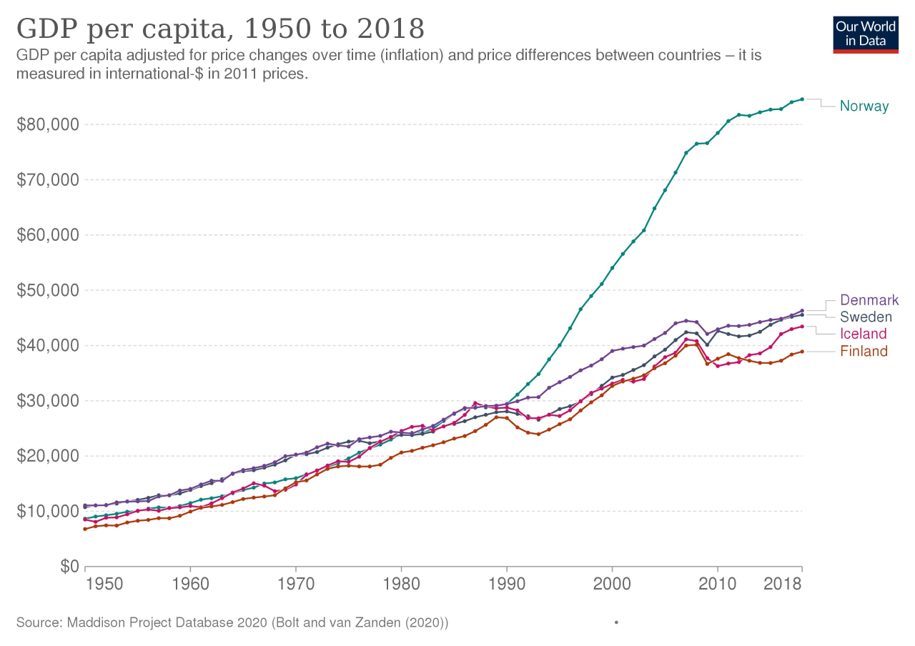
Norway’s economic success is unrivalled, both in Scandinavia as well as compared to other countries with oil resources. In the early 20th century, Norway was relatively poor; they had limited agricultural lands and relied heavily on ocean resources and their merchant marine fleet to fuel their economy. The hydroelectric resources were a part of their growth that put them back on par with their European neighbors.
The 1969 discovering of oil in the North Sea was the obvious answer to their economic growth. The overlooked aspect is the low levels of corruption, sound public policy for future economic success, and democratic institutions that were already deeply entrenched in Norway. Many oil-rich countries have squandered the wealth being incentivized for short-term spending at best, with politicians siphoning off the money at worse. Timing can matter tremendously; Norway was developed first, THEN discovered oil in 1969. That means that the already solid institutions were the ones to shepherd in their enormous success.
Countries can’t choose their neighbors and in the case of the Baltics, the shadow of Russia looms large. This video shows some of the historical context and the shifting political geography of the Estonia, Latvia, and Lithuania.
The mystery on the ‘sailing stones’ in Death Valley’s Racetrack playa has been solved and I wrote about a few years ago when it happened, but the video embedded above is so well done, it’s worth revisiting this remote, harsh landscape where large rocks can ‘flow’ uphill.
SPOILERS (since 2014): On very rare occasions, when it rains in the region, water will accumulate in the playa (discovermagazine.com), and if the temperature dips below freezing a thin layer of ice will cover the playa. If the wind is powerful and consistent enough, the wind will push the panels of ice against these rocks and over time, the ice floes will push these rocks, leaving behind distinctive trails (latimes.com). This perfect combination of water, wind, ice and heat creates a remarkable signature on the landscape (livescience.com). The decidedly non-aerodynamic rocks of Death Valley’s Racetrack Playa leave behind a trail in the hot desert. Numerous attempts using GPS receivers (NatGeo.com) and good ol’ fashioned observations have been made, but observing ice in Death Valley is so rare that it was never observed until 2014 (phys.org).
In February of 2022, I could not imagine a scenario where Ukraine, without any other military allies, would be able to repel a Russian invasion, much less start winning back some territory that they lost. True, many got it wrong, but what did we not see? I overestimated the competency of the Russian military and assumed greater demographic resources would be sufficient to explain the result of the conflict. More importantly though, I underestimated the galvanizing force that nationalism would have on a country under attack. If Ukraine wasn’t the most cohesive ethnic group with a cohesive national identity, this Russian invasion strengthened the cultural cohesion and the political identity to successfully fight back. The video below is a good explanation of the changes in the war from 2021 to Sept. 2022.
Energy prices have risen across Europe in the last year, and as winter approaches many fear that an energy crisis might be on the horizon. This brings up many questions, with the first and most obvious one being, why did energy prices rise? Complex global markets are, well, complex, but large geopolitical events are often the stage for trade disruptions that can lead to shortages. The Russian invasion of Ukraine in April 2022 was a major move, one that many European countries were quick to condemn. Russia is an energy exporter with large oil, coal and natural gas reserves. Russia supplied 40% of the EU’s natural gas before the war, but only 9% now after the Nord Stream 2 pipeline ceased being utilized. Nord Stream 1, which pipes gas through the Baltic to Germany, has a very limited flow currently (officially, this is annual maintenance, but skeptics note that the flow is lower than regular maintenance and suspect Russia is putting the squeeze on the EU). This summer’s heat wave wouldn’t have been as big and issue if energy were abundant and relatively cheap in Europe.
Europe has stumbled into an energy crisis because of these geopolitical maneuverings. Natural gas is a primary energy source, but one that is especially used for heating and therefore, more critical in the wintertime. The United States and European countries sought to impose strong economic sanctions against Russia, hoping to cut into Putin’s revenue stream and stop the war; or at least not feel as though they were funding the war. This overvalued the power of an embargo of an and underappreciated the reliance of the European economy and standard of living on access to affordable energy.
A quick animated explanation of the current energy catastrophe in Europe
Natural gas prices in Europe were at times in the summer, 7 to 8 times more expensive than gas in the United States. Many private individuals, small businesses, and any business with a thin profit margin, felt the squeeze of energy bills. Russia isn’t backing down from any economic sanction, saying that other regions besides Europe will gladly buy Russian gas. China has kept Russian production from grinding to a halt, effectively breaking the westward embargo, by sending it East. Consequently, Europe is facing the negative consequences of the economic sanctions more so than the Russian energy sector.
The collapse of the Sri Lankan government was a shock, but outside of regional experts, few were paying attention to the South Asian Island nation during the global pandemic to worry about their agriculture and economy. Now is the time for us to reflect and consider. There was a currency crisis, food shortages, energy shortages, a suffering tourism industry during COVID, a popular uprising, but underneath it all were the policies that destabilized the whole system. Policies that sounded seductively enticing, and generated global admiration from the WEF and sustainable agriculture advocates. Sri Lanka received a glowing ESG score, but despite this international acclaim, it came with one fatal flaw—the policies didn’t support the people of Sri Lanka.
I will focus primarily on the agricultural aspects of crisis (since it fits best with human geography curriculum) but yes, there were other political and economic factors. Organic farming is only for the wealthy in developed countries that can afford organic food as a lifestyle choice, or the very poor in rural, underdeveloped regions that engage in subsistence agriculture without access to Green Revolution technologies. Organic food accounts for 1% of the global food trade, and most of humanity relies of the technological advancements made by the Green Revolution for their food supply.
Fertilizer is in short supply with the ban on synthetics.
The government of Sri Lanka announced a 10-year plan to transition to 100% organic farming, by banning synthetic fertilizers and pesticides (the very inputs that double Sri Lanka’s yield in the 1960s from the Green Revolution). Over 30% of Sri Lankan farmland lay dormant without enough manure and other approved replacements. Something else that we often forget is the modern agriculture is heavily dependent on fossil fuel usage for the heavy machinery to replace manual labor. As the economy struggled, fuel prices went up and resources were rationed so that farmers couldn’t run their machinery and couldn’t get they products to the market. 85% of farmers suffered crop losses and overall production declined by over 20%, which might not sound like much as the 4th largest tea exporter in the world and a country that primarily consumes rice, crashing the rice and tea markets in catastrophic.
Sustainable agriculture sounds lovely as a goal, but not if the needs of the people are not being met first. Sri Lanka serves a cautionary tale for countries prioritizing international environmental aims over policies that will promote economic growth and human flourishing within their borders. The romanticism of organic agriculture is a fine choice for those who can afford it, but horrible to impose on those who cannot.