Search

GEOGRAPHY EDUCATION

Supporting geography educators everywhere with current digital resources.

Author

sethdixon

I am a geography professor at Rhode Island College.

What can I do with a Geography Degree?

“While it is easy to understand getting excited about maps, different cultures and environments, and even being better citizens through geography, it is harder to see how geographic knowledge can lead to good jobs or meaningful careers. In recent years, people have discovered that large numbers of societal problems have geographic dimensions, and that education and training in geography provides essential skills and knowledge for real-world problem solving. As a result, geography has become a necessary ingredient in hundreds of different jobs. This assortment of careers helps demonstrate the wide array of employment opportunities that exist for graduates with education in the field of geography. Within this publication, careers are divided into a number of different employment categories, including:

  • ​Geography Education
  • Environmental Geography
  • Geospatial Technologies
  • Land Use Planning

Source: tage.maps.arcgis.com

Many students enjoy geography classes but aren’t sure about what they can do with this geography degree.  This StoryMap from the Texas Alliance for Geographic Education is an excellent resource.  Additionally, the American Association of Geographers career page is a phenomenal resource.   


TagseducationESRIStoryMap, geography, geography education.

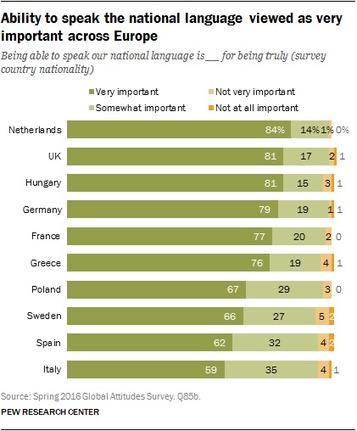
Language: The cornerstone of national identity

“Of the national identity attributes included in the Pew Research Center survey, language far and away is seen as the most critical to national identity. Majorities in each of the 14 countries polled say it is very important to speak the native language to be considered a true member of the nation.”

Source: www.pewglobal.org

Most Europeans see language as a strong prerequisite to be a part of the “national identity.”  Immigration has put a strain on cultural identities that are often very political. A majority of European agree on the link between language and national identity, but not surprisingly, the older Europeans and those on the political right feel more strongly about the importance of speaking the national language to truly ‘belong.’


Tags: language, culturepolitical, Europe, migration, ethnicity.

Minnesota becomes a gateway to Canada for rejected African migrants

More than 430 African migrants have arrived in Winnipeg since April, up from 70 three years ago. Most come by way of Minneapolis, sometimes after grueling treks across Latin America and stints in U.S. immigration detention.


A tangle of factors is fueling the surge: brisker traffic along an immigrant smuggling route out of East Africa, stepped-up deportations under the Obama administration and the lure of Canada’s gentler welcome. Advocates expect the Trump administration’s harder line on immigration will spur even more illegal crossings into Canada, where some nonprofits serving asylum seekers are already overwhelmed. Now Canadians worry smugglers are making fresh profits from asylum seekers and migrants take more risks to make the crossing.


Tags: migration, USACanada, borders, political.

Source: www.startribune.com

Israel Proves the Desalination Era Is Here

One of the driest countries on Earth now makes more freshwater than it needs


Driven by necessity, Israel is learning to squeeze more out of a drop of water than any country on Earth; researchers have pioneered new techniques in drip irrigation, water treatment and desalination. “The Middle East is drying up,” says Osnat Gillor, a professor at the Zuckerberg Institute who studies the use of recycled wastewater on crops. “The only country that isn’t suffering acute water stress is Israel.” That water stress has been a major factor in the turmoil tearing apart the Middle East, but Bar-Zeev believes that Israel’s solutions can help its parched neighbors, too — and in the process, bring together old enemies in common cause.


Tags: drought, water, environment, Israeltechnology, Middle East.

Source: www.scientificamerican.com

How the U.S. Air Force Mapped the World at the Dawn of the Cold War

One specialized unit gathered data that could guide a missile to a target thousands of miles away.


The work of the 1370th bridged a crucial gap in the history of military technology. By the late 1950s, both the United States and the Soviet Union had developed intercontinental ballistic missiles, but satellite navigation systems like GPS weren’t yet up and running. That left military planners with a huge challenge: how to program a missile to hit a target on the other side of the world. Even a tiny mistake could be disastrous.


Tags: mapping, cartography, technology, historical.

Source: news.nationalgeographic.com

Creating RI’s Off-Shore Wind Farm

Today, to the southeast of Block Island, there are five new structures rising from the ocean. These are the towers of the Block Island Wind Farm (BIWF), the first offshore wind energy installation in the United States. The turbines will generate 30 megawatts of energy; providing electricity to 17,000 households on Block Island and coastal Rhode Island (McCann, 2016), and replacing the diesel generators that previously powered New Shoreham. The turbines are on schedule to begin turning in November 2016 once commissioning is complete.

Source: uri.maps.arcgis.com

One of the overriding, major take-home points of this ESRI StoryMap, is that a project of this scale, scope, and magnitude requires geographic data across many disciplines (to see the largest off-shore wind farm in the world, click here).


Tags: mapping, Rhode IslandESRIStoryMap, GISresources, water, coastalenergy, environment depend.

Special Economic Zones

“Special Economic Zones (SEZs) are the most rapidly spreading kind of city, having catapulted exports and growth from Mauritius and the Dominican Republic to Shenzhen and Dubai — and now across Africa. Today more than 4000 SEZs dot the planet, a major indication of our transition towards the “supply chain world” explored in Connectography.  See more maps from Connectography and order the book here.”


Tags: globalizationurban, economicindustry, regions.

Source: www.paragkhanna.com

Providence area sees biggest shift away from manufacturing jobs in US

A new study illustrates just how drastically employment has plunged in Rhode Island’s historic industrial base over recent decades. Since 1980, the Providence metropolitan area has experienced the largest shift in the country away from manufacturing jobs and into work requiring college degrees, according to a paper by Stephan Whitaker, a research economist at the Federal Reserve Bank of Cleveland. “In 1980, 40% of workers in the Providence metro area worked in manufacturing and 25% worked in degree-intensive fields,” Whitaker writes. “By 2014, manufacturing had dropped to just 11%, and degree-intensive jobs had risen to 47%.”


Tags: urbanindustrymanufacturinglabor, economic, Rhode Island.

Source: wpri.com

The fate of religious freedom in the former USSR, 25 years after its collapse

It’s been 25 years since the fall of the Soviet Union. How has religious freedom fared in this part of the world?

Source: www.deseretnews.com

The collapse of the former Soviet Union was one of the biggest political events of the 20th century with long-reaching cultural ramifications.  The generations of state-sponsored atheism followed by a variety of new political policies has meant that religious freedoms vary greatly in the regions that were once a part of the USSR.  This article gives a good breakdown of all the former SSR’s and the state of religious freedom today in each of them.    


Tags: religionChristianityIslam, Russia, Ukraine, Armenia, AzerbaijanGeorgia, Belarus, Latvia, Lithuania, Estonia, Moldova, Tajikistan, Uzbekistan, Kyrgyzstan, Turkmenistan, Kazakhstan.      

Create a free website or blog at WordPress.com.

Up ↑