Search

GEOGRAPHY EDUCATION

Supporting geography educators everywhere with current digital resources.

Category

Uncategorized

#APHGCHAT

“Did you miss Wednesday’s #aphgchat (like me)?  If so, you can get caught up with this archive of the chat.  As a bonus, I also added my absolute favorite resources for each unit at the tail end of the chat.” 

Tagssocial media, teacher training, geography education, APHG.

Source: storify.com

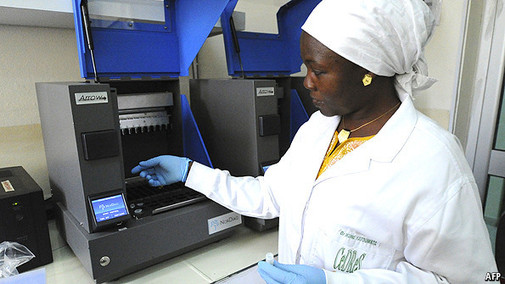
How was the AIDS epidemic reversed?

“If ever there was a demonstration of the power of science, it is the course of the fight billed ‘Mankind v AIDS’. Until 1981 the disease (though already established in parts of Africa) was unknown to science. Within a decade it passed from being seen as primarily a threat to gay men, and then to promiscuous heterosexuals, to being a plague that might do to some parts of Africa what the Black Death did to medieval Europe. But now, though 1.6m people a year still die of it, that number is on a downward trajectory­, and AIDS rarely makes the headlines any more. How was this achieved?  The answer has two parts: sound science and international co-operation.”

Source: www.economist.com

The Ebola epidemic has dominated headlines recently.  In their haste, it has been lost on that media the scary medical story of the 20th century (AIDS) that was going to doom Africa is now a success story.  Some of the stories about Ebola have treated Africa as one monolithic place–Africa is not a single story.  

Tagsmedical, diffusion, Africa, regions, perspective.

Chimamanda Adichie: The danger of a single story

“Our lives, our cultures, are composed of many overlapping stories. Novelist Chimamanda Adichie tells the story of how she found her authentic cultural voice — and warns that if we hear only a single story about another person or country, we risk a critical misunderstanding.”

Source: www.youtube.com

To gain a global perspective inherently requires understanding multiple perspectives.  Africa is frequently portrayed as ‘the other’ but also homogenized within a single narrative that ‘flattens’ truth.  How can we teach and learn about other places in a way that develops geographic empathy and shows the many stories of that can belong to any one place? 

Tags: Africa, perspective, TED.

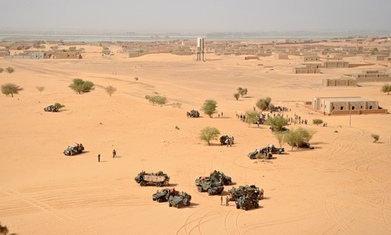
Population growth far outpaces food supply in conflict-ravaged Sahel

“The Sahel’s ability to produce food is not keeping pace with its growing population, and global warming will only exacerbate the imbalance, according to a new study.  Among the 22 countries making up the arid region in northern Africa, the population grew to 471 million in 2010 from 367 million in 2000, a jump of nearly 30%. As the population grew rapidly, the production of crops remained essentially unchanged.  Using satellite images to calculate annual crop production in the conflict-ridden Sahel belt, south of the Sahara desert, the researchers then compared output with population growth and food and fuel consumption.”


Tags: Africa, Sahelpopulation, environment, water, ecology, environment depend, weather and climate, sustainability, agriculture, food production.

Source: www.theguardian.com

The Legacy of Canals

“The historical geography of Erie Canal reshaped a nation.”

Source: www.lowbridgeproductions.com

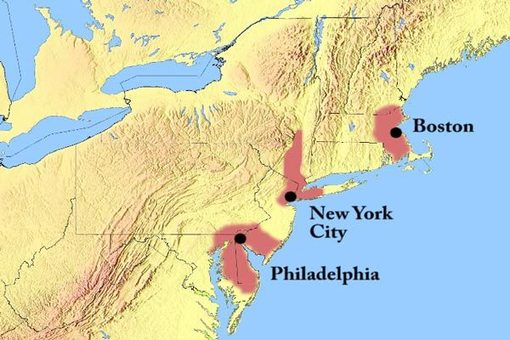
Back in the early 1800s, New York was one of the three biggest cities in the United States, but what led to it’s surge past Philadelphia and Boston?  Geography and new technological innovations that favored New York City’s relative location.   NYC was the only city on the East coast that could access the Great Lakes via canal, and after the construction of the Erie Canal, NYC has always been the preeminent city in the USA.  

TagsNYC, transportation, industry, economic, globalization, technology.


Why Almost Nobody Lives In Most Of Canada

“Canada: land-wise, it’s one of the world’s biggest countries, but population-wise, it’s anything but.The map comes from the Government of Canada’s ‘Plant Hardiness Site,’ which contains images showing ‘Extreme Minimum Temperature Zones’ throughout the Great White North.”

TagsCanada, map, North America, weather and climate.

Source: www.huffingtonpost.ca

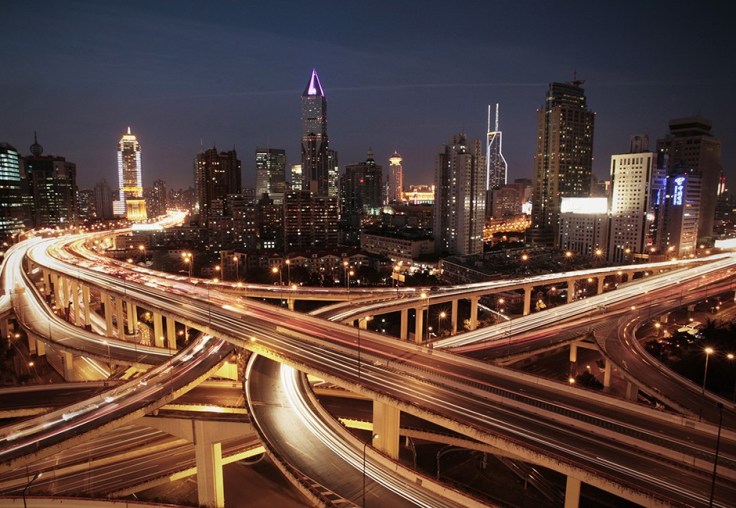
Megacities Interactives

“By 2025, the developing world, as we understand it now, will be home to 29 megacities. We explore the latest UN estimates and forecasts on the growth of these ‘cities on steroids’, and take a look at the challenges and opportunities megacities present for the tens of millions living in Lagos, Mexico City and Dhaka.”

Source: www.theguardian.com

Through this BBC interactive mapping feature with rich call-out boxes, the reader can explore the latest UN estimates and forecasts on the growth of megacities (urban areas with over 10 million residents).  These ‘cities on steroids’ have been growing tremendously since the 1950s and present a unique set of geographic challenges and opportunities for their residents.   Also, this Smithsonian Magazine interactive (also on the rise of Megacities), argues that dealing with megacities is one of the traits of the Anthropocene. 

Download the BBC data as a CSV file to be able to import this into a customizable ArcGIS online map.  This will help you to create an analytical storymap (but I still enjoy a good narrative storymap).  

Tags: urban, megacitiesESRI, anthropocene, CSV.

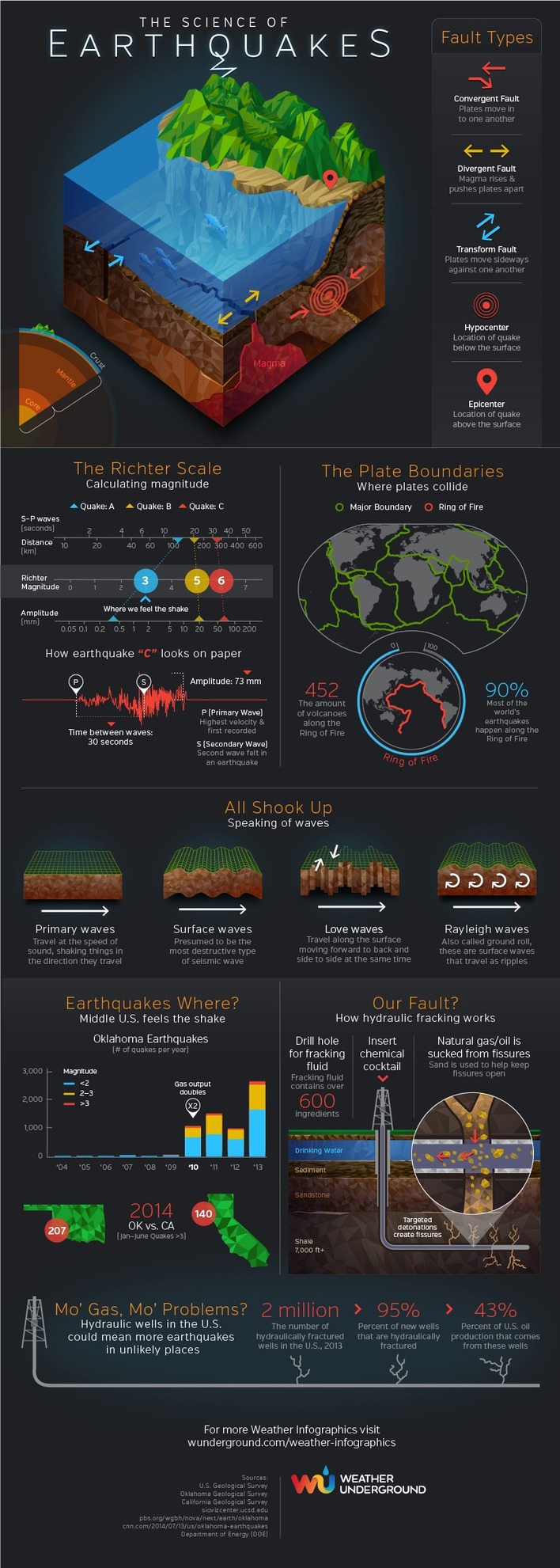
The Science of Earthquakes by Weather Underground

From fault types to the Ring of Fire to hydraulic fracking, the Earthquakes infographic by Weather Underground helps us understand the complexities of what shakes the ground.

Tags: disasters, geomorphology, physical, infographic.

Source: www.wunderground.com

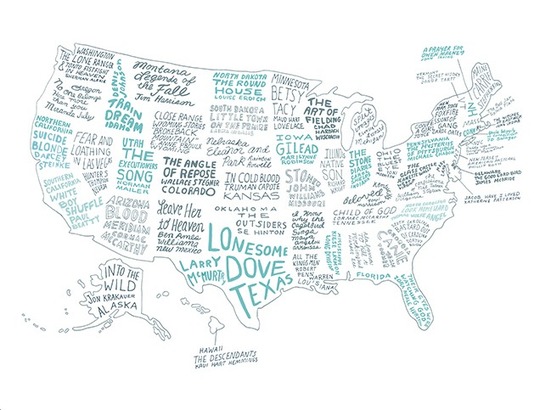
The Literary United States: A Map of the Best Book for Every State

“Two weeks ago, we published a literary map of Brooklyn, highlighting the books we felt best represented the neighborhoods in which they were set. Compiling the list of books for that map had us thinking about what it means for a story to not just be from a place, but also of it, and why it is that some places have an abundance of literary riches (we’re looking at you, American South), while others, well, don’t. There are those stories that so beautifully evoke a time and a place and a way of life that it becomes close to impossible to separate the literary perception of a place from its reality—one winds up informing the other.  All [books on this states list] are literary in voice and spirit; every last one will let you understand a time and place in a more profound way than you maybe thought possible.


TagsEnglish.

Source: www.bkmag.com

Create a free website or blog at WordPress.com.

Up ↑