Search

GEOGRAPHY EDUCATION

Supporting geography educators everywhere with current digital resources.

Category

Uncategorized

Europe’s Free Travel Zone in Danger: Map of Temporary Border Controls in the Schengen Area

Map and explanation of the crisis in the EU’s Schengen Area, where many countries have temporarily reintroduced border controls.


Over the past months, concern has been rising that Europe’s border-free travel zone, known as the Schengen Area, is falling apart. As unprecedented numbers of refugees and other migrants enter the Schengen Area, individual member countries have begun to re-start border checks in the places where they abolished them decades ago.


Tags: borders, political, Europe, supranationalism, refugees.

Source: www.polgeonow.com

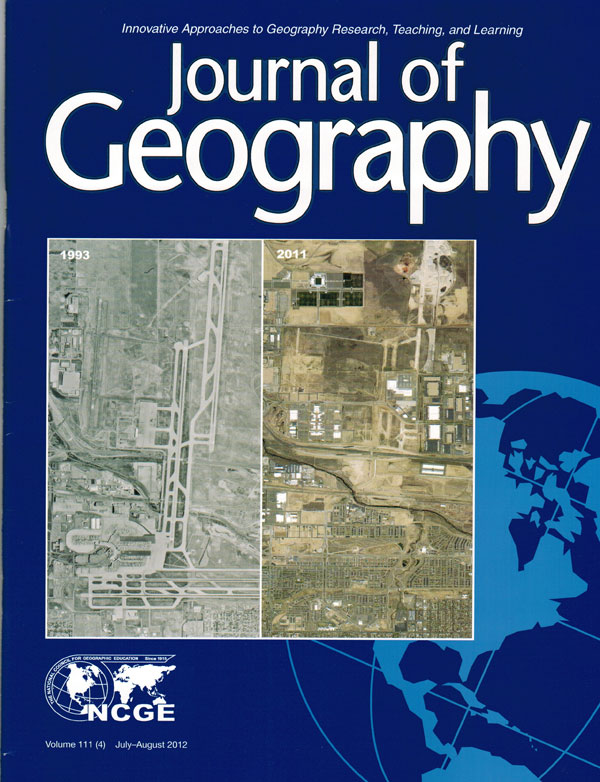
Special APHG Edition of the Journal of Geography

“The special APHG issue of the Journal of Geography (Volume 115, Issue 3) has 11 articles that are all focused on APHG.”

Source: www.tandfonline.com

With 11 superb articles from leaders in the APHG community, this issue of the Journal of Geography is a MUST HAVE for all APHG teachers (all NCGE members can digitally access it).  If you aren’t an NCGE member yet, this alone is reason to become one today).  


On Saturday, July 30, 2016, members of the AP Human Geography Development Committee will present a workshop for high school AP teachers during the annual conference of the National Council for Geographic Education (NCGE). The workshop will take place between 8:00 A.M. and 12:15 P.M. at the Tampa Marriott Waterside Hotel. The cost of the workshop is included in the NCGE conference attendance fee.  A special conference rate is available for Florida teachers.  Early-bird registration ends April 1st so act now.


Tags: NCGEAPHG, geography education, teacher training.


BioBlitz 2016

Learn more about the National Parks BioBlitz 2016 events, from National Geographic.

Source: www.nationalgeographic.com

The network of geographic alliances will be working on a BioBlitz national initiative in 2016. This article highlights two mobile apps that will enable users to use their smartphones to explore and archive the natural world around them and run an awesome BioBlitz. 


Tags: National Geographicphysical, biogeography, environment, edtech.

The Dead Sea’s Geography

Fields of sinkholes instead of beaches, roads swept away by floods, large industrial ponds instead of a sea and one overarching question: What can be done so that things don’t get even worse in the next 20 years?

Source: www.haaretz.com

This interactive really is a dramatic look at Israel’s endangered natural wonder, the Dead Sea, and explores the reasons why it is in danger of dying. Now if you are a wise guy like my students you are asking “How can it die if it is already the Dead Sea?”  Historically, we have undervalued the role of salty lakes in the broader ecosystem and physical landscape.  Humanity has searched for freshwater to fuel our settlements and has considered them ‘dead weight’ and not ‘living waters.’  The Dead Sea isn’t alone; hypersaline lakes such as the Aral Sea and the Great Salt Lake have also undergone transformations.    
 

Do terror attacks in the Western world get more attention than others?

Reports of bombings tend to get huge numbers of mentions on social media, but that doesn’t always mean a similar level of news coverage.

Source: www.bbc.com

The short answer is obviously “Yes.”  Yet, this question brings up other questions about cultural empathy and how ‘connected’ we might feel to people of other places than our own global neighborhood.  This political cartoon-ish map

has more truth in it than we might like to admit; it is subtitled ‘How terrible it is the the Western world when a tragedy happens in…?’


Questions to Ponder: Does the ‘where’ influence if we perceive the event as a true tragedy or not (or maybe just the magnitude or importance of the tradegy)?  How come?  What does this say about us as inidividuals, society, and the media?  How can we teach our students in a way to foster more cultural empathy?


Tagssocial mediaplaceculture, political, terrorism, media. 

Amid economic concerns, the U.K. considers an EU exit

“The U.K. has been a member of the European Union for more than 40 years, but that partnership might come to an end amid British concerns over eurozone turmoil and the ongoing refugee crisis. British voters will soon hold a referendum to decide whether or not to exit the EU. Judy Woodruff talks to Steven Erlanger of the New York Times for the possible implications of a U.K.-EU split.”

Source: www.youtube.com

The European Union at one time seemed as though it would continue to further and further integrate European politics and economics.  With talk of possibly leaving the EU and a referendum on whether the UK should stay in the EU or not, the EU offered some extra special exemptions for the UK.  For a more shorter video on this topic, see this TestTube video.    


Tags: Europe, supranationalism, economic, political.

Geography’s place in the world

Is the subject’s amalgam of a wide range of subject matter and methodologies a strength or a weakness? Five scholars have their say

Source: www.timeshighereducation.com

Similarities Between Spanish And Arabic

Spanish and Arabic have more in common than you think, and it’s not a coincidence.

Source: www.youtube.com

These two languages are not in the same language family yet there are many similiarities (article with more connections that in the video).   I would like to challenge you educators to not just say to your students “these similarities are neat!”  Make the geographic connections to explain the ‘why’ behind this cultural pattern and the implications of it. 


Questions to Ponder: What past political factors led to this cultural convergence?  How were global regions different in the past?  What are the were the impacts of this convergence, both in the past and lingering results today?   


Tagsdiffusion, languagetoponyms, culture, colonialism, regions.

The Economy Depends on Good Geography Instruction

“Geography-related jobs—a sector that features high salaries and low unemployment—will grow rapidly over the next decade, according to the U.S. Bureau of Labor Statistics. Employment of geographers is projected to grow by 29 percent from 2012 to 2022, compared with an anticipated 11 percent increase for all occupations. Employment of geoscientists is projected to rise 16 percent from 2012 to 2022, and a 14 percent increase is expected for surveying and mapping technicians. Yet, the American Geosciences Institute’s ‘Status of the Geoscience Workforce 2014’ report predicts a shortage of around 135,000 geoscientists by the end of the decade.  We are not preparing our young people to claim these jobs and advance innovative ways to use technology.”

Source: www.edweek.org

Create a free website or blog at WordPress.com.

Up ↑