Search

GEOGRAPHY EDUCATION

Supporting geography educators everywhere with current digital resources.

Category

Uncategorized

Ten Geographic Ideas that Changed the World

Adapted from the book by Professor Susan Hanson…

This is an excellent review/summary of an edited volume that shows the value of geographic thought and its importance in the modern world.  This review conveniently gives a one paragraph synopsis of each chapter.  It does not need to be read chronologically, so you can pick and choose what you find relevant to your course.  The top 10 are (in order of inclusion in the book): the Idea of the Map, the Weather Map, GIS, Human Adjustment, Water Budget Climatology, Human Transformation of the Earth, Spatial Organization and Interdependence, Central Place Theory, Megalopolis and Sense of Place.  The book is available on Amazon.

See on Scoop.itGeography Education

See on webhost.bridgew.edu

Thousands mourn Sikh temple victims in US

See on Scoop.itCultural Geography

Memorial service held in town in state of Wisconsin for six Sikhs gunned down on Sunday.


The clean-up, memorial service and grieving was marked by people of all religions and ethnicities come together.  This is an excellent video and I especially enjoyed President Obama’s statements of the political rights and freedoms that should be consider universal human rights. 

See on www.aljazeera.com

Singapore’s ‘National Night’ Encourages Citizens to Make Babies

See on Scoop.itGeography Education

Singapore’s unbelievably low birthrates have inspired National Night, a campaign to encourage Singaporean couples to let their patriotism explode on August 9.


Not all countries are concerned about overpopulation; Singapore’s National Night was an innovative campaign to boost fertility rates (warning: the video is a touch provocative). 

See on blogs.smithsonianmag.com

Google Earth to Map your Trips

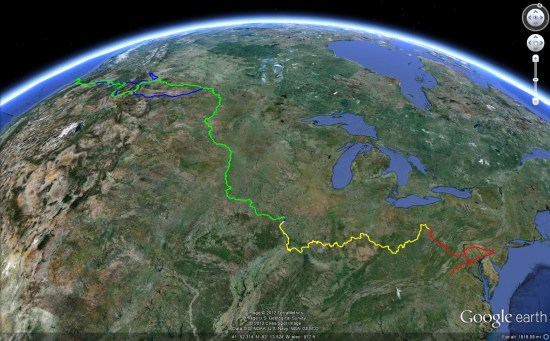
Download KML FILE to BEST view this interactive map within Google Earth.

My wife and I took a fabulous trip to the United Kingdom and Greece that was primarily for a writing project that she is working on at the moment.  We still toured liked Americans are wont to do. Many people will typically share their photos with friends on Facebook or tweet their favorite images as they go. Thinking about geography education and my readers, I had different plans.

  1. I created a photo album on PhotoBucket and uploaded my pictures.
  2. I added locations, geo-tagged the pictures and saved it as a Google Earth KML file.
  3. I then imported the KML file in Google Maps in the map that is displayed above.

In essence, this is a glorified way to share a photo album with the opportunity to have an interactive map open simultaneously. This is not meant to be the definitive visual tour of London or anywhere else; my trip is just the backdrop for showing the type of projects that students can make with free software.  Although I am embedding the Google Maps version, it really was designed to be used in Google Earth, which is a free download.

You can see the complete photo album of the trip (okay, not the complete one since we took over 600 pictures, but does anyone really want more than 160?).
But I am curious to see if the Google Earth KML file gives ‘added value’ to the sharing of trip pictures.  The image below is nice, but the maps, comments and temporal sequence  give the picture added context (which hopefully, you’ll find in the Google Earth KML file).  Let me know what you think about the idea of using this as a teaching tool.

And while we are discussing London and the City of London (yes those are two separate things), enjoy this video about the complex political geography of the two cities.

Nesting Cans Activity

See on Scoop.itGeography Education

This blog post outlines an excellent craft activity designed for K-6 students to teach the concept of scale.

See on firstgradetothecore.blogspot.fr

New York — before the City

TED Talks 400 years after Hudson found New York harbor, Eric Sanderson shares how he made a 3D map of Mannahatta’s fascinating pre-city ecology of hills, rivers, wildlife — accurate down to the block — when Times Square was a wetland and you…

KC: The Manhattan Project created a picture of the area before the development of a city, the way Henry Hudson did during his 1609 exploration. After 10 years (1999-2009), the research project has expanded to study the entire city of New York. The Welikia Project analyzes geography and landscape ecology to discover the original environment and compare it to present day. Scientists have learned that world’s largest cities once had a natural landscape of freshwater wetlands and salt marshes, ponds and streams, forests and fields with an equally diverse wildlife community. By focusing on the city’s biodiversity of 400 years ago and the modern era, information can be gathered about what has changed, what has remained constant, where the city was done well and where it needs to improve. This source is useful because it allows for the visualization of NYC in a way never seen before. Urban environments, such as NYC, have a landscape largely created by humans, so the skyscrapers, pavement, and mass population is far removed from the landscape it once was.

Find more information about the Welikia Project at http://welikia.org and more on New York City’s urban ecology at: http://www.scoop.it/t/urban-geography

See on Scoop.itGeography Education  See on www.ted.com

Mexico’s Drug Wars – Photo Essays

See on Scoop.itGeography Education

Photographer Anthony Suau documents the surging influence of the drug cartels in Northern Mexico and the efforts by police to maintain law and order…


The issus connected to drug trafficking are intense in Mexico for a variety of geogaphic factors.  This is not something we typically see as a part of the the new global economy, but it certainly has been connected to the processes of globalization.  For more sources on the Mexican Drug Trade, see: http://www.scoop.it/t/mexican-drug-trade ;

See on www.time.com

The Disputed Spratly Islands

See on Scoop.itGeography Education

link to part 2 http://youtu.be/I5t9wpEzKRc or http://youtu.be/myNxTaW5z3w link to part 3 http://youtu.be/7mJK4Sgxrbw...


This video clip shows the historical background of the political and economic factors that have lead to competing claims in the South China Sea.  The Exclusive conomic Zone (EEZ) with projected oil fields is the main prize and China has been flexing it’s regional muscles. 

See on www.youtube.com

Top Ten differences between White Terrorists and Others

See on Scoop.itHistory and Social Studies Education

This top 10 list is an insight look at the differences in media coverage and popular perception of terrorism based of the cultural background of the terrorist. From a blog typically focused on the MiddleEast, history and religion, you can imagine why the somewhat perplexed at how the terrorist attack on the a Sikh temple is being presented in the media and how Americans conceptualize this type of attack. Just to share one in the top ten: “White terrorists are [portrayed as] ‘troubled loners.’ Other terrorists are always suspected of being part of a global plot, even when they are obviously troubled loners.”  

See on www.juancole.com

Blog at WordPress.com.

Up ↑