Search

GEOGRAPHY EDUCATION

Supporting geography educators everywhere with current digital resources.

Category

Uncategorized

Spatial Analysis of the NBA Finals

See on Scoop.itGeography Education

Navigate court maps and view analysis of every shot taken over the ’11-’12 season for the Miami Heat and Oklahoma City Thunder.

Who said geography has nothing to do with sports?!?  While there are many cultural and economic impacts on sport preference and prevalence, let’s discuss the geography of the hardwood and a spatial analysis of the shot selections between the two teams.  Clearly ‘place matters’ to many NBA players as their success on the court depends on finding their preferred spots within the flow of offense.

See on www.nytimes.com

AP Human Geography test results

See on Scoop.itGeography Education

On Twitter,  College Board’s Head of AP test Trevor Packer tweeted about AP HG test results, noting: “2012 AP Human Geography scores: 12.6%=5; 19.5%=4; 20.4%=3; 17.9%=2; 29.6%=1. These may shift slightly as late exams are scored.”

In other tweets about AP HG test results, Trevor Packer noted: “AP Human Geography students showed stronger learning this year than in the past–smaller percentage of 1s, higher percentages of 4s/5s. College professors say: AP Human Geo students who score 1s need more critical interpretation of maps and cause/effect focus in essays.  In terms of really distinguishing which AP Human Geo students deserve college credit, Question 3 was the most effective.  AP Human Geo students did best on the walls/barrier question (#1), while many struggled with the international migration question (#3).”

See on twitter.com

Scientists observe ‘tragic experiment’ of tsunami debris

See on Scoop.itGeography Education

Jeff Larson has seen just about everything wash up on the shores of Santa Cruz: bottles, toys, shotgun shells, busted surfboards and fishing floats that looked like they had bobbed across the Pacific.


This is just another long-term ‘after-shock’ of the tsunami that devasted Japan over 1 year ago. 

See on www.latimes.com

How Racist Are We? Ask Google

See on Scoop.itCultural Geography

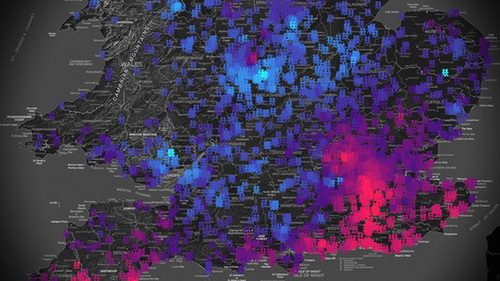
Research that compares the use of racially charged search terms with voting patterns suggests that Barack Obama’s race lowers his chance of re-election.


The United States is not a ‘post-racial’ society, obviously.  This research uses  region-specific Google searches on racial ephitats to act as a proxy for regions that are most racially charged.  This graphic is a result of the research found at: http://www.theatlantic.com/politics/archive/2012/06/can-google-predict-the-impact-of-racism-on-a-presidential-election/258322/ 


See on campaignstops.blogs.nytimes.com

Vector-Based Maps in iOS 6

See on Scoop.itGeography Education

Apple announced today that it’s revamping the Maps application on iOS devices—iPhone, iPad, iPod touch—introducing a lot of showy new features like…


Earlier this week I posted an article that was skeptical about Apple’s foray into online mapping that essentially said that Apple could not replace Google.  This article focuses on the differences in Apples mapping strategy–primarily shifting digital mapping for raster based data to vector data.  This is a perfect example to show GIS students the relevance of how data is stored. 

See on persquaremile.com

Evolution in a Big City

See on Scoop.itGeography Education

Using newts, coyotes and mice, Jason Munshi-South shows how animals develop genetic differences in evolution, even within an urban city. “Evolution in a Big …


Humanity has obviously had an enormous impact on the environment and our sprawl metropolitan areas are the primary example.  However, we often fail to thing about how urbanization is impacting other species inhabiting the planet.  Our cities have essentially created ‘islands’ of livable habitat for many species and the same evolutionary processes of divergence and extinction are now seen in our urban areas.  Island biogeography is becoming increasingly important as we continue to fracture and fragment the environment within which other species can live.  This incredible Ted Talk can be seen (and flipped) on the new TED-ED site at: http://ed.ted.com/lessons/evolution-in-a-big-city

See on www.youtube.com

Ethnicity and Religion: A Case Study

See on Scoop.itGeography Education

In a nation of 230 million people, 700 languages and some 300 ethnicities, ethnic Chinese are one of Indonesia’s historic minorities.


Religion and ethnicity are often connected, but not always.  This case study of such a group, the Chinese Muslims of Indonesia, provide an interesting glimpse into the economic, historic and political patterns of these cultural groups that are parts of communal identities.  

See on www.saudiaramcoworld.com

Earth As Art : Pick Your Favorites!

See on Scoop.itGeography Education

The USGS is celebrating 40 years of the LANDSAT

Program by having a competition to select the top 5 “Earth as Art” images from the more than 120 scenes from their curated collection.  All readers can select 5 images on the USGS website and the poll closes on July 6, 2012 (The image above is from Coahuila, Mexico).

See on eros.usgs.gov

Local Life Expectancies

See on Scoop.itGeography Education

We often talk about life expectancy data at the national level; this simplification has a great deal of utility but obscures regional distinctions within a country.  Some counties in the United States have life expectancies on par with Japan (84), while the worst off counties are more similar to Indonesia (69).  Even more startling, in 661 counties, life expectancy stopped dead or went backwards for women since 1999.  This is a dramatic look at the importance of scale within any geographic analysis to arrive at reasonable conclusions.  So let’s start looking at local demographic data instead of just nationally aggregated data.  For more on this press release, see:  http://www.healthmetricsandevaluation.org/news-events/news-release/girls-born-2009-will-live-shorter-lives-their-mothers-hundreds-us-counties

See on www.healthmetricsandevaluation.org

Blog at WordPress.com.

Up ↑