Search

GEOGRAPHY EDUCATION

Supporting geography educators everywhere with current digital resources.

Category

Uncategorized

Earth’s Gravity Revealed in Unprecedented Detail

See on Scoop.itGeography Education

After just two years in orbit, ESA’s GOCE satellite has gathered enough data to map Earth’s gravity with unrivalled precision.


Gravity isn’t the same everywhere.  “ESA’s GOCE mission has delivered the most accurate model of the ‘geoid’ ever produced, which will be used to further our understanding of how Earth works. The colours in the image represent deviations in height (–100 m to +100 m) from an ideal geoid. The blue colours represent low values and the reds/yellows represent high values. The geoid is the surface of an ideal global ocean in the absence of tides and currents, shaped only by gravity. It is a crucial reference for measuring ocean circulation, sea-level change and ice dynamics – all affected by climate change.”  Follow the link to see an animated version. 

See on www.esa.int

AP Human Geography Course Home Page

See on Scoop.itGeography Education

Links to course, exam and teaching resources for AP Human Geography…


The AP Human Geography test is less than one month away (May 18th).  This is hardly a ‘new’ resource, but there are great materials, sample questions, lesson plans, teaching strategies and other helpful resources for teaching college level human geography. 

See on apcentral.collegeboard.com

Radiant City

See on Scoop.itGeography Education

In this feature length film Gary Burns, Canada’s king of surreal comedy, joins journalist Jim Brown on an outing to the suburbs.


This 2006 documentary is a critical look at suburbia that has comments from suburbanites interspersed with planners, real estate agents, experts and urban academics. 

See on topdocumentaryfilms.com

Carmakers In China Rev Up As Industry Shifts East

See on Scoop.itGeography Education

China is now the world’s largest car market, and a crucial one for Detroit companies. Chinese consumers bought 18.5 million vehicles last year, and foreigners, especially Americans, have played a key role in developing the industry.


China now is the world’s largest auto market as China is no longer simply a place where things are produced.  China has become a consumer on good as their workers wages allow them to consume more goods. 


See on www.npr.org

China now eats twice the meat we do

See on Scoop.itGeography Education

We can learn a lot from examining the way China’s diet has changed in the last 20 years — as well as its required efficiencies and the agriculture that supports it.


The United States still consumes more meat per capita than China, but as China’s economy has grown (along with it’s income and standard of living), the consumer habits have changed as well.  What will the impacts of the rise in Chinese meat consumption mean? 

See on grist.org

The Invisible Borders That Define American Culture

See on Scoop.itGeography Education

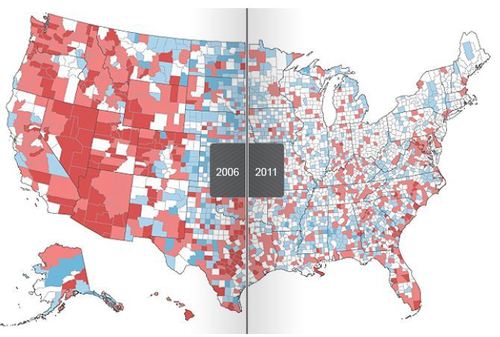
We can be connected (or disconnected) based on where we move, how we speak, and even what sports teams we root for.


This article is a great source for discussion material on regions (include the ever-famous “Soda/Pop/Coke” regions).  How do we divide up our world?  What are the criteria we use for doing so?

See on www.theatlanticcities.com

Which Regions Produce the Most NFL Players?

See on Scoop.itGeography Education

Despite Friday Night Lights portrayals, there’s a lot more geographic diversity in NFL prospects than you might think.


Happy NFL draft weekend!  As I’m sure you were asking yourself, I was thinking, “where do NFL players come from?” Are there strong spatial patterns of this distribution?  How do cultural forces impact the prevalence of a particular sport in a specific region?  It’s not as skewed to the South a you might think. 

See on www.theatlanticcities.com

Welcome to the Anthropocene

See on Scoop.itGeography Education

A 3-minute journey through the last 250 years of our history, from the start of the Industrial Revolution to the Rio+20 Summit. The film charts the growth of…


This video is a great primer to discuss human and environmental interactions as related to industrialization, globalization and climate change. 

See on www.youtube.com

Time to Revisit Food Deserts

See on Scoop.itGeography Education

Research on obesity and food availability in poor areas suggests that access must be considered alongside factors like price, taste and education, too.


Access to fresh food is one of the barriers to healthy eating within many poorer neighborhoods in the United States and these areas that lack healthy options are referred to as “food deserts.”  At least that was what the conventional wisdom was.  This article looks other factors and issues surrounding healthy food options including poverty, education, transportation and culture.   

See on opinionator.blogs.nytimes.com

Blog at WordPress.com.

Up ↑