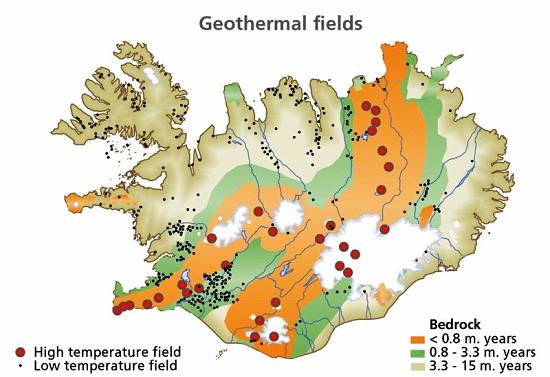
Country that is 100 percent powered by renewable energy taps into new natural resource.
Source: www.cbsnews.com
Country that is 100 percent powered by renewable energy taps into new natural resource.
Source: www.cbsnews.com
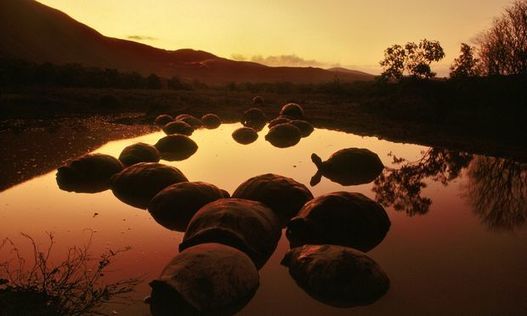
Radiolab wraps 2015 with a series of special episodes.
Source: www.radiolab.org
The Galapagos Islands (as are most islands) filled with remarkably distinct species from the mainland–one of the key reasons that the island were so instrumental in shaping Charles Darwin’s thinking about evolution. This environmental Radiolab podcast is mainly about the Galapagos wildlife and it’s conservation and covers many important biogeographic concepts (with time in the episode):
Tags: Ecuador, biogeography, environment, ecology, historical.
“GeoInquiries are designed to be fast and easy-to-use instructional resources that incorporate advanced web mapping technology. Each 15-minute activity in a collection is intended to be presented by the instructor from a single computer/projector classroom arrangement. No installation, fees, or logins are necessary to use these materials and software.”
Source: geographyeducation.org
ESRI has produced GeoInquires for Earth Science, History and now AP Human Geography. If you try out an APHG GeoInquiry, please take a moment or two to give the folks at ESRI some feedback (a free book from ESRI for the first reviewers). They are especially looking for reviewers for the GeoInquiries for 1) Distance, transportation, and scale 2) USA Demographics and 3) Agricultural Patterns. If can get a free ESRI book for your time by assisting them in refining these educational resources.
Tags: mapping, geospatial, ESRI, APHG.
Map animation depicting the break up of Yugoslavia through the series of political upheavals and conflicts that occurred from the early 1990’s onwards. Different areas of control are colour coded.
Tags: devolution, historical, political, states, borders, political.
Source: www.youtube.com
“In Indonesia’s Central Kalimantan province, the peat areas are burning and emitting a toxic smoke causing untold damage to the environment, wildlife and human health. Most of the fires in Central Kalimantan are blazing in former peatland forests, which have been drained, cleared and burned for oil palm and agriculture, large and small. The dried-out peat ignites easily, burns underground and creeps under the surface. Experts from the Center for International Forestry Research (CIFOR) travel to the heart of the fires to see the situation with their own eyes and measure the extent of the impact.”
More information please visit: http://blog.cifor.org/fire
Source: www.youtube.com
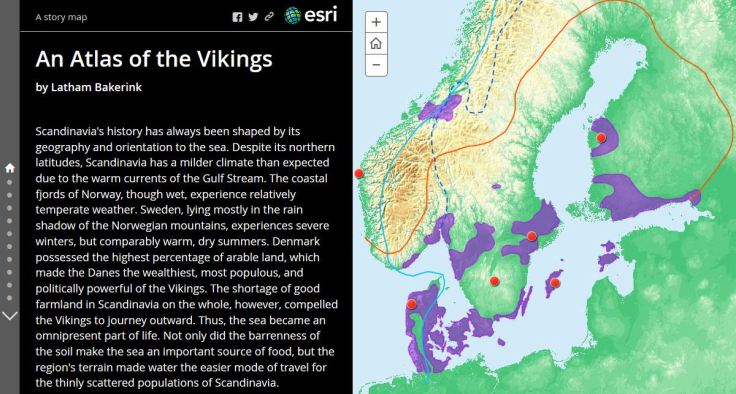
“Scandinavia’s history has always been shaped by its geography and orientation to the sea. The shortage of good farmland in Scandinavia on the whole, however, compelled the Vikings to journey outward. Thus, the sea became an omnipresent part of life. Not only did the barrenness of the soil make the sea an important source of food, but the region’s terrain made water the easier mode of travel for the thinly scattered populations of Scandinavia.”
Source: rigea.maps.arcgis.com
A student of mine produced this excellent Story Map after being inspired by the History Channel’s TV show, Vikings. History is so often shaped by geographic factors and better understood with maps.
Tags: mapping, historical, StoryMap, ESRI, Denmark, Sweden, Finland, Iceland, Norway.

A newly constructed bridge in northern Ontario has heaved apart, indefinitely closing the Trans-Canada highway — the only road connecting Eastern and Western Canada. At least one town has declared a state of emergency.
Source: www.cbc.ca
One bridge going down isn’t noteworthy, but when that functionally separates Canada in two…that IS noteworthy. A detour into the U.S. and around some Great Lakes is one heckuva detour.
Tags: transportation, Canada.
In a time where interfaith and cultural and religious diversity are scrutinized and need support, Raheel Raza is a force to be reckoned with. Her outspoken and strong opinions on Muslim society and Islamic beliefs have been groundbreaking and inspiring; however others consider them to be a source of criticism and condemnation. Yet Raza remains undeterred in her fight against gender prejudices and her mission to improve the female position in Islamic society continues.
Source: www.youtube.com
Islamophobia is a real problem today and I teach to reduce geographic ignorance and fears about an unknown ‘other.’ That has also created an environment where many–myself included–are hesitant to shine the light on issues of gender equity and other cultural problems in the Muslim world for fear of it entrenching students with bigoted viewpoints to cling to them all the more firmly. Also, many are worried that critiques will also be perceived as Islamophobia. Recently the Swedish foreign minister called out Saudi Arabia’s legal restraints on women–some called this Islamophobic, Saudi Arabia removed its Swedish ambassador and stop issuing visas to relative silence from the global media and no support from the international community.
We cannot lay the blame on an entire society/religion based on the actions of a few, but it would be disingenuous to pretend there were no problems. As Raheel Raza says, “culture is no excuse for abuse.” The linked videos are one Muslim woman’s critique on some cultural aspects within some Muslim societies. This is not to say that these problems are only in the Muslim world, nor does it means that the all Muslims live in or want to create oppressive societies–far from it. There is great, rich diversity of thought, opinions, and interpretations among Muslims.

New Zealanders finally completed voting in their flag referendum, but the results may be disappointing. PRI’s vexillology expert looks at what’s right — and mostly what’s wrong — about this proposal.
Source: www.pri.org
Vexillogist: someone nerdy enough about flags to know that vexillogy is the study of flags. As national symbols, they matter and changing a national icon is no small matter.
Tags: Flags, New Zealand.