Search

GEOGRAPHY EDUCATION

Supporting geography educators everywhere with current digital resources.

Category

Uncategorized

Detroit’s Beautiful, Horrible Decline

Two French photographers immortalize the remains of the motor city on film.  Pictured above is the Packard Plant; luxury-auto maker Packard produced its last car here in 1956.  To see more work by Yves Marchand and Romain Meffre, visit their website.

Source: content.time.com

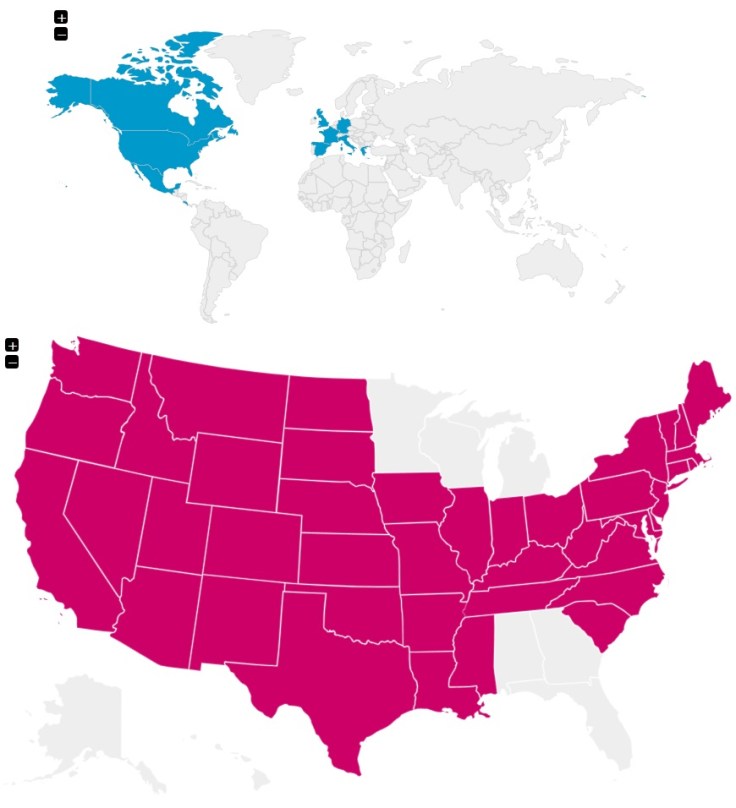
Visited Countries Map

“Create a Map of all the places you’ve been.”

Source: map1.maploco.com

This is an incredibly limited mapping platform, but if all you want to do is put countries of the world into two simple categories, then this works (see also their states of the United States, provinces of Canada, and countries of Europe maps).  It is imminently shareable online, so this is a popular way of creating a map of ‘countries/states I have visited’ for a Facebook wall–and yes, those maps above represent where I have been. 

Tags mapping, 201, edtech, cartography.

As South Carolina deals with its Confederate flag, one town in Brazil flies it with pride

After the Civil War, members of the Confederacy fled to Brazil. Their ancestors still live in the region and continue to fly the Confederate flag.

Source: www.pri.org

While people debate why the southern states actually seceded, there are many who still honor what they see as the gallantry of genteel southern society in the Southern Hemisphere.  It is important to note that Brazil was chosen as the home of this ‘Confederacy in Exile’ because it was the last western country to abolish slavery (1888 it ended there too).  Here is another article discussing the the Brazilian enclaves of ‘Confederados,’ or children of the unreconstructed South.   

Tags: Brazil, historicalthe Southlandscape.

100 African Cities Destroyed By Europeans

“When tourists visit sub-Saharan Africa, they often wonder ‘Why there are no historical buildings or monuments?’  The reason is simple. Europeans destroyed most of them. We only have a few drawings and descriptions by travelers who visited the places before their destruction. In some places, ruins are still visible. Many cities were abandoned when Europeans brought exotic diseases (smallpox and influenza) which started spreading and killing people. Most of those cities lie hidden. In fact the biggest part of Africa history is still under the ground.”

Source: howafrica.com

This article is a good introduction to historical African urbanism.  It is also a powerful reminder that the landscape does not only teach us based on what we see–the landscape can be a powerful witness by reminding us of the what is glaringly absent. 

Tags: historical, urban, placeAfricacolonialism.

Language in the Media

“Ever notice how the media treats black protesters & white rioters differently?”

Source: www.youtube.com

Some food for thought on how language in the media frames the narratives that most people receive.  Do you feel that the media treats all people and all groups fairly?  Can you think of some examples to make your case?


Tags: Languagemedia, race, class, culture.

Restless America: state-to-state migration

“Approximately 7.1 million Americans moved to another state in 2012. That’s over 2.2% of the U.S. population. The United States has a long history of people picking up and moving their families to other parts of the country, in search of better livelihoods. That same spirit of mobility, a willingness to uproot oneself, seems alive and well today based on the visualization of migration patterns above.

The visualization is a circle cut up into arcs, the light-colored pieces along the edge of the circle, each one representing a state. The arcs are connected to each other by links, and each link represents the flow of people between two states.”

Source: vizynary.com

This is a great way to visualize migration patterns within the United States.  What states are people migrating from and where are they going to?  Which states are more linked through these migratory bonds?  Here are the answers to these types of questions for every state of the union.  

Tags: migration, population, statistics, visualization, unit 2 population.

Ramadan in Sweden with no dusk, no dawn

During summer, the sun never sets in Sweden’s northernmost town, posing challenges for Muslims observing the holy month.

Source: www.aljazeera.com

Like many early religious traditions, Ramadan is observed based on measurements from the moon and sun. The start of Ramadan is determined by the sighting of the new moon, which moves about 11 days back in the Gregorian calendar each year. During Ramadan the consumption of food and water is prohibited between dawn and dusk, how do Muslims observing the fast manage in the far north of Scandinavia, where the sun never sets in the summertime (in 2015, Ramadan is from June 17 to July 17)?  Some Muslims in the West (and north) argue that ancient customs from the Arabian desert need updating now that the religion has diffused beyond the Middle East.    


Tags: Islam, perspective, religiondiffusion, culture.

Why South Carolina’s Confederate flag isn’t at half-staff after church shooting

The battle over a fraught symbol is resurrected.

Source: www.washingtonpost.com

The AME church in Charleston S.C. was targeted in a racist-motivated terrorist attack this week.  Many racial issues have come to the fore in the wake of this attack.  Two flags were lowered more than 100 miles away in Columbia, the state’s capital, the one’s picture above flying on the dome of the state house.  Whether South Carolina politicians want to or not, the issue of the Confederate Battle Flag has resurfaced because as a sanctioned part of the cultural landscape, it’s symbolism is continually called into question.


Tags: raceconflict, racism, historical, the Southlandscape.

Temples and Human Sexuality

It’s a good thing we have so many guardians of Indian culture to protect us, the impressionable Indian youth, from being corrupted and misled. (Much like Indian culture, this post is very NSFW.)

Hinduism is much more sensual and explicit in their depictions of the human body and sexuality than other religious traditions.  Sacred spaces in India consequently feature a different ethos on their temples and shrines.  The image here is among the more ‘tame’ ones in this set (just sayin’).  


Tags: culture, India, Hinduismsexuality, South Asia, religion.

Source: www.buzzfeed.com

Create a free website or blog at WordPress.com.

Up ↑