Her individual story might not warrant the attention it is getting, but it is challenging many people’s very notion of race and other categories (or axes) of identity–and that is worth discussing.
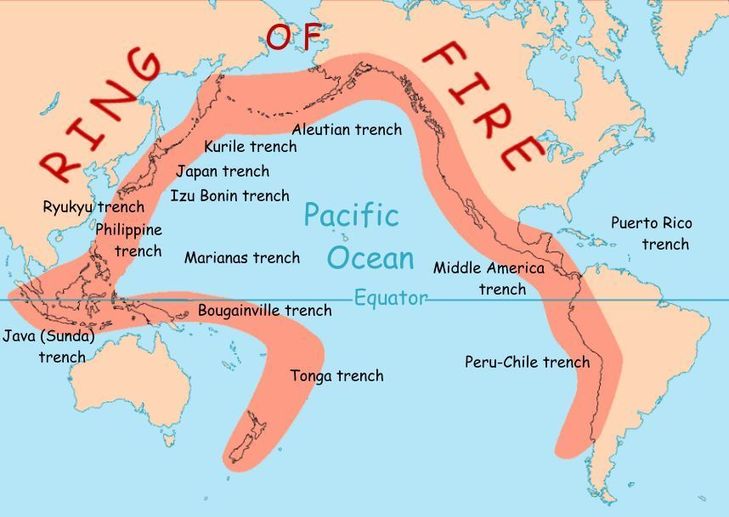
The Ring of Fire is a long string where there are volcanoes and different physical activity. This is located around the edges of the Pacific Ocean so some of South America has the Ring of fire located in it. The ring of fire consists of a string of 452 volcanoes stretches from the southern tip of South America. The fact that South America has 90% chance of earthquakes occuring,if the ring of fire was ever to have a reaction or have a earthquake South America would have to be prepared. If you live in South America you have to know the possibilities of what could happen at any given time, this ring of fire is a natural disaster at its finest.
This video is simple entry point into the various applications of remote sensing as well as various human and environmental interactions. This video highlights 5 examples:
Bare with me here; this culinary hack shows several images that are helpful for explaining how map projections represent parts of the Earth (or the orange in this example). The Polar regions are often displayed in azimuthal projections which are most accurate near one specified point. Slicing the orange at the top and bottom is akin to creating polar azimuthal projections. Universal Transverse Mercator (UTM) is a system that divides Earth into 60 “slices” with each wedge representing 6 degrees of longitude. Each wedge has a Meractor projection map with perfect representation along a central line of longitude. If we imagine the peel adjacent to one wedge has been flattened out, that is good way to visualize UTM maps.
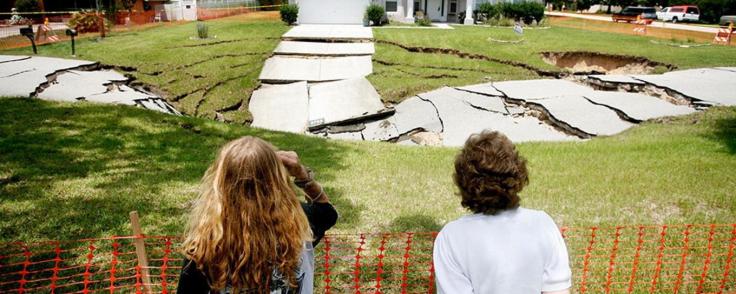
Sometimes the ground suddenly opens, consuming cars, homes and people. We may have a way to see these sinkholes coming – so why would anyone resist the idea?
Via the American Geographical Society: “Sinkholes – formed where groundwater dissolves soluble bedrock to form underground cavities. Sometimes, when the ceiling of a cavity can no longer support the weight of the overlying sediments, it can suddenly collapse, with catastrophic results.”
I don’t have enough time to comment on every link that I think would be of interest to you, so I’ve archived some tweets with likes that I think are worth exploring.
Roman Mars is obsessed with flags — and after you watch this talk, you might be, too. These ubiquitous symbols of civic pride are often designed, well, pretty terribly. But they don’t have to be. In this surprising and hilarious talk about vexillology — the study of flags — Mars reveals the five basic principles of flag design and shows why he believes they can be applied to just about anything.
I’m not ashamed to admit that I love flags; I enjoy thinking about the cultural, economic and geopolitical symbolism embedded in the flags and what that means for the places they represent. I share the above video for that purpose, but more importantly because it is an introduction to the audio podcast 99 Percent Invisible with a special ‘behind-the-scenes’ peek. Great geography resources rarely fall under the title “Geography” with a capital G. It takes geographic training to “see the geography” in the world around us. I’ve recently discovered the 99 Percent Invisible Podcast and while it is not explicitly (or even always) geographic, it is loaded with excellent materials about design and the details of the world around us that often go unnoticed, but deserve greater scrutiny. For example the episodes on the Port of Dallas as well as reversing of the Chicago River show how the physical and human systems intersect within urban areas. These two geo-engineering projects also were conceived on in very particular social, economic and technological contexts.
I also loved the episode Monumental Dilemma, about the uncomfortable 1800s New England memorialization of Hannah Duston for scalping Native Americans…this is incredibly awkward culturally as our society and social values have changes over the years. Do we tear it down? Ignore it? Apologize? Since the historical legacy is unsettled, so is the monument. So I’ll keep listening to the 99 Percent Invisible podcast and please recommend some especially geographic past episodes as I dig through the archives.





 GEOGRAPHY EDUCATION