Search

GEOGRAPHY EDUCATION

Supporting geography educators everywhere with current digital resources.

Category

Uncategorized

Can You Name the 10 Smallest Countries in the World?

“A photo gallery of the world’s ten smallest countries, from 0.2 square miles on up to 115 square miles, these ten smallest countries are microstates.”

Source: geography.about.com

What makes a country a country?  While there are many definitions, full political sovereignty is the gold standard.  This list has some people to try to create their own micronation (except for that little sovereignty detail).  As a student project, building their own fictitious micronation is a way to get them to think about the needs of a state and society in a more holistic manner. 

Tagspolitical, states, unit 4 political.
Wargaming: computerized scenario planning

Stratfor conducted extensive scenario planning when considering Russia’s offensive military options toward Ukraine. In this video some of the broader themes and deduction will be examined.

Source: www.youtube.com

The first 5:30 of the video is an introduction to the computerized scenario for the second half which comprises the actual analysis of what may (or may not) happen depending on how Russia gambles its military forces.  Here is a transcript of the last half of the video.


Tags: UkraineRussia, geopoliticspolitical, war.

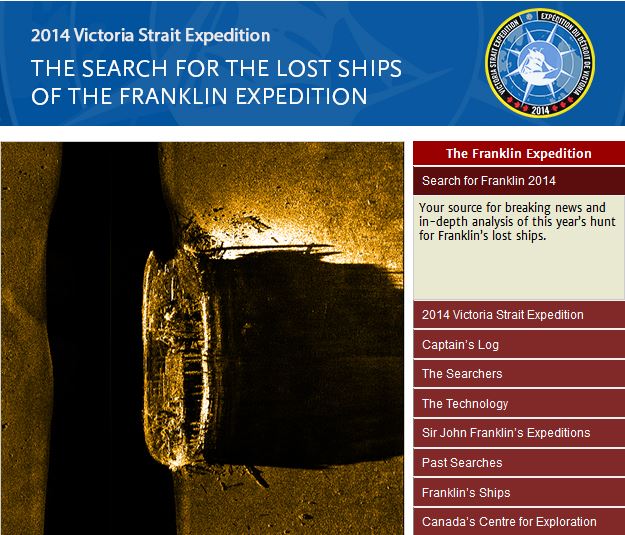
The Search for the Lost Ships of the Franklin Expedition

All the latest news on the the search for the lost ships of the Franklin Expedition, as well as information on past searches, the technology used in the searches, historical information about the Franklin Expedition itself, and much more.

Source: www.canadiangeographic.ca

Come learn about one of the greatest discoveries and explorations in our time that recovers the memory of explorers of yesteryear.  These 6 lesson plans are incredibly engaging and are a fantastic example of geographic concepts. 

TagsCanada, teacher training, edtech.

Geography Podcasts

“Thanks to Fred Kunze for this growing set of MAGE educational podcasts. They are indexed according to the Minnesota Academic Standards in History and Social Studies benchmarks, keywords, and grade levels.”

Source: lt.umn.edu

Did you know that MAGE has dozens of podcasts for geography teachers?  Well, now you do. 

Tagpodcast.

The Runner-Up Religions Of America

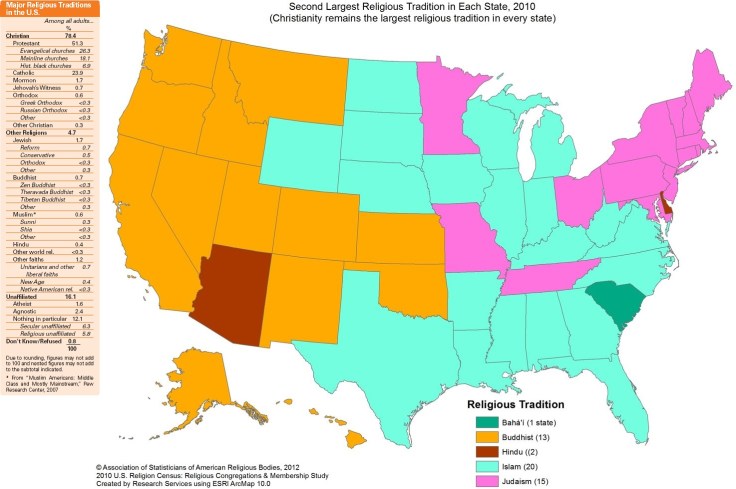
“Glance at the map above, Second Largest Religious Tradition in Each State 2010, and you will see that Buddhism (orange), Judaism (pink) and Islam (blue) are the runner-up religions across the country.

No surprises there. But can you believe that Hindu (dark orange) is the No. 2 tradition in Arizona and Delaware, and that Baha’i (green) ranks second in South Carolina? These numbers, although they look impressive when laid out in the map, represent a very tiny fraction of the population in any of the states listed.”

Source: www.npr.org

This map of the spatial pattern of the second largest religious tradition in each state, tells a different story than the tabular data on the left. 

Questions to Ponder: What are the most interesting stories and patterns visible in the spatial, mapped data?  What is the main second religion that is not as visually dominant on the map?  Why are both data sources valuable in understanding religions in the United States? 

Tags: culturereligion, USA.

A map of all the underwater cables that connect the internet

Cables

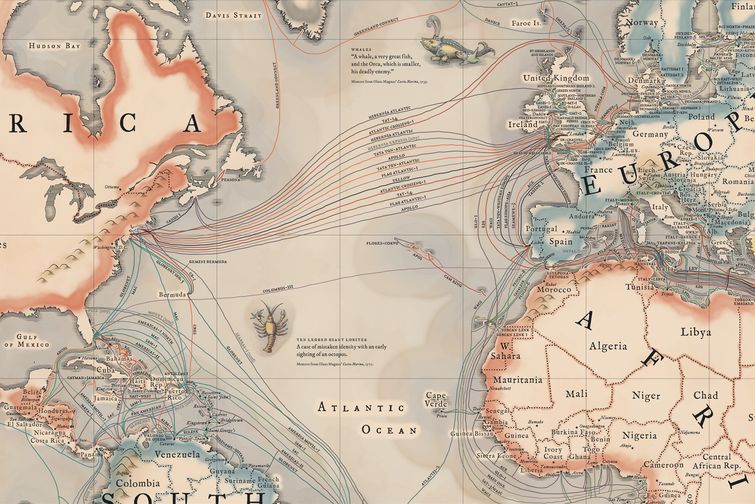
Do you know how the internet gets across the ocean? This amazing map shows every cable that makes it possible.

Source: www.vox.com

Because globalization.  

TagsTime-Space Compression, developmenttechnology, economic, globalization, industry, unit 6 industry..

‘Dirty Old London’: Geographies of Human Waste

In the 19th century, London was the capital of the largest empire the world had ever known — and it was infamously filthy. It had choking, sooty fogs; the Thames River was thick with human sewage; and the streets were covered with mud.  But according to Lee Jackson, author of Dirty Old London: The Victorian Fight Against Filth, mud was actually a euphemism. ‘It was essentially composed of horse dung,’ he tells Fresh Air’s Sam Briger. ‘There were tens of thousands of working horses in London [with] inevitable consequences for the streets. And the Victorians never really found an effective way of removing that, unfortunately.'”

Source: www.npr.org

History gets sanitized, and the we forget some of the more unpleasant parts of past geographies.  Victorian London was filthy, but this isn’t just a problem of the past as it remains an urban and developmental issue.  The NY Times just reported on how the sewage system is clogged with wet wipes say aren’t as ‘flushable’ as advertized.  These are the negative externalities of urbanization.  This map of San Francisco shows the spatial and social inequalities of public restrooms and other public amenities for the homeless.  India is the country with the most people without adequate access to sanitary waste disposal and that is a massive impediment to their progress.  Public urination is also health/gender issue and the city of  Hamburg is fighting back with a technological deterrent to public urination (actually quite entertaining).  And if you want the “news of the weird” version of this story on the geography of human waste…well, here you go (you were warned). 

TagsLondonUK, historical, pollution, urban ecologypodcast.

First photographs emerge of new Pacific island off Tonga

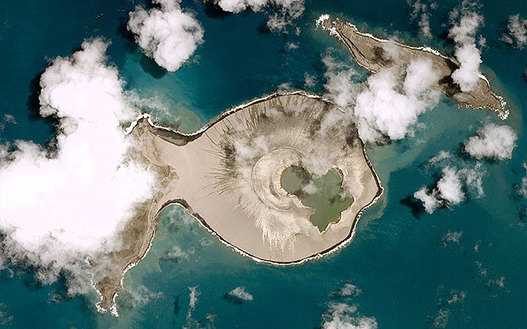
The first photographs have emerged of a newly formed volcanic island in the Pacific Ocean after three men climbed to the peak of the land mass off the coast of Tonga. Experts believe a volcano exploded underwater and then expanded until an island formed. The island is expected to erode back into the ocean in a matter of months.

Source: www.telegraph.co.uk

Additionally, here are two islands off the coast of Japan that ‘kissed’ after a volcanic eruption caused them to coalesce into one island

Tags: physicalimages, volcano.

Protecting an Ocean at Risk

“Pristine Seas is an exploration, research, and media project to find, survey, and help protect the last wild places in the ocean. These pristine places are unknown by all but long-distance fishing fleets, which have started to encroach on them. It is essential that we let the world know that these places exist, that they are threatened, and that they deserve to be protected.  Learn more about Pristine Seas here: http://ocean.nationalgeographic.com/ocean/explore/pristine-seas/

Source: www.youtube.com

I was enchanted hearing Enriq Sala discuss his passion for ocean biodiversity and purity.  This passion, combined with scientific exploration and political advocacy is the backbone of a National Geographic’s Pristine Seas project.  Here is one news story about the Seychelles, and how they are trying to manage their fishing industries to promote sustainability and hopefully the Pristine Seas project will lead to greater awareness of the need for ocean conservation. 

Tags: water, conservation, National Geographicphysical, biogeography, environmentpollution, resources.

Blog at WordPress.com.

Up ↑