Search

GEOGRAPHY EDUCATION

Supporting geography educators everywhere with current digital resources.

Shifts in Political and Cultural Norms

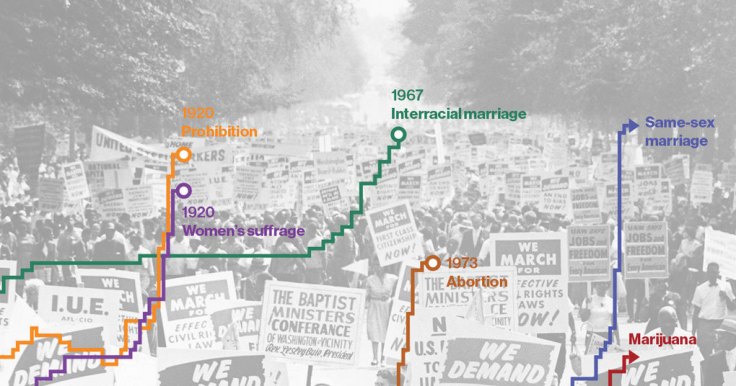
Eleven years after Massachusetts became the first state to allow same-sex couples to marry, the Supreme Court on April 28 will hear arguments about whether to extend that right nationwide. The case comes amid a wave of gay marriage legalization: 28 states since 2013, and 36 overall. Such widespread acceptance in a short amount of time isn’t a phenomenon unique to gay marriage. Social change in the U.S. appears to follow a pattern: A few pioneer states get out front before the others, and then a key event—often a court decision or a grassroots campaign reaching maturity—triggers a rush of state activity that ultimately leads to a change in federal law.

We looked at six big issues—interracial marriage, prohibition, women’s suffrage, abortion, same-sex marriage, and recreational marijuana — to show how this has happened in the past, and may again in the very near future.

Source: www.bloomberg.com

Linguistic Geography: My Fair Lady

Source: www.youtube.com

This is a most decidedly dated reference for pop culture, but a great movie for making explicit the idea that the way we speak is connected to where we’ve lived (also a good clip to show class differences as well as gender norms). The clip highlights many principles and patterns for understanding the geography of languages.

Tags: Language, class, gender, culture, historical, London, unit 3 culture and place.

Living in the Age of Airplanes

“LIVING IN THE AGE OF AIRPLANES is a story about how the airplane has changed the world. Filmed in 18 countries across all 7 continents, it renews our appreciation for one of the most extraordinary and awe-inspiring aspects of the modern world.” airplanesmovie.com

Source: vimeo.com

I was absolutely delighted to see this film on the big screen…it was as visually stunning as any film I’d ever seen.  I and my young children were mesmerized.  So much of the modern world that we take for granted is absolutely revolutionary.  This is a great teacher’s guide to teaching with this film.

Tags: transportation, globalization, diffusion, industry, economicNational Geographic, video, visualization.

The Individual and the Global

“Never doubt that a small group of thoughtful, committed citizens can change the world; indeed, it’s the only thing that ever has.” –Maragret Mead

Source: www.youtube.com

I share this video as a part of my final lecture in world regional geography as I attempt to tie up loose ends and help my students see the global linkages and connections.  Occasionally in the course of a semester where we examine global problems, it is easy to become pessimistic about the world.  In spite of all our problems, the world is becoming a better place, and I share this video to emphasize that individuals still have the power to act, and are not simply things to be acted upon by larger forces.  I can’t change everything everywhere, but I can do something, somewhere…so do something.  


Tags: development, globalization.

Ethiopia tests Sub-Saharan Africa’s first light rail system

Ethiopia is due to launch a light rail transit system later this year, the first of its kind in Sub-Saharan Africa.

Source: www.youtube.com

This is a very encouraging accomplishment; from Lagos to Nairobi, similar projects are now being considered. 

Tags: Ethiopia, Africa, development. transportation, planning, urban.

Burka Avenger is the Muslim Female Superhero We’ve All Been Waiting For

“The Muslim world doesn’t have the best reputation when it comes to female empowerment. With a lack of of strong, independent female role models, young women in the region have few places to look in popular culture for guidance. Until now.

Meet Burka Avenger, the game-changing Pakistani cartoon that, for the first time, has flipped the status quo on its head with its female superhero protagonist, who fights crime in her magical burka.”

Tags: Pakistangender, popular culture, SouthAsiaglobalization, culture, Islam.

Source: mic.com

Help the Nepal Aid Effort By Making a Map

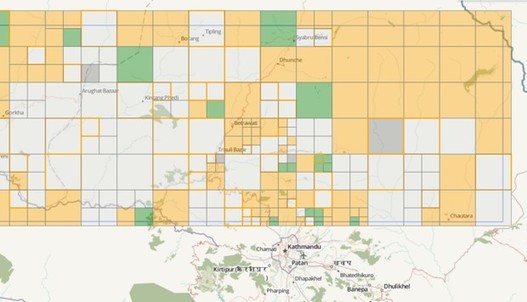
Become one of the citizen cartographers around the globe tracing and checking roads, buildings, and open spaces to assist people on the ground.

Source: www.citylab.com

If you want to help Nepal, you can donate time and geospatial abilities by helping provide workers with better maps.  This is probably one of the easier on-ramps to collaborative mapping, and the help is desperately needed.  You can also have students explore the Nepal earthquake in ArcGIS online; this has become a ‘teachable moment’ and  IRIS provides powerpoint slides for teachers to this example in the classroom.


Tags: Nepal, disasters, physical, tectonics, mapping, geospatial.

Sixty Languages at Risk of Extinction in Mexico—Can They Be Kept Alive?

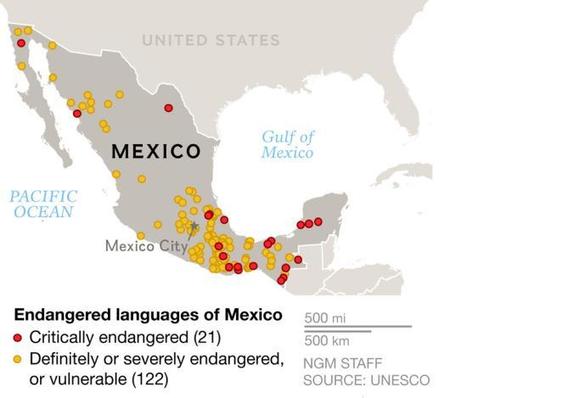
Sixty of Mexico’s native languages are at risk of being silenced forever—but many people are working to keep them alive, experts say.

Source: news.nationalgeographic.com

If is a language dies, an entire culture dies. Every year more and more languages and threatened and it gets worse as more people try to keep up with the demand of globalization. “Mexico isn’t the only country losing its voices: If nothing is done, about half of the 6,000-plus languages spoken today will disappear by the end of this century.”  Endangered Languages are going to be all the more common.  

TagsMexico, language, folk cultures, culture, globalization.

These two maps show the shocking inequality in Baltimore

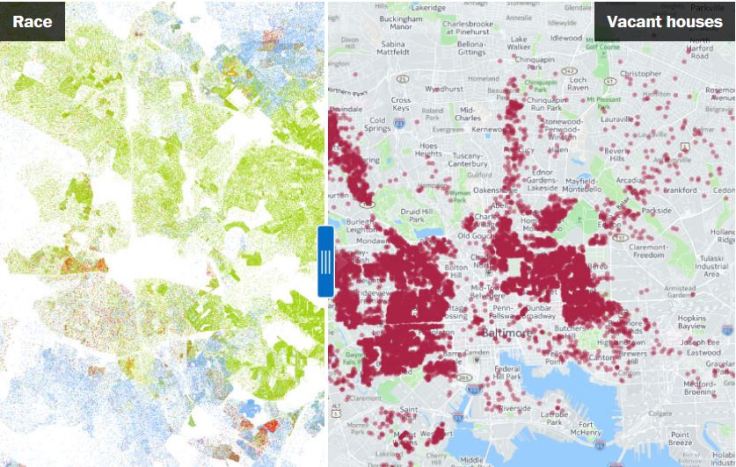
How vacant houses trace the boundaries of Baltimore’s black neighborhoods.

The map on the left shows one very tiny dot for each person living in Baltimore. White people are blue dots, blacks are green, Asians are red and Hispanics yellow.The map on the right shows the locations of Baltimore City’s 15,928 vacant buildings. Slide between the two maps and you’ll immediately notice that the wedge of white Baltimore, jutting down from the Northwest to the city center, is largely free of vacant buildings. But in the black neighborhoods on either side, empty buildings are endemic.


Tags: neighborhood, gentrificationurban, place, economicracepoverty, spatialhousing.

Source: www.washingtonpost.com

Blog at WordPress.com.

Up ↑