Search

GEOGRAPHY EDUCATION

Supporting geography educators everywhere with current digital resources.

Population pyramids: Powerful predictors of the future

“Population statistics are like crystal balls — when examined closely, they can help predict a country’s future (and give important clues about the past). Kim Preshoff explains how using a visual tool called a population pyramid helps policymakers and social scientists make sense of the statistics, using three different countries’ pyramids as examples.”

Seth Dixon‘s insight:

This is an incredibly powerful and remarkably well-done TED-ED lesson on the importance and value of population pyramids.  This lesson goes nicely with this article fro the World Bank entitled “The End of the Population Pyramid” which highlights the demographic changes that will be reshaping global demographics in the next 50-100 years.  

Tag: population, demographic transition model, TED.

22 International Borders

See on Scoop.it – Geography Education

“Brazil (top) and Bolivia (bottom).”

Seth Dixon‘s insight:

This photographic exploration of various borders shows that some are are just administrative lines that show peaceful collaboration; others are fraught with geopolitical tension or demonstrate radically distinct land use management patterns. 


Tags: land use, borders, political.

See on www.viralnova.com

Primate Cities: Mexico City

Seth Dixon‘s insight:

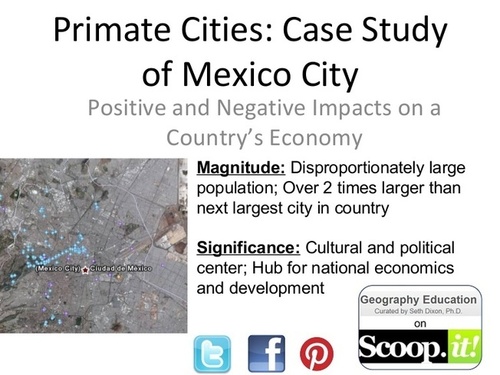
In 2011, one of the AP Human Geography Free Response Questions focused on identifying if the rank-size rule applied the urban hierarchy of a country (Mexico), or if a primate city dominated the network of metropolitan regions.  To prepare people to understand the rubric, I put together this presentation, based primarily on my time researching in Mexico City (download the PPT file).  The problems with primate cities are hardly unique to Mexico City; this additional BBC article bemoans Britain’s lack of a true second city, arguing that London’s shadow looms too large for sustained national development outside of the primate city. 

Tags: APHG, urban,  unit 7 cities, megacities.

See on www.slideshare.net

Sports Movies and Globalization

See on Scoop.it – Geography Education

Hamm said he was drawn to the true story of an agent looking for India’s first pro-baseball player

Seth Dixon‘s insight:

This 6 minute clip is a preview of the movie “Million Dollar Arm.”  It looks to be a fun movie, but what I find academically interesting about the movie is the portrayal of one of the countless fascinating cultural and economic mergers created by globalization.  The story is about the economic forces motivating baseball scouts to seek out untapped labor pools in areas such as India that were previously not a part of baseball’s cultural reach (and the really cool global lives of these individuals). 

Tags: sport, globalization, popular culture, economic, labor, India.

See on abcnews.go.com

Military Mobilizations: Ukraine and Russia

See on Scoop.it – Geography Education

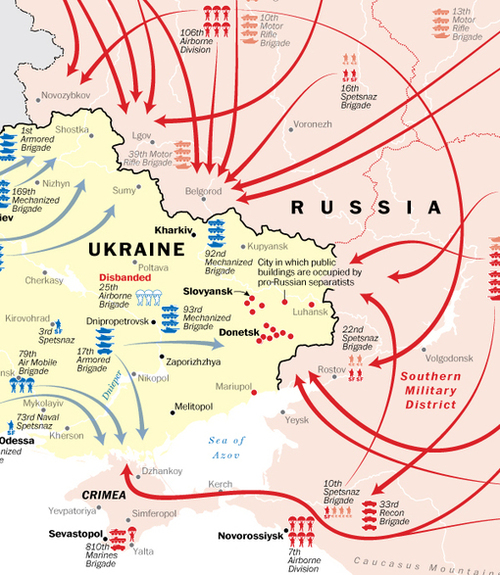
An important look at the military reality of the crisis.

Seth Dixon‘s insight:

We have known that pro-Russian forces have taken control of government buildings in part of Ukraine, and that forces on both sides have been mobilizing along the border.  It is hard to make sense of all the news reports but this map helps to bring the reality on the ground into sharp focus.  

See on www.washingtonpost.com

Retronyms: Linguistic Shifts

See on Scoop.it – Geography Education

A ‘retronym’ is a term specifying the original meaning of word after a newer meaning has overtaken it.

Seth Dixon‘s insight:

Technological change demands linguistic change.  The technological world in which our societies are immersed changes our lived experiences and aspects of culture such as language. For example, vinyl disks were simply called records until compact discs, audio tapes and digital files flooded the music market.  An artist may still cut a record today, but the record probably won’t be available in vinyl.   Vinyl, then, is a ‘retronym’ to now describe what was once called a record, which now has other meanings and connotations. This list has 14 other examples of retronyms, which exemplifies the cultural patterns and processes that create pop culture.  


Tags: language, culture, popular culture, technology.

See on mentalfloss.com

Block-Long Sinkhole Swallows Cars in Baltimore

See on Scoop.it – Geography Education

“A block-long sinkhole opened up in a residential neighborhood in rain-soaked Baltimore on Wednesday, devouring cars and forcing the evacuation of several houses.”

Seth Dixon‘s insight:

We like to think that the Earth beneath our feet is solid and that the configuration of the landforms in our neighborhood will be unchanging.  This a dramatic reminder that Earth’s physical processes don’t ever stop–even if we’ve built a city in that spot.

Tags: physical, geomorphology, erosion, landforms, weather and climate, urban ecology.

See on www.nbcnews.com

Where the extremely poor live

See on Scoop.it – Geography Education

Seth Dixon‘s insight:

The World Bank has produced a report entitled “Prosperity for All.”  In this the extremely poor are defined as making less than $1.25 a day.  Two thirds of the extremely poor live in just 5 countries (India, China, Nigeria, Bangladesh and DR Congo). 

Tags: poverty, development, economic, globalization, labor, NGOs.

Defining ‘the South’

See on Scoop.it – Geography Education

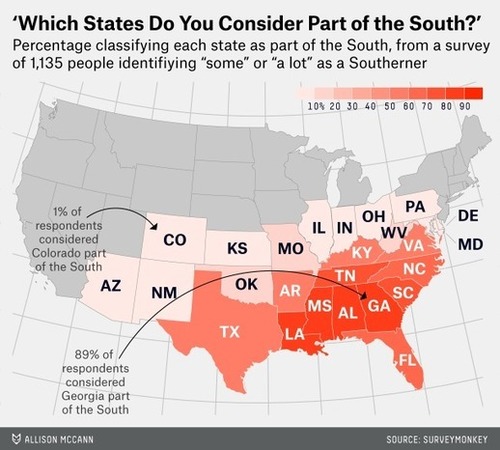
“The Southerners were considerably more certain of which states are their own. While the top few Midwest states barely pulled 80 percent of the vote, nearly 90 percent of respondents identified Georgia and Alabama as Southern, and more than 80 percent placed Mississippi and Louisiana in the South. South Carolina, Tennessee, Florida and North Carolina all garnered above 60 percent.”

Seth Dixon‘s insight:

I enjoy activities that challenge students to map out vernacular regions since it forces them to establish some criteria and consider the attributes of particular places.  So what does your ‘South’ look like? 

Tags: mapping, the South, regions.

See on fivethirtyeight.com

Blog at WordPress.com.

Up ↑