Search

GEOGRAPHY EDUCATION

Supporting geography educators everywhere with current digital resources.

“Natural” Foods?

“The False Advertising Industry reveals the shocking truth about what is allowed in ‘Natural’ food. Only the USDA Organic Seal guarantees your food contains no Genetically Modified Organisms, no toxic pesticides, and no growth hormones or antibiotics.”

Seth Dixon‘s insight:

This funny video shows how meaningless the word “natural” is when it is only used as a buzzword or slogan.  Many food companies are trying to show their “natural” roots these days–some with a new label and others are trying to legitimately clean up their production line.  In fact, McDonald’s has gone to great lengths to show their costumers where the food is coming from and to personalize the food producers to alleviate their fears.  They have created a Track my Maccas iPhone App which used several geospatial technologies to explore the commodity chain of McDonalds items (keep in mind that this is the companies own promotional tool). 

Tags: agriculture, GMOs, food production, mapping, geospatial.

See on www.youtube.com
World of Change

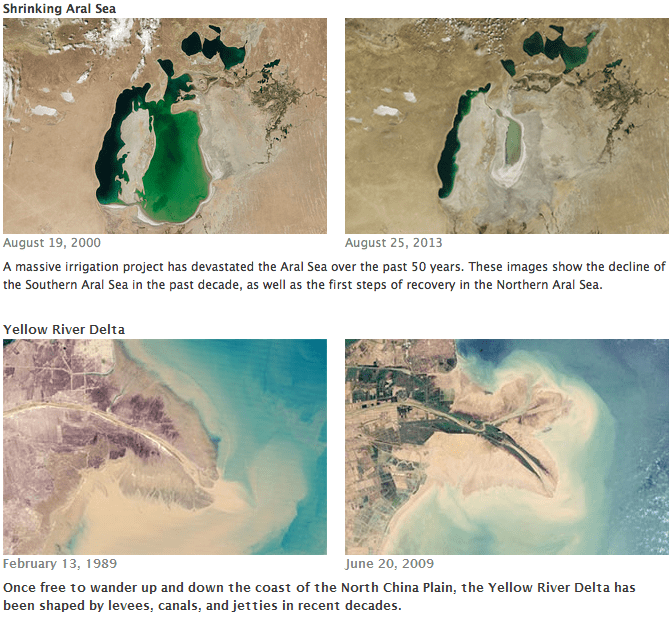
“Earth is constantly changing. Some changes are a natural part of the climate system, such as the seasonal expansion and contraction of the Arctic sea ice pack. The responsibility for other changes, such as the Antarctic ozone hole, falls squarely on humanity’s shoulders. Our World of Change series documents how our planet’s land, oceans, atmosphere, and Sun are changing over time.”

Seth Dixon‘s insight:

This article from NASA’s Earth Observatory highlights 25 classroom-ready examples of environmental change that can readily detected with satellite imagery. 

Tags: remote sensing, land use, environment, geospatial, environment modify, unit 1 Geoprinciples.

See on earthobservatory.nasa.gov

AralSea

Pyroclastic Flow followed by series of Tornados, Sinabung Volcano

The pyroclastic flow deposits red-hot material on the slope of the volcano. After a few minutes, air heated by the deposit establishes a convective regime and due to the speed of the rising air a series of small tornados are formed.
During daylight it is difficult to imaging how hot the deposit is. Click here to see a pyroclastic flow deposit glowing at night from this same location.

Seth Dixon‘s insight:

Mount Sinabung recently erupted, killing at least 15 people and destroying tons on property on the island of Sumatra in Indonesia.  This footage is both awe-inspiring and terrifying.    

Tags: disasters, Indonesia, physical, SouthEastAsia.

See on www.youtube.com

Does English still borrow words from other languages?

English language has “borrowed” words for centuries. But is it now lending more than it’s taking, asks Philip Durkin, deputy chief editor of the Oxford English Dictionary.  Knowledge of what is being borrowed, and from where, provides an invaluable insight into the international relations of the English language.  Today English borrows words from other languages with a truly global reach.

See on www.bbc.co.uk

The Real Pirates of the Caribbean

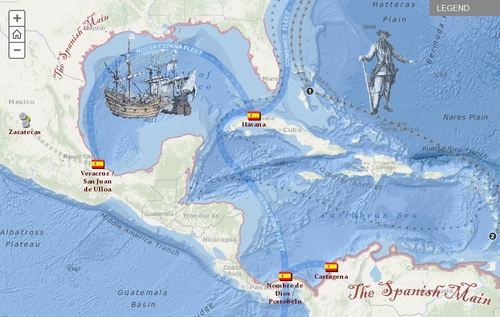
Explore the travels and exploits of five real pirates of the Caribbean. Click through the tabs to track the adventures of each pirate overlaid on Spanish ports and pirate strongholds in the area. Zoom into the map to see additional detail.

Seth Dixon‘s insight:

This interactive StoryMap is great way to show the historical and geographic context of colonial-era piracy in the Caribbean.


Tags: Middle America, ESRI, mapping, historical.

See on mediamaps.esri.com

Security Still A Major Concern In Sochi

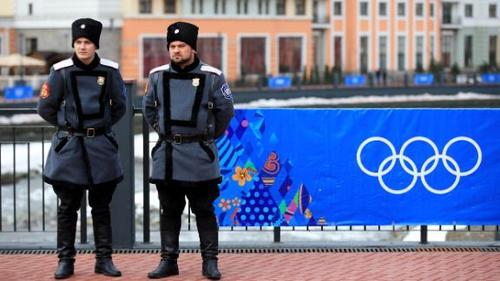
ESPN Video: Jeremy Schaap details the threats to the 2014 Winter Olympic Games in Sochi, Russia.

Seth Dixon‘s insight:

It’s not everyday that ESPN will use terms like insurgency, region, state, suicide bombs, attacks, threats, heightened security, terrorists and black widows during a video clip, but when they do it’s worth paying attention to the geographic context of their story.

Tags: sport, political, conflict, devolution, Russia.

See on espn.go.com

9 Reasons the U.S. Ended Up So Much More Car-Dependent Than Europe

Understanding mistakes of the past can help guide U.S. transportation policy in the future.

In 2010, Americans drove for 85 percent of their daily trips, compared to car trip shares of 50 to 65 percent in Europe. Longer trip distances only partially explain the difference. Roughly 30 percent of daily trips are shorter than a mile on either side of the Atlantic. But of those under one-mile trips, Americans drove almost 70 percent of the time, while Europeans made 70 percent of their short trips by bicycle, foot, or public transportation.  The statistics don’t reveal the sources of this disparity, but there are nine main reasons American metro areas have ended up so much more car-dependent than cities in Western Europe.

See on www.theatlanticcities.com

GMO-Free Europe

Seth Dixon‘s insight:

Would you like to map out the GMO-free regions of Europe?  Looking for resources discussing the impacts of GMOs on society?  This is a partisan site with some nice resources for a student project. 

See on www.gmo-free-regions.org

Pangaea and Plate Tectonics


The supercontinent Pangaea, with its connected South America and Africa, broke apart 200 million years ago. But the continents haven’t stopped shifting — the tectonic plates beneath our feet (in Earth’s two top layers, the lithosphere and the asthenosphere) are still traveling at about the rate your fingernails grow. Michael Molina discusses the catalysts and consequences of continental drift.


Seth Dixon‘s insight:

This Ted-ED lesson is a great visual way to show the basics of plate tectonics and some geomorphological processes. 


Tags: physical, geomorphology, TED, K12, video.

See on www.youtube.com

Blog at WordPress.com.

Up ↑