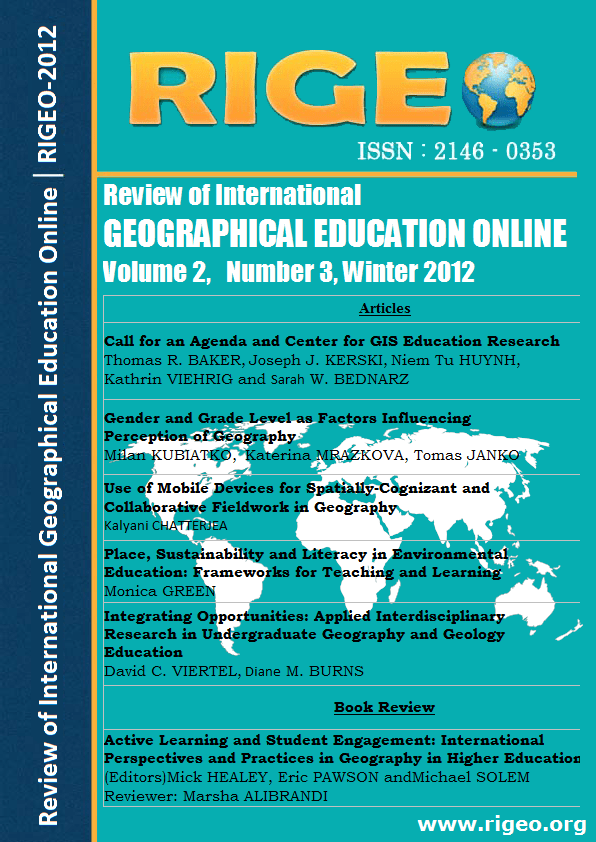
The Review of International Geographical Education Online (RIGEO) has recently published a new issue that contains this article about GIS education. While geographers promote GIS education, we need to study the impact, efficacy and pedagogy of GIS education more seriously as we plan for the future.
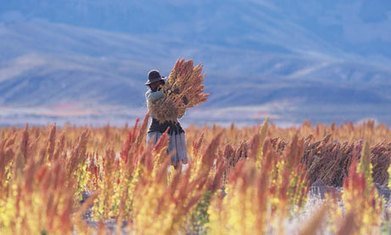
Bolivian and Peruvian farmers sell entire crop to meet rising western demand, sparking fears of malnutrition
Seth Dixon, Ph.D.‘s insight:
Quinoa was once a traditional Andean grain that few outside of South America consumed, but it has quickly become a staple among the health-conscious in developed countries in recent years. Dieticians and nutritional experts give it their seal of approval because it is a low-fat starch that is high in protein and filled with amino acids. This rapid adoption of quinoa in high-priced whole food stores has changed the economics of quinoa dramatically. Peruvian and Bolivian farmers are selling at high prices with huge global demand. Local consumers who have traditionally relied on this crop however, now have to pay triple the price to eat quinoa, causing some to question the ethics of quinoa consumption. A simple change in cultural eating habits in one part of the world can have some major impacts on the economy and agriculture of another region.
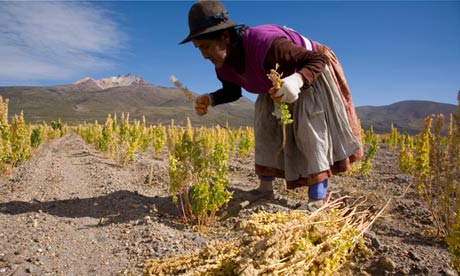
Bolivian and Peruvian farmers sell entire crop to meet rising western demand, sparking fears of malnutrition
Seth Dixon, Ph.D.‘s insight:
Quinoa was once a traditional Andean grain that few outside of South America consumed, but it has quickly become a staple among the health-conscious in developed countries in recent years. Dieticians and nutritional experts give it their seal of approval because it is a low-fat starch that is high in protein and filled with amino acids. This rapid adoption of quinoa in high-priced whole food stores has changed the economics of quinoa dramatically. Peruvian and Bolivian farmers are selling at high prices with huge global demand. Local consumers who have traditionally relied on this crop however, now have to pay triple the price to eat quinoa, causing some to question the ethics of quinoa consumption. A simple change in cultural eating habits in one part of the world can have some major impacts on the economy and agriculture of another region.
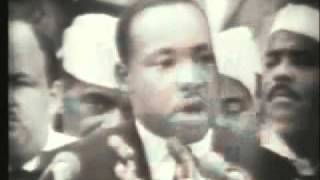
I Have a Dream Speech Martin Luther King’s Address at March on Washington August 28, 1963. Washington, D.C. When we let freedom ring, when we let it ring fro…
Seth Dixon, Ph.D.‘s insight:
There is much to glean from Martin Luther King’s famous I Have a Dream speech as a fantastic rhetorical device. This speech has a profound impact on the the psyche of the America culture and it has endured as a pivotal moment in history. As we celebrate his life and legacy this Monday, it is an appropriate time to contemplate that the ending of segregation (a spatial division of races) has reshaped the United States.
Many streets in the United States bear the name “Martin Luther King Jr.” to memorialize both the man and the Civil Rights movement. This streets, as this YouTube video suggests, are often in poor, crime-ridden and violent neighborhoods. This video highlights the irony between the historical memory of Martin Luther King Jr. and places of memorialization that bear his name. This video echoes much of what the authors of the fantastic book “Civil Rights Memorials and the Geography of Memory” say (in fact one of the authors is shown in this video).
Questions to ponder: If Martin Luther King Jr. represents non-violence, then why are streets bearing his name often in ‘violent’ neighborhoods? Where should Martin Luther King be memorialized in the United States? Only in the South? Only in predominantly African-American communities? What does the geography of the spaces where he is memorialized say something about the United States?
A Greek exit from the euro has become a bomb fizzling at the heart of the eurozone. What could happen if it explodes?
Seth Dixon, Ph.D.‘s insight:
This is still all speculation, but this speculation is grounded in the very real possibility that Greece may leave the Eurozone. This one possible scenario would have a profound ripple effect throughout the European Union and beyond. This interactive explores each of these 8 possible results.
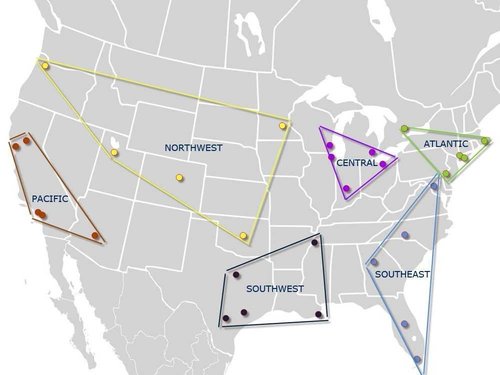
The NBA has the cleanest map of all the sports leagues.
Seth Dixon, Ph.D.‘s insight:
Sports league have historically used geographic references to describe their league, conference or divisions (This was just one of the many reasons I was so appalled that San Diego State was going to join the Big East. Thankfully that plan was stymied). To have successful rivalries, teams often play up local proximity of fan bases (Yankees/Red Sox, Duke/North Carolina, Michigan/Ohio State) to add intensity to the on-field action. Given that teams and fans travel, the logistics make regionally based division economically prudent. This map (and the full set of major professional leagues in North America) shows that the NBA has the most geographically consistent divisions.
I Have a Dream Speech Martin Luther King’s Address at March on Washington August 28, 1963. Washington, D.C. When we let freedom ring, when we let it ring fro…
Seth Dixon, Ph.D.‘s insight:
There is much to glean from Martin Luther King’s famous I Have a Dream speech as a fantastic rhetorical device. This speech has a profound impact on the the psyche of the America culture and it has endured as a pivotal moment in history. As we celebrate his life and legacy this Monday, it is an appropriate time to contemplate that the ending of segregation (a spatial division of races) has reshaped the United States.
Many streets in the United States bear the name “Martin Luther King Jr.” to memorialize both the man and the Civil Rights movement. This streets, as this YouTube video suggests, are often in poor, crime-ridden and violent neighborhoods.
This video highlights the irony between the historical memory of Martin Luther King Jr. and places of memorialization that bear his name. This video echoes much of what the authors of the fantastic book “Civil Rights Memorials and the Geography of Memory” say (in fact one of the authors is shown in this video).
Questions to ponder: If Martin Luther King Jr. represents non-violence, then why are streets bearing his name often in ‘violent’ neighborhoods? Where should Martin Luther King be memorialized in the United States? Only in the South? Only in predominantly African-American communities? What does the geography of the spaces where he is memorialized say something about the United States?
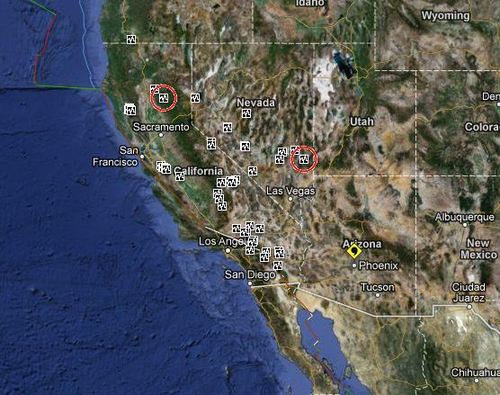
Map of the World, in real time with natural disaster information.
“This is a Emergency and Disasters Information and monitoring services. Hosted by National Association of Radio-distress signalling and Infocommunications.
Should we look to traditional societies to help us tweak our lives? Wade Davis takes issue with the whole idea
Seth Dixon, Ph.D.‘s insight:
Jared Diamond is famous for his work in writing Guns, Germs and Steel as well as Collapse. His latest work, The World Until Yesterday, he encourages modern readers to examine the traditional societies for insights on how to improve the human condition. In this book review by Wade Davis, he critiques this approach and suggests that we should see indigenous societies as reminders that our modern lifestyle is not the only way.