Search

GEOGRAPHY EDUCATION

Supporting geography educators everywhere with current digital resources.

One Race, Every Medalist Ever

See on Scoop.itHistory and Social Studies Education

“Usain Bolt’s 9.63 set an Olympic record in the 100. So how far ahead of every Olympic medalist is he?”
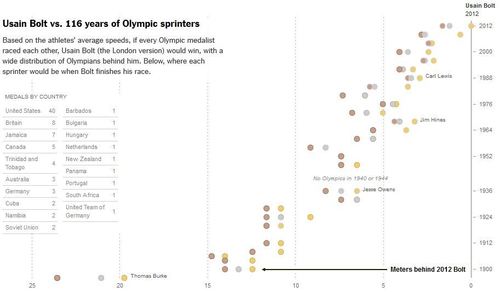
The race was spectacular, but how fast were these medalists compared to other Olympians from different eras?  Literally, Yohan Blake, Justin Gaitlin and Tyson Gay would have all beat every Olympian ever expect Usain Bolt.  Humanity is constantly pushing the physical limits of human physicality with technology.  What are the limits of this historical trend?

See on www.nytimes.com

Is Assad Carving Out A Haven For Syria’s Alawites?

Questions are growing about the fate of President Bashar Assad’s regime. One possibility is the creation of a breakaway region in the northwest coastal mountains dominated by the president’s Alawite minority.

This podcast explores the geopolitical possibilities that are facing the minority Alawites of Syria. If the major cities of Syria fall to the rebels, would a smaller Alawite breakaway state even be economically or politically viable? This podcast argues that it would not, and therefore many Alawites see this as a zero sum game.  While this is all speculative, it uses spatial and geographic prinicples to assess the viability of possible outcomes.

See on Scoop.itGeography Education See on www.npr.org

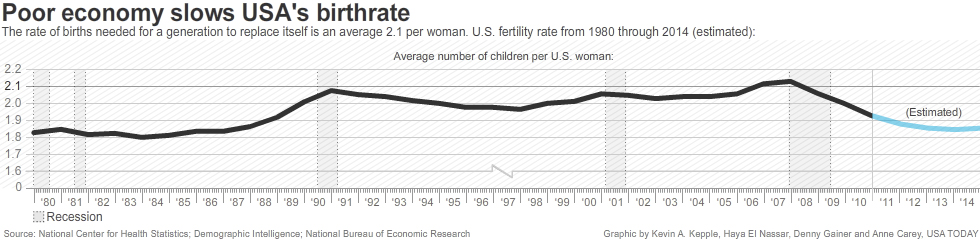
Americans put off having babies amid poor economy

“Births have plummeted since their 2007 peak, and the recession is a factor. There’s worry that the birthrate will be affected for years.”

The graph for this article is an incredible visual that highlights how the economic conditions of a country can impact its demographics.  Not surprisingly, Americans have less children during tough times.  Questions to ponder: would this phenomenon be expected in all parts of the world?  Why or why not?  Demographically, what will the long-term impact of the recession be?

See on Scoop.itGeography Education    See on www.usatoday.com

Why the fax thrives in Japan

See on Scoop.itCultural Geography

The Japanese are regarded as a hi-tech nation, the country that gave the world huge electronics companies. Why, then, are faxes so popular there?


The technology that we use is in part dependent on out cultural values. 

See on www.bbc.co.uk

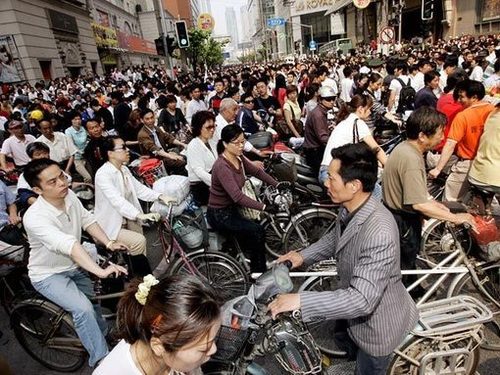
Issues from Global Population Growth

“Find In-depth Review, Video And Infographic On World Population.  Learn more about population growth, factors for overpopulation, population density map and UN plan to combat world population.”

This video displays some intriguing statistics about global population growth.  Equally important the video explores some concerns that are presented with a large population.  This video can also be viewed as one long infographic.  Admittedly, this video (and most academic literature) approaches the population issue from a strong perspective which advocates for the reduction of total population; if you feel it necessary to have an ideological counterweight in the classroom, this article from the LA Times may be what you are looking for.

See on Scoop.itGeography Education  –See on www.youtube.com

Drought Worsens in Midwest

See on Scoop.itGeography Education

“The worst drought in 50 years has intensified across the US midwest, not only condemning this year’s corn crop but threatening the prospects for next year’s too, new figures showed on Thursday.”


The current drought in the Midwest is having a much greater impact than making residents hot and uncomfortable. Farmland prices were on the rise, and the market was acting on the assumption that of good years with bountiful harvests.  As a breadbasket, the drought in deepening fears of a global food crisis and greatly impacting food production with economic, energy (ethanol) and political ramifications.   

See on www.guardian.co.uk

Walk Appeal

See on Scoop.itGeography Education

Walk Appeal promises to be a major new tool for understanding and building walkable places, and it explains several things that were heretofore either contradictory or mysterious.

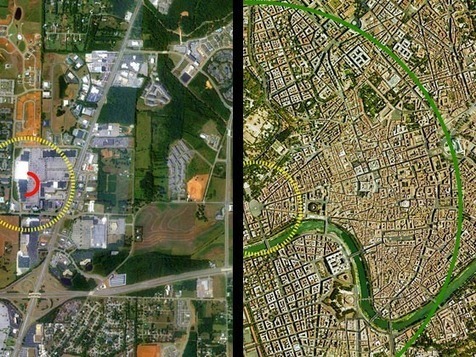
What is a reasonable distance to walk around town?  Research shows that cities with improved sidewalks, less parking lots, attractive storefronts and other amenities that encourage walking.  If  walking the urban environment is and of itself an experience worth having and makes the person feel like a flâneur, experiencing the city on a deeper level, automotive transport goes down and walking goes up.  Urban infrastructure is more important for most people than distance in deciding whether to get in the car or walk down the street (for distances under 2 miles).  Bottom line: neighborhoods that have an attractive sense of place are more walkable.

See on bettercities.net

Americans Least Green—And Feel Least Guilt, Survey Suggests

See on Scoop.itGeography Education

A new global survey suggests world’s the most wasteful countries feel the least guilty—and vice-versa.


Our consumption patterns, ecological footprint and lifestyle choices have a significant impact on how we feel about sustainability initiatives and human/environmental interactions.  

See on news.nationalgeographic.com

Why Should Techies Care About Education Theory?

See on Scoop.itSocial Media Classroom

“Earlier this year, I penned a post titled ‘The Audrey Test’ in which I laid out a number of topics with which I argued education technologists (particularly ed-tech entrepreneurs) needed to be familiar if I was to take them at all seriously. The response – both in the comments section and elsewhere – were fairly revealing, I thought, particularly as some folks sneered at the notion that learning theories, histories, or sciences were at all relevant to building ed-tech products, services or businesses.” 


See on www.hackeducation.com

Blog at WordPress.com.

Up ↑