Search

GEOGRAPHY EDUCATION

Supporting geography educators everywhere with current digital resources.

Understanding the Darfur Conflict

See on Scoop.it – Geography Education
This is a short, but effective video to quickly explain the geographic factors that have led to such turmoil within the Darfur region.  For more in-depth resources, see:

http://www.scoop.it/t/darfur-devastation


See on www.youtube.com

Colorful Places & Spaces

See on Scoop.it – Geography Education

It is only right to start this site off with photos of the Holsteiner Stairs by artist Horst Glaesker. In 2008, I saw photos of this installation in Wuppertal, Germany and I knew I had to create a colour blog.


How can public art help create a sense of place?  How does this transform the neighborhood and community?  What are the cultural and econommic impacts of public art?       

See on plentyofcolour.com

Could there be Water Wars in the Future?

See on Scoop.it – Geography Education

The debate on Aquifers continues as new technologies designed by oil companies are able to tap historic water reserves deep in the Earths crust.  The geopolitical significance of water rises as population growth within dry climates continue to rise. 

See on www.princeton.edu

The Artist Behind the Apple Globe

See on Scoop.it – Geography Education

I recently discovered the identity of the artist who created the “apple globe” that I use as my twitter avatar and that is prominently displayed on my various sites.  The artist, Kevin Van Aelst, teaches at Quinnipiac University and has kindly allowed me to continue using the image.  Please check out more of his work and enjoy his thoughtful use of mundane object in new spatial ways: http://www.kevinvanaelst.com/ 

See on www.kevinvanaelst.com

12 of the Most Beautiful Bays in the World

See on Scoop.it – Geography Education

This is a great set of images that show coastal processes for a geomorphology or physical geography class.  Pictured above is Palm Bay, Australia, which also happens to show fluvial processes as well.  

See on www.theworldgeography.com

What is the Arab Spring?

See on Scoop.it – Geography Education

The Choices Program asks Brown University’s Political Scientist Melani Cammett to briefly explain the Arab Spring.  This is a great primer to teach young students who don’t follow international news to understand the beginnings of the Arab Spring.  For more videos by the Choices Program in their “Scholars Online” series, see:

http://www.choices.edu/resources/scholarsonline.php

See on www.youtube.com

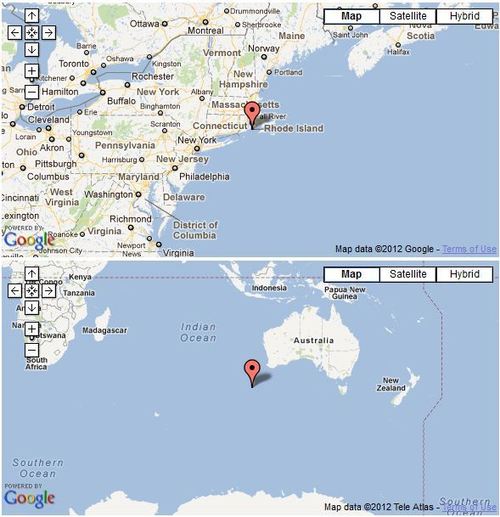
Antipodes Map: The other side of the world

See on Scoop.it – Geography Education

In geography, the antipodes of any place on Earth is its antipodal point; that is, the region on the Earth’s surface which is diametrically opposite t…


I know that most Americans have learned at an early age that if you dig a hole through the center of the Earth, you’ll end up in China.  Geologic and impossibilities aside, most Americans would actually end up in the Indian Ocean as displayed by this clever pairing up maps that shows the user the Antipode of any given place on Earth.

See on visual.ly

Environment, Energy and Resilience

See on Scoop.it – Geography Education

Indonesia has the largest share of the world’s mangroves — coastal forests that have adapted to saltwater environments. They play important environmental and ecological roles.


Mangroves play a key role of acting as an ecological buffer in coastal region that provide the area with resilience against tsunamis, hurricanes and other forms of coastal flooding.  Their role in carbon sequestration is also vital as energy emissions globally continue to rise.  So let’s jump scales: how are global issues locally important?  How is the local deeply global?  How can stakeholders at either scale find common ground with the other?  

See on www.npr.org

Environment, Energy and Resilience

See on Scoop.it – Geography Education

Indonesia has the largest share of the world’s mangroves — coastal forests that have adapted to saltwater environments. They play important environmental and ecological roles.


Mangroves play a key role of acting as an ecological buffer in coastal region that provide the area with resilience against tsunamis, hurricanes and other forms of coastal flooding.  Their role in carbon sequestration is also vital as energy emissions globally continue to rise.  So let’s jump scales: how are global issues locally important?  How is the local deeply global?  How can stakeholders at either scale find common ground with the other?  

See on www.npr.org

Blog at WordPress.com.

Up ↑