Search

GEOGRAPHY EDUCATION

Supporting geography educators everywhere with current digital resources.

Tag

cultural norms

5 American Habits I Kicked in Finland

From to-go mugs to small talk

Source: www.theatlantic.com

I’m not trying to disparage one culture group over another, but to point out that some cultural traits and norms only make sense in a certain place within a particular cultural context.  Sometimes its hard to see our own culture until we go somewhere else with a different cultural background. 


Questions to Ponder: What is a cultural trait that you realized was distinct only after being in contact with those from places/cultural settings?  Why are some traits perceived as strange outside of their cultural context but perfectly normal within them?     


Tags: Finland, culturecultural norms.

The great Korean bat flip mystery

MLB’s code is clear: Flip your bat and you’ll pay. But in South Korea, flips are an art. How does this alternate world exist? And what does it say about us? Writer Mina Kimes trekked across South Korea with illustrator Mickey Duzyj to unravel the mystery.

Source: www.espn.com

There are unwritten rules in Major League Baseball, or in geographic terms, there are are cultural norms that are informally enforced to maintain homogeneity and to prevent  cultural drift.  Jose Bautista’s repuation as a villain has much to do with his rejection of a key MLB unwritten rule–Never ‘show up’ the pitcher by flipping the bat.  In South Korea, typically a country much more associated with cultural traditions of honor and respect than the United States, bat flipping is much more accepted and common (diffusion plays a role in the story–baseball came to South Korea via Japan).  This is an interesting story about South Korean baseball’s cultural norms that might intrigue some sports fans. 


Tags: sport, popular culturediffusion, culturecultural norms, South Korea, East Asia.

Getting Japanese Citizenship

“To become a Japanese citizen, a foreigner must display ‘good conduct’, among other things. The rules do not specify what that means, and make no mention of living wafu (Japanese-style). But for one candidate, at least, it involved officials looking in his fridge and inspecting his children’s toys to see if he was Japanese enough (he was). Bureaucratic discretion is the main reason why it is hard to get Japanese nationality. The ministry of justice, which handles the process, says officials may visit applicants’ homes and talk to their neighbors.”

Source: www.economist.com

Japan has a remarkably homogeneous population, in large part because they have very tight immigration laws (here is a more extended list of the requirements to obtain a Japanese citizenship).


Questions to Ponder: How is the notion of Japanese citizenship different from American citizenship?  As Japan’s population continues to decline, how might that change Japan’s migration/citizenship policies?   


Tags: JapanEast Asia, place, perspective, cultural norms, culture.

What assimilation means to the ‘taco trucks on every corner’ Trump supporter

Marco Gutierrez, founder of Latinos for Trump, explains his view of immigration and assimilation to the US.

Source: www.pri.org

I’m NOT trying to use this platform to advance any partisan political agenda, but I think this brings up some very interesting narratives that are used when discussing migration and culture, which becomes a political ‘hot-button’ topic.  There is often cultural pressure on the migrant to assimilate into the host culture (or at least acculturate to a certain degree).  This larger national discussion centers on whether cultural assimilation should be expected of migrants and how much cultural diffusion the host culture will be receiving from the migrants.

Questions to Ponder: How are cultural norms placed on migrants?  What are some recent examples of migrants not wanting to assimilate that have led to political tension?

Tags: culture, cultural norms, migration, political.

More young adults are living with their parents

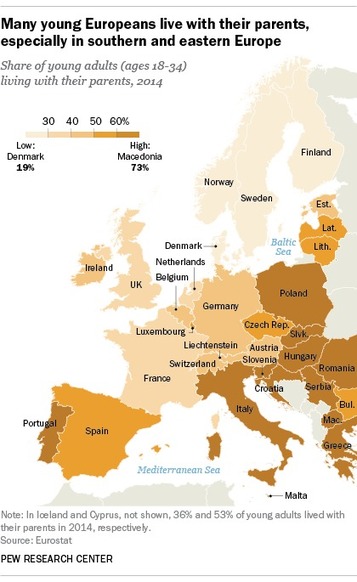
Across much of the developed world, researchers have found that more young adults are living at their parents’ home for longer periods of time.


Across the European Union’s 28 member nations, nearly half (48.1%) of 18- to 34-year-olds were living with their parents in 2014, according to the EU statistical agency Eurostat.  The Scandinavian countries have the lowest rates, with Denmark coming in at 18.6%. Southern and eastern European countries tend to have higher rates, led by the former Yugoslav republic of Macedonia: 72.5% of 18- to 34-year-olds reportedly were living with their parents.

Source: www.pewresearch.org

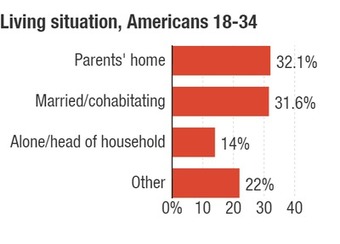
This isn’t news because this trend gradually became a new part of the economic and cultural norms of the developed world–but the impact is enormous.  In the United States, more young adults live with parents than partners (for the first time in the 130 years that the statistic has been collected).  The world isn’t what it was in 1880.  

32.1% of young adults in the U.S live with parents, and 48.1% of young adults in the European Union Union live with parents.   


Questions to Ponder: What are some contributing factors to this trend in the United States and Europe?  What does this say about housing costs, economic, and cultural conditions? 


Tags: socioeconomic, housingstatisticspopulation, cultural norms, culture.

For First Time In 130 Years, More Young Adults Live With Parents Than With Partners

“For the first time in more than 130 years, Americans ages 18-34 are more likely to live with their parents than in any other living situation, according to a new analysis by the Pew Research Center.  Less educated young adults are also more likely to live with their parents than are their college-educated counterparts — no surprise, Pew notes, given the financial prospects in today’s economy.  Black and Hispanic young people, compared with white people, are in the same situation.  But the overall trend is the same for every demographic group — living with parents is increasingly common.  Still, young Americans are still less likely to live with their parents than their European counterparts, Pew says.

Source: www.npr.org

I find that the best statistics have great explanatory power, make sense when placed in the right context, and STILL manage to leave you amazed.  These stats fit that bill for me and as the school year is ending, it’s a milestone that doesn’t mean what it did for generations past.  32.1% of young adults in the U.S live with parents, and 48.1% of young adults in the European Union Union live with parents.   


Questions to Ponder: What are some contributing factors to this trend in the United States and Europe?  What does this say about housing costs, economic, and cultural conditions? 


Tags: socioeconomic, housingstatisticspopulation, cultural norms, culture.
Blog at WordPress.com.

Up ↑