Search

GEOGRAPHY EDUCATION

Supporting geography educators everywhere with current digital resources.

Tag

culture

English–History and Connotations

“What is the difference between ‘a hearty welcome’ and ‘a cordial reception’? In a brief, action-packed history of the English language, Kate Gardoqui explains why these semantically equal phrases evoke such different images.”

Source: www.youtube.com

This TED-ED video (and lesson) shows how the connotations of English words often times depend on the linguistic root (sweat–Germanic, perspire–Latin). English has obviously changed much over the years, but this other TED-ED video (and lesson) also shows some good language family information and traces it back to proto-Indo-European roots.


Tags: languagecultureEnglishTED, video.

The Real Threat to Hinduism: The Slow Death of India’s Rivers

Hinduism shares an intricate, intimate relationship with the climate, geography, and biodiversity of South Asia; its festivals, deities, mythology, scriptures, calendar, rituals, and even superstitions are rooted in nature. There is a strong bond between Hinduism and South Asia’s forests, wildlife, rivers, seasons, mountains, soils, climate, and richly varied geography, which is manifest in the traditional layout of a typical Hindu household’s annual schedule. Hinduism’s existence is tied to all of these natural entities, and more prominently, to South Asia’s rivers.


Hinduism as a religion celebrates nature’s bounty, and what could be more representative of nature’s bounty than a river valley? South Asian rivers have sustained and nourished Hindu civilizations for centuries. They are responsible for our prosperous agriculture, timely monsoons, diverse aquatic ecosystems, riverine trade and commerce, and cultural richness.  Heavily dammed, drying in patches, infested by sand mafia and land grabbers, poisoned by untreated sewage and industrial waste, and hit by climate change — our rivers, the cradle of Hinduism, are in a sorry state.


If there is ever a threat to Hinduism, this is it. Destroy South Asia’s rivers and with it, Hinduism’s history and mythology will be destroyed. Rituals will turn into mockery, festivals, a farce, and Hinduism itself, a glaring example of man’s hypocritical relationship with nature. The fact that we worship our rivers as mothers and then choke them to death with all sorts of filth is already eminent.

Source: thediplomat.com

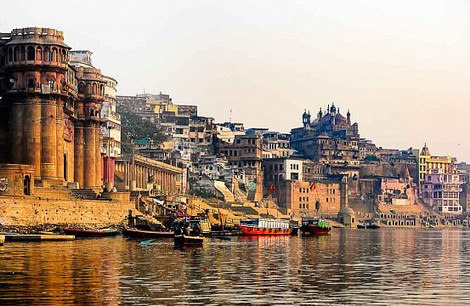
This might be a controversial op-ed because it has a strong perspective on the religious and environmental dimensions of modern Indian politics…that said, I think it is well worth the read.  The Ganges is both a holy river, and a polluted river; that juxtaposition leads to many issues confronting India today. 


Tagsculturereligion, India, South Asia, Hinduism, pollution, industry,   environment, sustainability, consumption, fluvial

How the letters of the alphabet got their names

There seems to be little predictability to the English names for the letters of the alphabet, to say nothing of the names of letters in other languages. Some begin with an e-as-in-egg sound (eff, ell); some end in an ee sound (tee, dee); and others have no obvious rhyme or reason to them at all. How did they get that way?


Tags: language, culturehistorical, English.

Source: www.economist.com

Quebec urges shopkeepers to stop saying ‘Hi’

The unofficial greeting in the bilingual Canadian city of Montreal has long been a friendly ‘Bonjour, Hi!’ But that standard is no more since a motion mandating store clerks to greet customers only in French was passed in Quebec’s provincial legislature. The move reaffirms French as the primary language in the province, where use of English can be controversial. The motion – which is not a law – was passed unanimously, but the province’s premier called the debate ‘ridiculous’. Introduced by the fiercely Francophile Parti Quebecois, the motion ‘invites all businesses and workers who enter into contact with local and international clients to welcome them warmly with the word bonjour‘.”

Source: www.bbc.com

This is a great example of how culture isn’t just passively received, but it’s actively constructed.  The call to defend cultural traits of a region to maintain it’s local distinctiveness is oftentimes why a region has a strong sense of place.  


TagsCanadalanguage, placeculture, landscape

English–Origins and Roots

When we talk about ‘English’, we often think of it as a single language. But what do the dialects spoken in dozens of countries around the world have in common with each other, or with the writings of Chaucer? Claire Bowern traces the language from the present day back to its ancient roots, showing how English has evolved through generations of speakers.

Source: www.youtube.com

English has obviously changed much over the years, but this video (and lesson) also shows some good language family information and traces it back to proto-Indo-European, using the English as the main example.  This other TED-ED video (and lesson) shows how the connotations of English words often times depend on the linguistic root (sweat–Germanic, perspire–Latin).   


Tags: languagecultureEnglishTED, video.

How Bollywood stereotypes the West

Hollywood’s view of India can be insensitive – but Indian films present clichés about the West, and about Indian emigrants too, writes Laya Maheshwari.


Nostalgia for the colour and vivacity of India turns into a snobbish belief that ‘Indian culture’ is inherently more fun and cheerful than the drab and lifeless world in France, the US, or the UK. The rule-conforming nature of Western society is seen as antithetical to ‘living it up’, which our exuberant protagonists are wont to do. Western weddings cannot match up to Indian ones; nor is Western food anywhere as tasty as Indian food. People residing in Western societies are just not as street-smart as our Indian protagonists.


Tagsculture, India, South Asia, media

Source: www.bbc.com

‘It’s Our Right’: Christian Congregation In Indonesia Fights To Worship In Its Church

A Christian congregation outside Jakarta built a new church legally, but Muslims in the area object to it. In 2010, the Supreme Court ruled to allow worship at the church, but it remains sealed.


Vocal Muslim citizens opposed construction of the church and pressured the local government to cancel the permits. The local government acquiesced to the demands. But the church group went to court, and won. On an appeal, they won again. Finally, the case went all the way to Indonesia’s Supreme Court — where the church group won a third time, in 2010. But to this day, the congregation can’t worship there.

Indonesia, with its mix of Muslim, Hindu, Buddhist and Christian citizens, has long had a reputation as a country that embraces religious diversity. Andreas Harsono, the Indonesia researcher for Human Rights Watch, sees things differently.


Tags: Indonesiaculture, religion.

Source: www.npr.org

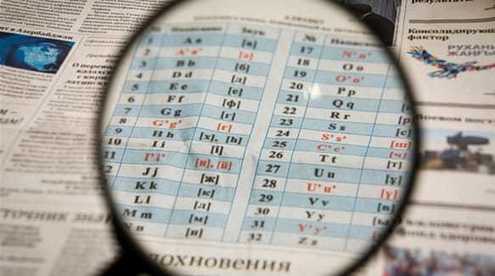
Kazakhstan to switch from Cyrillic to Latin alphabet

“Kazakh was written in Arabic script until 1920 when it was substituted by the Latin alphabet. In 1940, it was replaced by a Cyrillic one. ‘Given that over 100 countries in the world use the Latin script, it is crucial for Kazakhstan’s integration into the global educational and economic environment,’ said Gulnar Karbozova.

The former Soviet Republic declared independence in 1991. Its state language is Kazakh, a member of the Turkic family.

Yet, Russian is widely spoken across Kazakhstan and is its second official language.”

Source: www.aljazeera.com

Having to translate your language into another is one level of cultural difference, but having to change into another writing system (transliteration) adds an extra layer of foreignness that makes interactions more difficult.  Kazakhstan, a with a history of connections to the Middle East and Russia, is now making a choice that appears to signal greater connection to the larger global community.  This is not going to be an easy transitions, as as this additional BBC article notes, the choice comes with plenty of advantages and disadvantages


Tags: languagecultureworldwide, regions, Central Asia, Kazakhstan.

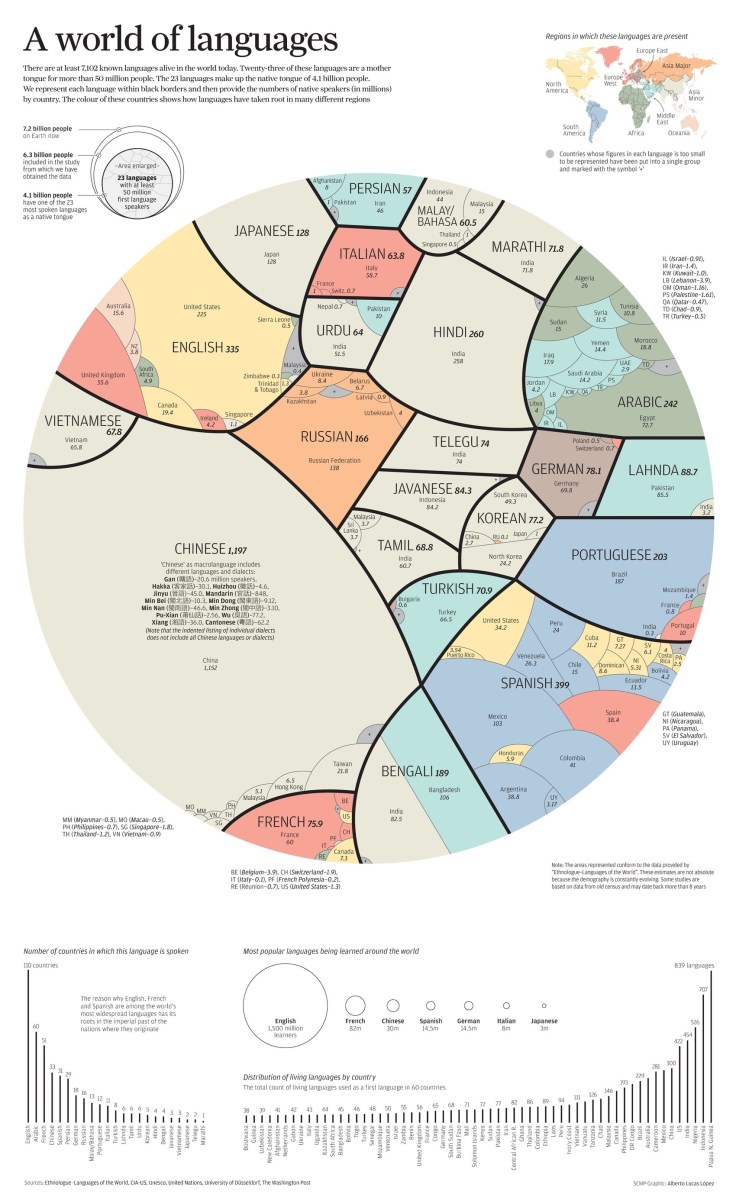
Pie Chart of the World’s Most Spoken Languages

Source: imgur.com

This infographic has been making the rounds again this year and it is worth shaing again.  It is a great way to visualize the dominant languages on Earth.  Since this only counts one language per person, mother tongues are listed.  Consequently, lingua franca’s such as English and France are smaller than you might have presumed them to be.  


Tags: language, culture, infographic.

Blog at WordPress.com.

Up ↑