When the Dutch wanted to expand their territories, they turned to the North Sea to create more arable land for Dutch farmers. Likewise, Singapore has reclaimed land to expand their territories. Over 95% of Egypt’s population live along the Nile River and its fertile delta, and the population (over 110 million people) continues to grow and is seeking new options. While this isn’t expanding into the sea, it is a type of land reclamation project as they environment is modified to make the desert bloom. Both of these embedded videos are helpful introductions to the political, economic, demographic, and environmental aspects of these projects in the Middle East.

“The wonders of modern medicine and nutrition make it easy to believe we enjoy longer lives than at any time in human history, but we may not be that special after all.” SOURCE: BBC
This BBC article explores many of our assumptions about demographic issues before statistics were recorded. This article especially looks at the notion that our life span has been increasing throughout history. This would be a good article to get some background information about stage 1 of the demographic transition. In a nutshell, the article’s premise is that just because life expectancy is increasing, it does not mean that our lifespan is the main reason. The main reason life expectancy has improved is that more children are surviving their early years not because we have extended the lifespan of elderly so much.
GeoEd Tags: medical, population, statistics, mortality.
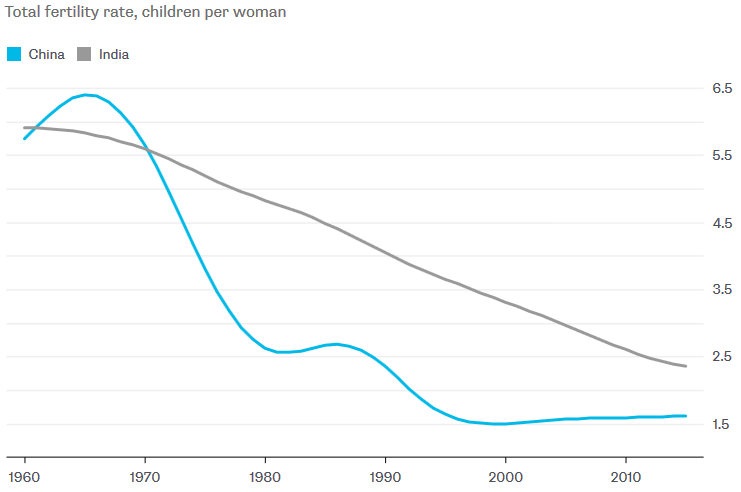
Some of the most spectacularly wrong predictions in history have been made by those who claim that overpopulation is going to swamp the planet. Thomas Malthus, a British economist writing in the late 1700s, is the most famous of these. Extrapolating past trends into the future, he predicted that population growth would inevitably swamp available food resources, leading to mass starvation. That didn’t happen — we continued to develop new technologies that let us stay ahead of the reaper.
In 1968, Stanford biologist Paul Ehrlich wrote “The Population Bomb,” warning that unchecked population growth would lead to mass starvation in the 1970s. He was just as wrong as Malthus. Global population did surge, but food production managed to keep up.
So far, the prophets of overpopulation have been defeated by technology. But human ingenuity alone can never deliver a final victory in the battle to feed the world — eventually, population growth will overwhelm the Earth’s ability to provide calories. That’s why in order to put Malthus and Ehrlich finally to rest, a second component is needed — lower fertility rates. To save both the environment and themselves, humans must have fewer kids.
Fortunately, this is happening. During the lifetimes of Malthus and Ehrlich, humans still tended to have large families, with each woman bearing an average of five children over her lifetime. But shortly after Ehrlich’s book, that began to change.
Source: www.bloomberg.com
Mathusian ideas are incredibly controversial; there are articles that will proclaim that he was right and others that will point to how he got it all wrong. The critics of Malthus see that Earth and humanity will survive as fertility rates fall almost everywhere but the Neo-Malthusians see that while fertility rates are dropping, the total population of the world continues to climb. This article has many great fertility rate charts.
Questions to Ponder: What did Malthus get right? What did he get wrong?
Tags: Malthus, op-ed, demographics, population, APHG, unit 2 population.

Every 12 years, there’s a spike in births among certain communities across the globe, including the U.S. Why? Because the Year of the Dragon, according to Chinese folk belief, confers power, fortune, and more. We look at what happens to Dragon babies when they grow up, and why timing your kid’s birth based on the zodiac isn’t as ridiculous it sounds.
Source: freakonomics.com
1976. 1988. 2000. 2012. We often assume that births on a graph in any given year will follow a smooth linear pattern similar to the years around it, but the Chinese zodiac and the mythical standing of the dragon can create spikes in diasporic communities away from the mainland. This economic podcast offers an interesting glimpse into the looks some of the communal impacts of a mini-baby boom and cultural reasons for these patterns.
Tags: Taiwan, podcast, population, demographic transition model, models, unit 2 population.
Source: www.youtube.com
This video explores some of the impacts of a declining population on a country (for example, a smaller workforce, economic decline, and growing public debt). Eastern Europe as a region is used as the principle example and the countries of Bulgaria, Moldova, and Japan are highlighted.
Tags: declining populations, population, demographic transition model, models, migration, Bulgaria, Moldova, Japan.

The map provides a level of detail previously unavailable. It is the first ever to collect data published by all of Europe’s municipalities.
Source: www.citylab.com
Questions to Ponder: What regions can you identify as a part of a trend? What possible factors have led to these patterns? What are the long-term implications of this data?
Tags: Europe, declining populations, population, demographic transition model, models, migration.
“Simulating climate conditions over the last 125,000 years and predicting how those changes would have allowed humans to spread around the globe, this video models human migration patterns.” Read more: http://ow.ly/lWIp304qZEo
Source: www.youtube.com
The World Economic Forum noted that some spatial research that was originally published in Nature, shows how geneticists took DNA samples from people of different cultures in different parts of the world to track their dispersal throughout the globe. The video uses climatic data, combined with the genetic data, to create a model showing how the human race spread across the globe over a 125,000 year period.
Tags: diffusion, demographics, mapping, migration, population, historical, video, visualization.
In which John Green teaches you about population. So, how many people can reasonably live on the Earth? Thomas Malthus got it totally wrong in the 19th century, but for some reason, he keeps coming up when we talk about population. In 1800, the human population of the Earth passed 1 billion, and Thomas Malthus posited that growth had hit its ceiling, and the population would level off and stop growing. He was totally right. Just kidding, he was totally wrong! There are like 7 billion people on the planet now! John will teach a little about how Malthus made his calculations, and explain how Malthus came up with the wrong answer. As is often the case, it has to do with making projections based on faulty assumptions. Man, people do that a lot.
Source: www.youtube.com
This is a succinct summary of Malthusian ideas on population. What do you think of his ideas? Any specific parts of his theory that you agree with? Do you disagree with some of his ideas? What did history have to say about it?
Tags: Demographics, population, models, APHG, unit 2 population.

“All newborn children in Scotland will receive the boxes by the summer following a three-month pilot. The boxes include clothing, bedding and toys and are based on a project that has been running in Finland since 1938 to give all children an equal start.”
Source: www.bbc.com
Just before World War II, the Finnish government provided boxes filled with material goods to expectant mothers with the hopes of improving infant mortality rates, pre-natal care, and promoting good parenting. The baby box was born and not surprisingly, Finland has the best infant mortality rates in the world. Now Scotland is implementing a similar program as this idea is has diffusing around the world.
Tags: Finland, UK medical, population, demographic transition model, unit 2 population.



 GEOGRAPHY EDUCATION