Search

GEOGRAPHY EDUCATION

Supporting geography educators everywhere with current digital resources.

Tag

economic

Income and Wealth Inequality

Inequality is a big, big subject. There’s racial inequality, gender inequality, and lots and lots of other kinds of inequality. This is Econ, so we’re going to talk about wealth inequality and income inequality. There’s no question that economic inequality is real. But there is disagreement as to whether income inequality is a problem, and what can or should be done about it.

Source: www.youtube.com

There are many of the 35 videos in the Economics crash course set that touch on geographic issues.   This crash course team explains the difference between wealthy inequality and income inequality.  This video also has a nice laymen’s explanation of the GINI coefficient and how it measures inequality.   In another video in the series, they demonstrate how globalization can be seen as the path to economic growth and others see the process of globalization as what has created poverty


Tagsdevelopment, laborglobalization, economicindustry, poverty, crash course

How a Steel Box Changed the World: A Brief History of Shipping

“As the container shipping industry continues to boom, companies are adopting new technologies to move cargo faster and shifting to crewless ships. But it’s not all been smooth sailing and the future will see fewer players stay above water.”

Source: www.youtube.com

This WSJ video, similar to an animated TED-ED video, explains some of the geographic consequences of economic innovation. Containerization has remade the world we live in, and will continue to see it drive economic restructuring.  


Tags: transportationlabor, globalization, diffusion, industry, economic.

Borders and the Arctic Ocean

The ice in the Arctic is disappearing. Melting Arctic ice means new economic opportunities: trade routes in the Arctic ocean, and access to natural resources. Because of this, the Arctic nations are now moving to expand their border claims. Russia has shown that it’s the most ambitious, using a potent combination of soft power and military buildup to advance its agenda. They’ve said the Arctic is rightfully theirs.

Source: www.youtube.com

This video is the second video in “Vox borders” series that is shaping up to be an excellent resources for geography educators.  This focus is on Svalbard and Russia’s designs within the Arctic, but this TestTube episode is a shorter version that emphasizes how receding summer ice is being seen as an economic opportunity for all maritime claims in the Arctic.  Canada, the U.S., Russia, and Denmark (Greenland) all are subtly expanding their maritime claims.


Questions to Ponder: How do borders impact the develop/preservation of the Arctic?  How should uninhabited lands and waters be administered politically?


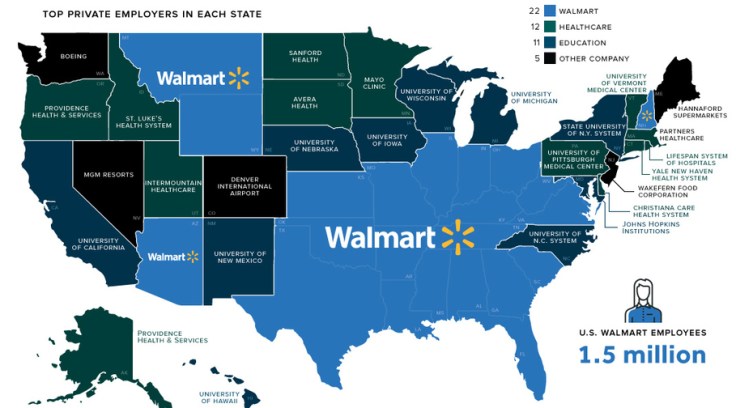
Walmart Nation: Mapping the Largest Employers in the U.S.

Walmart employs 1.5 million people across the country – and the retail behemoth is now the largest private employer in 22 states.


In an era where Amazon steals most of the headlines, it’s easy to forget about brick-and-mortar retailers like Walmart.

But, even though the market values the Bezos e-commerce juggernaut at about twice the sum of Walmart, the blue big-box store is very formidable in other ways. For example, revenue and earnings are two areas where Walmart still reigns supreme, and the stock just hit all-time highs yesterday on an earnings beat.


Tag: rural, retail, labor, economicindustry.

Source: www.visualcapitalist.com

Robots can pick strawberries. Now what?

“The robots have arrived. And they’ll be picking crops in Florida fields soon. Robots can do things humans can’t. They can pick all through the night. They can measure weight better. They can pack boxes more efficiently. They don’t take sick days, they don’t have visa problems.

Google ‘are robots taking our jobs?’ and you get millions of theories: Robots will take over most jobs within 30 years; yes, but it’s a good thing; yes, but they will create jobs, too; chill out, they won’t take them all. Truckers, surgeons, accountants and journalists have all been theoretically replaced by prognosticators.

But harvesting specialty crops is different: Plants vary in shape and size and determining ripeness is complex — experts have said there are too many variables for robots. Until now.”

Source: www.tampabay.com

Many industries have been, and will continue to be transformed by automation and robotics.  There is a great amount of uncertainty and anxiety in the labor pools as workers see many low skill jobs are being outsourced and other jobs are being automated.  Some economic organizations are preparing resources for workers to strengthen their skills for the era of automation. 


Questions to Ponder: How will a machine like this transform the agricultural business? How might it impact migration, food prices, or food waste?


Tags: economic, laboragribusiness, industry, food production, agriculture.

Globalization, Trade, and Poverty

What is globalization? Is globalization a good thing or not. Well, I have an answer that may not surprise you: It’s complicated. This week, Jacob and Adriene will argue that globalization is, in aggregate, good. Free trade and globalization tend to provide an overall benefit, and raises average incomes across the globe. The downside is that it isn’t good for every individual in the system. In some countries, manufacturing jobs move to places where labor costs are lower. And some countries that receive the influx of jobs aren’t prepared to deal with it, from a regulatory standpoint.

Source: www.youtube.com

There are many of the 35 videos in the Economics crash course set that touch on geographic issues, but I’d like to highlight episodes 16 and 17 especially.  Many see globalization as the path to economic growth and others see the process of globalization as what has created poverty.  In many ways both have a point as demonstrated in the 16th episode of this crash course.  In a follow-up video, they explain the difference between wealthy inequality and income inequality.  This video also has a nice layman’s explanation of the GINI coefficient and how it measures inequality.   


Tagsdevelopment, laborglobalization, economicindustry, poverty, crash course


Divided island: How Haiti and the DR became two worlds

Haiti and the Dominican Republic share a border, and an island. But the two countries are very different today: the Dominican Republic enjoys higher quality of life for many factors than Haiti. I went to this island and visited both countries, to try and understand when and how their paths diverged.

Source: www.youtube.com

This video is an exciting debut for the new series “Vox borders.”  By just about every development metric available, the Dominican Republic is doing better than Haiti, the only bordering country on the Caribbean island of Hispaniola with the DR.   


Questions to Ponder: How does the border impact both countries?  How has sharing one island with different colonial legacies shaped migrational push and pull factors?


Tags: Haiti, Dominican Republic, video, poverty, development, economic, labor, migration, political, borders.

When Rich Places Want to Secede

At the core of Catalonia’s separatist movement is an argument that a country’s better-off regions shouldn’t have to pay to cover their less productive counterparts.


As a relatively rich region with its own independence movement, Catalonia’s not alone: A small set of secession movements in historically productive areas, most visibly in Europe, say they’d be better off on their own, and more are pointing to Catalonia’s example to regain momentum.

The common wisdom used to be that separatist movements mostly came from weak minorities that rallied around racial or ethnic injustices. “With globalization, that changed significantly,” said Andrés Rodríguez-Pose, a professor of economic geography at the London School of Economics (LSE). “Virtually everywhere in the world,” movements have swapped out the “identity card” for the “economic card.”

Inequality between regions is baked into the entire concept of modern nationhood—if subsidizing poorer parts of a country were motivation enough to split off, every region would have done it by now. Plus, there are economic perks to staying together: Trade is easier across internal borders, and diversified regions diffuse risk.


Tags: Cataloniaeconomic, political, devolution, autonomyEurope.

Source: www.theatlantic.com

Braves’ New Ballpark Is An Urban Planner’s Nightmare 

“The Braves chose to relocate to Cobb County from downtown Atlanta’s Turner Field after only 19 years because of a $400 million public subsidy from Cobb taxpayers. The costs are almost certain to balloon thanks to some significant fiscal buffoonery on the part of Cobb officials, including a lack of a comprehensive transportation plan and forgetting to ask the Braves to pay for traffic cops. Attached to SunTrust Park like a Cinnabon-scented goiter is the Battery Atlanta, a $550M mixed-used development that looks an awful lot like a New Urbanist project, the widely criticized school of planning that is equal parts social engineering and neoliberalism. SunTrust isn’t solely accessible by car—the Braves run a stadium shuttle bus that serves a couple of outer MARTA stations—but, compared to the team’s former home, the non-motorized options are paltry.”

Source: deadspin.com

There are many great geography angles to look at this particular issue.  The scale of governance matters in creating the political context for any given situation.  In this article, we see City vs. County vs. Metropolitan regional politics jockey for position, putting the interest of their own county above that of the larger metropolitan region.  We also see competing visions of ideal urban planning (a more sprawling, automobile-centered model vs. public transit, multi-use planning that is enclosed vs. open) all layered upon racial and socio-economic context of this particular place.   


Tagsarchitecture, scale, sport, urban, planning, urbanism, economic.

Blog at WordPress.com.

Up ↑