Search

GEOGRAPHY EDUCATION

Supporting geography educators everywhere with current digital resources.

Tag

environment

America’s recent drought history, animated

“California’s drought just hit a new milestone: As of this week, 32.98 percent of the state is experiencing “exceptional” drought, making it the worst drought in the 14 years that the Department of Agriculture’s Drought Monitor has tracked data.”

Source: www.washingtonpost.com

The recent drought in California has only deepened and this Washington Post article shows an animated map that highlights the temporal and spatial patterns in the drought data (hint–it’s not pretty).  In a related note, May 2014 was the hottest May in recorded history.     

Questions to Consider: What are some reasons (both from human and physical geography) for this severe drought? What can be done in the short-term to lessen the problem? What can be done to make California’s water situation better for the next 50 years?

Tags: physical, weather and climate, consumptionCalifornia, water, environment, resources, environment dependurban ecology.

Where Will The World’s Water Conflicts Erupt?

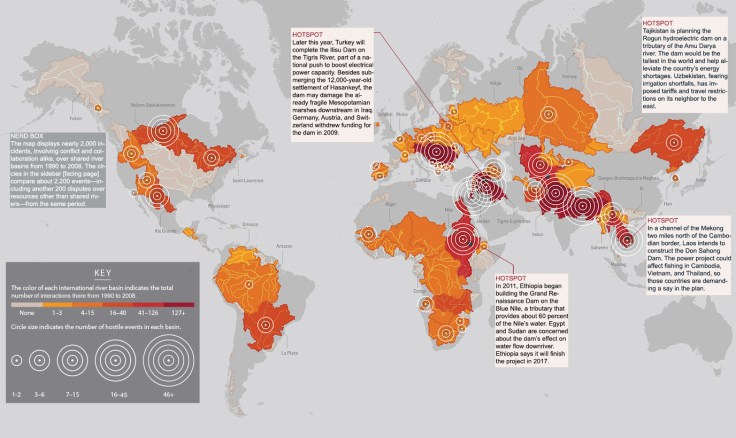
As the climate shifts, rivers will both flood and dry up more often, according to the latest report from the Intergovernmental Panel on Climate Change. Shortages are especially likely in parts of the world already strapped for water, so political scientists expect feuds will become even more intense. To track disputes worldwide, researchers at Oregon State University spent a decade building a comprehensive database of international exchanges—-both conflicts and alliances—over shared water resources. They found that countries often begin disputes belligerently but ultimately reach peaceful agreements. Says Aaron Wolf, the geographer who leads the project, “For me the really interesting part is how even Arabs and Israelis, Indians and Pakistanis, are able to resolve their differences and find a solution.”

Source: www.popsci.com

Too often we think of political conflicts within the framework of state borders; this mapping project divides the world into watersheds and forces us to look at global politics through a different and enlightening lens (Hi-Res image).  Oil might be the most economically valuable liquid resource, but water is the most critical for human habitation.  This infographic is reminiscent of this one, asking where the next ‘water wars’ might take place.   


Tags: water, political, unit 4 political environment, conflict, infographic

Philippines floods: the aftermath

See on Scoop.itGeography Education

The torrential rains that caused widespread flooding in Manila, the capital of the Philippines, have left the city reeling…

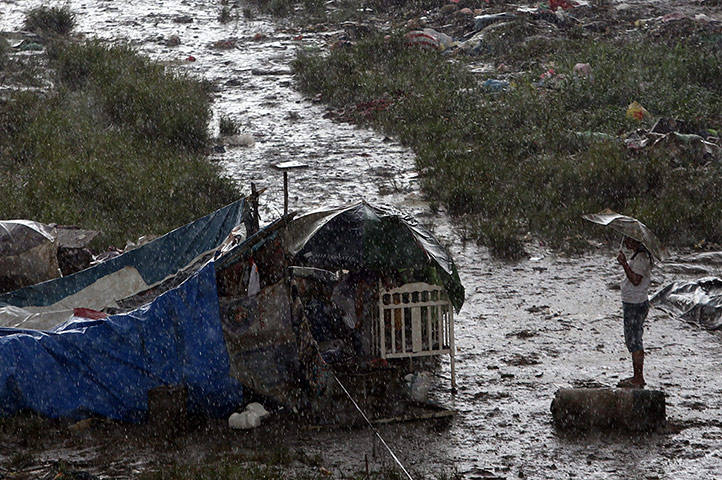
This is a grim, but captivating photo gallery showing how people adapt to environmental disasters.  Human settlements are vulnerable to disasters based on their environmental situations but people still display an amazingly capacity to be resilient in the face of danger.  “The torrential rains that caused widespread flooding in Manila, the capital of the Philippines, have left the city reeling. Thousands of people remain in evacuation shelters, and those who stayed in their homes during the deluge face a major clean-up operation.”

See on www.guardian.co.uk

Jared Diamond: Why societies collapse

Via Scoop.itGeography Education

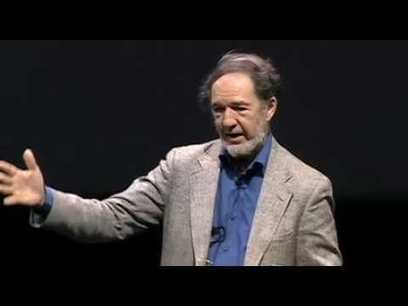
This talk (based on his controversial book, Collapse) explores the economic and environmental causes behind why a society that is overextended might collapse or recede from a golden age. Jared Diamond uses multiple historical examples such as classical Mayan civilization and Easter Island as well as modern societies such as Rwanda and Haiti, to argue that unsustainable management of the environmental resources might lead to short-term economic successes, but the environmental degradation may threaten the long-term economic viability of the economic system. This talk ties agricultural patterns, economic practices and political policies that can strengthen or weaken a society and the book looks to the past to assess the challenges of the present and future. This TED talk brings geographic concepts and spatial thinking to many of contemporary global issues.

Via www.youtube.com

Mapping the Anthropocene

Via Scoop.itGeography Education

As follow-up to an earlier post about how we have enter the age of the Anthropocene, this stunning map is a fantastic visual representation of the forces that merit the dawning of a new geologic age.  This map depicts the lights at night, major roads, railways power lines, oversea cables, airline routes and shipping lanes.  It also expands the areas according to population size.  For more on the production of this map, see the Globaia website.

Spotted on Living GeographyVia www.viewsoftheworld.net

Create a free website or blog at WordPress.com.

Up ↑