Via Scoop.it – Geography Education

This video (like the book of the same title) explores the course of human history to find the geographic factors that can help to explain the global inequalities between societies. Jared Diamond’s answer lies in the military strength (guns), superior pathogens (germs) and industrial production (steel) that agricultural societies were able to develop as the critical advantages over hunter/gatherer societies. The raw materials at the disposal of the societies inhabiting particular environments partially explain the economic possibilities before them.
 Diamond hypothesizes that the orientations of the continents play a critical role in the relative advantages among agricultural societies (East-West orientations allow for greater diffusion of agricultural technologies than North-South orientations since the growing seasons and ecology are more compatible), giving Eurasia an advantage over Africa and the Americas. The Fertile Crescent had native plant and animal species ideal for domestication, which then diffused to Europe. Societies that have more developed animal husbandry develop a resistance to more powerful germs. Consequently, when two societies come in contact those with the best resistance to the worse diseases are more successful. Similarly, industrial production depends on an agricultural surplus since specialization requires that some workers not needing to produce their own food to work on technological innovations. Societies that had agricultural advantages were able to invest in technologies (primarily steel) that would enhance their advantages over other societies, as seen during colonization. Societies that had the best environments had access to large plant eating mammals suitable for domestication and the most productive grains would be poised to produce more dangerous guns, germs and steel—the key resources for economic dominion resulting in global inequalities.
Diamond’s critics argue that the ‘geography hypothesis’ is environmental determinism that does not properly value human choices into the equation. Still, the core of this book is the search for connections between the themes of Geography with a spatial framework and the video is available via Netflix, public libraries and many other outlets.
Via www.pbs.org
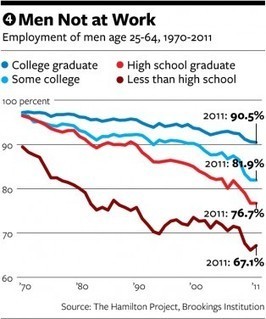

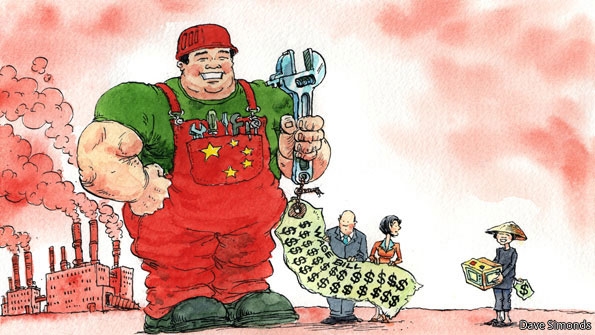
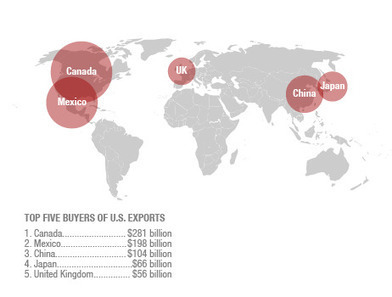
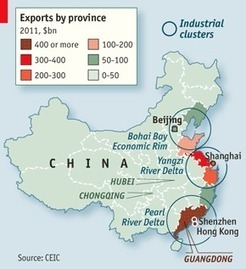 Manufacturing prices are rising, especially in the coastal provinces where factories have usually been agglomerated (also known as Special Economic Zones –SEZs). The more success that China has in manufacturing, land prices will go up, environmental and safety standards will increase. Collectively, this will mean that labor costs for the factories will also be increasing as Chinese workers are not only producing but also becoming consumers of manufactured goods with an increased standard of living. This is changing the spatial patterns of employment in China and will impact Chinese manufacturing’s global influence. Sarah Bednarz recommends this article as “a needed update on the new international division of labor (NIDL).” For more on the topic, see



 GEOGRAPHY EDUCATION