Search

GEOGRAPHY EDUCATION

Supporting geography educators everywhere with current digital resources.

Tag

migration

Human Population Through Time

It took 200,000 years for our human population to reach 1 billion—and only 200 years to reach 7 billion. But growth has begun slowing, as women have fewer babies on average. When will our global population peak? And how can we minimize our impact on Earth’s resources, even as we approach 11 billion?

Source: www.youtube.com

As stated in a Vox article, “The video above, from the American Museum of Natural History, shows essentially all of human history in just six minutes. It shows humanity spreading across the world over a few hundred thousand years — even as our population remained under 1 million. After that came the rise and fall of many empires and civilizations, plagues, wars, and so on — all the way to our current population of around 7 billion.”  Admittedly, the video is a bit “slow” in the middle, but that is a major part of the story of human population growth, and only serves to show how dramatic the population growth is at the end.  This video brings up more questions than it has answers.


Tags: demographicsmappingmigration, populationhistorical, unit 2 population 

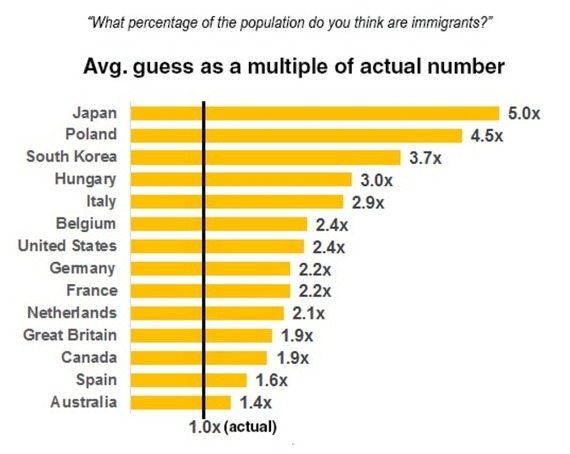
Why you’re probably wrong about levels of immigration in your country

In developed countries around the world, people think immigrant populations are much larger than they actually are.


Americans consistently mention immigration as one of the nation’s most pressing political concerns, and it has become a signature issue in the presidential campaign. But while many Americans consider immigration one of the biggest issues for the future president, surveys suggest that they also have little understanding of the scale of the problem. The United States wasn’t alone in this tendency to exaggerate.


Tags: migrationstatistics, political.

Source: www.weforum.org

Portraits Of NYC Immigrants Reveal Cultural Backgrounds

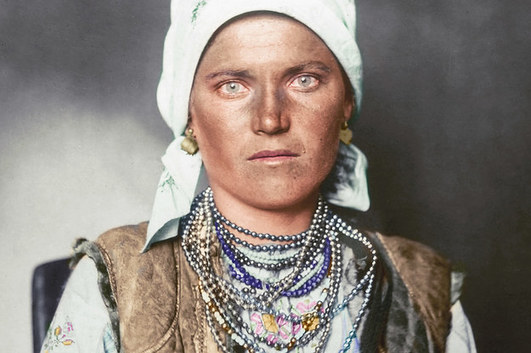
Here are just a handful of the 12 million men, women, and children who arrived at Ellis Island, New York, between 1892 and 1954 to start a new life in the USA, often dressed in their finest clothes. The portraits show immigrants wearing the national dress of their country of origin, including military uniforms from Albania, bonnets from the Netherlands, and clothing of Sámi people from the Arctic regions.

The photographs were taken between 1906 and 1914 by amateur photographer Augustus Francis Sherman, the chief registry clerk at Ellis Island, then the country’s busiest immigration station. In 1907 some of the photos were published by National Geographic.

Source: www.buzzfeed.com

These images show some of the diverse cultural backgrounds of turn-of-the-century American immigrants.  The formal clothing that represents the folk cultures that they came from hint at the massive cultural shift that these immigrants must have experienced upon arriving to the United States.  These photos of migrants wearing clothing representing their Old World lives right as they are about to culturally assimilate (or acculturate) into the New World are pictures I find quite poignant and personal.    


Tagsculturemigrationhistorical, folk culturesethnicity, unit 3 culture.

Being white, and a minority, in Georgia

“A generation ago, this Atlanta suburb was 95 percent white and rural with one little African-American neighborhood that was known as ‘colored town.’ But after a wave of Hispanic and Asian immigrants who were attracted to Norcross by cheap housing and proximity to a booming job market, white people now make up less than 20 percent of the population in Norcross and surrounding neighborhoods. It’s a shift so rapid that many of the longtime residents feel utterly disconnected from the place where they raised their children.”

Source: www.bostonglobe.com

This article touches on some pretty weighty (and sensitive) topics, but in a fairly nuanced manner.  Local ethnic neighborhoods change as international migration patterns bring in new residents and this demographic shift can is currently impacting national political parties.  That’s geography, various processes at a variety of scales that are all interconnected.  


Tags: migration, ethnicity, neighborhood, scale.  

What assimilation means to the ‘taco trucks on every corner’ Trump supporter

Marco Gutierrez, founder of Latinos for Trump, explains his view of immigration and assimilation to the US.

Source: www.pri.org

I’m NOT trying to use this platform to advance any partisan political agenda, but I think this brings up some very interesting narratives that are used when discussing migration and culture, which becomes a political ‘hot-button’ topic.  There is often cultural pressure on the migrant to assimilate into the host culture (or at least acculturate to a certain degree).  This larger national discussion centers on whether cultural assimilation should be expected of migrants and how much cultural diffusion the host culture will be receiving from the migrants.

Questions to Ponder: How are cultural norms placed on migrants?  What are some recent examples of migrants not wanting to assimilate that have led to political tension?

Tags: culture, cultural norms, migration, political.

When Mexico Was Flooded By Immigrants

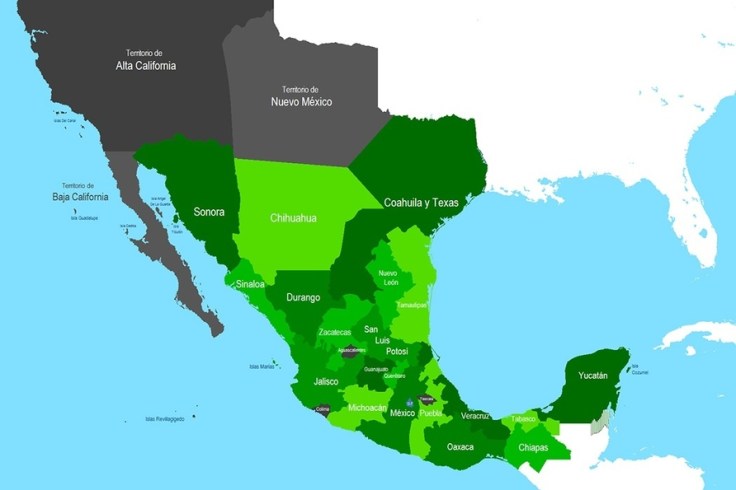
In the early nineteenth-century, Mexico had a problem with American immigrants.

Source: daily.jstor.org

A century and a half ago, the immigration debate and geopolitical shifts in power on the United States-Mexico border reflected a profoundly different dynamic than it does today.  This history has enduring cultural impacts on southwestern states that had the international border jump them.


Tags: culture, demographicsmigration, North Americahistorical, colonialism, borders, political.

Why Africa’s migrant crisis makes no sense to outsiders

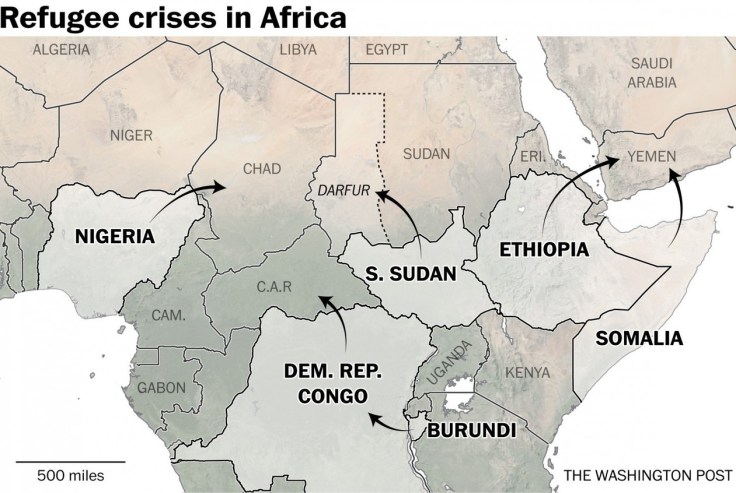
“Violence and insecurity are so bad that other war-torn countries have become sites of refuge.”


In 2015, nearly 100,000 Ethiopians and Somalis traveled by boat to Yemen, one of the world’s most dangerous countries. Last year, nearly 5,000 citizens of Congo, which is fighting powerful rebel groups, were seeking refuge in the Central African Republic, itself torn apart by civil war. And yet 10,000 Burundians have fled their country’s own growing civil unrest for Congo. Thousands of Nigerians escaping the extremist Islamist group Boko Haram have gone to Chad, where different strains of that same insurgency conduct frequent deadly attacks. 


Developing countries have long taken in a disproportionate number of the world’s refugees — roughly 80 percent, according to the United Nations. But even for migration experts and relief workers, the willingness of refugees to leave one war for another is shocking. It’s also proving an enormous challenge for humanitarian agencies, which are already overstretched and often not equipped to welcome refugees in countries that are still racked by conflict.


Tags: refugeesAfrica, migration, conflict, political, war

Source: www.washingtonpost.com

‘Normal America’ Is Not A Small Town Of White People

“The sense that the normal America is out there somewhere in a hamlet is misplaced: it’s not in a small town at all.  I calculated how demographically similar each U.S. metropolitan area is to the U.S. overall, based on age, educational attainment, and race and ethnicity.1 The index equals 100 if a metro’s demographic mix were identical to that of the U.S. overall.”

Source: fivethirtyeight.com

We often do imagine that your typical American is from the Heartland, and that very term, strengthens that connotation.  100 years ago that was true that your average American was one a farm or a small town, as 72% of Americans lived in rural areas.  Today, that is decidedly not the case but we still sometimes think (and act) as if it were (84% today live in urban areas).  The United States is urban, diverse, and bi-coastal in it’s primary demographic composition.   


Tag: rural, migration, USA, census.

U.S. Hispanic and Asian populations growing, but for different reasons

Both Hispanics and Asians been among the fastest-growing racial/ethnic groups in recent years, but since 2010, number of Asians have increased at a faster rate.

Source: www.pewresearch.org

It is often noted that the cultural composition of the United States is undergoing a shift, referred to by some as the “Browning of America.”  The story of Asian and Hispanic growth in the United States are occurring simultaneously, which makes many assume that they are growing for the same reasons.  The data clearly shows that this is not the case.  

Tags: migration, USA, ethnicity.

Blog at WordPress.com.

Up ↑