Search

GEOGRAPHY EDUCATION

Supporting geography educators everywhere with current digital resources.

Tag

poverty

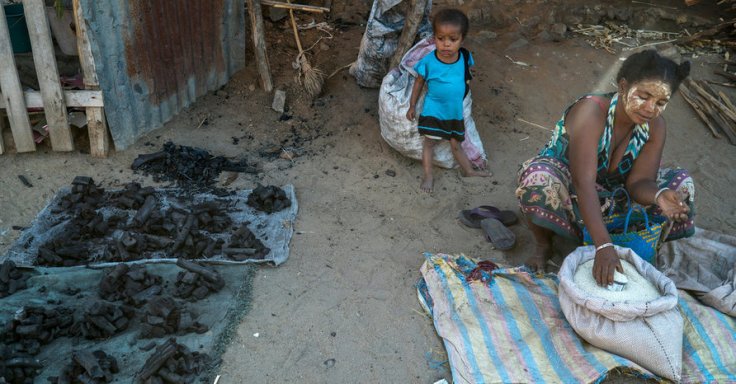
Africa’s Charcoal Economy Is Cooking. The Trees Are Paying.

In Madagascar, the booming charcoal business is contributing to deforestation and may exacerbate the effects of global warming.

Source: www.nytimes.com

Deforestation does not happen in a vacuum–it occurs in an economic, political, and historical context.  Rural Africans have less access to high value commodities and converting forests into charcoal is one of the few options (similar to the issue in Haiti).  The short-term economic gain for a few individuals leads to long-term environmental problems such as soil erosion, flooding, and habitat destruction for many species.  


Tags: biogeography, environmentecology, poverty, development, economic, labor, Madagascar, erosionAfrica, resourcespolitical ecology.

The Subtle Design Features That Make Cities Feel More Hostile

Think your city doesn’t like you? You’re right.

Source: www.atlasobscura.com

Geography explores more than just what countries control a certain territory and what landforms are there.  Geography explores the spatial manifestations of power and how place is crafted to fit a particular vision.  Homeless people are essentially always ‘out of place.’  These articles from the Society Pages, Atlas Obscura, the Atlantic and this one from the Guardian share similar things: that urban planners actively design places that will discourage loitering, skate boarding, and homelessness, which are all undesirable to local businesses.  This gallery shows various defensive architectural tactics to make certain people feel ‘out of place.’  Just to show that not all urban designs are anti-homeless, this bench is one that is designed to help the homeless (and here is an ingenious plan to curb public urination).  


Tags: urbanplanning, architecture, landscape, place, poverty.

How To Get A Country To Trust Its Banks

“It’s something you can see on every block in most major cities. You probably see one every day and never give give it a second thought. But in Yangon, Myanmar in 2013, an ATM was a small miracle. For decades, Myanmar was cut off from the rest of the world. There were international sanctions, and no one from the U.S. or Europe did business there.”

Source: www.npr.org

We often assume that one form of technology, a system, institute should work equally well where ever it is.  But the nuances of cultural geography mediate how societies interact with technological innovations, and as demonstrated in this Planet Money podcast, “People in Myanmar (Burma) were reluctant to use ATMs because they didn’t trust the banks. They weren’t sure that the machines would actually give them their money.”  


Tags: Burma, Southeast Asia, poverty, development, economicpodcast.

Cutting Haiti’s Forests

The major environmental problem facing Haiti’s biodiversity is explained, including video of tree-cutting within a national park.

Source: www.youtube.com

Deforestation does not happen in a vacuum–it occurs in an economic, political, and historical context.  Having successfully staged a slave revolution against France in 1806, they were ostracized from the global community (since the powers that be did not want to see slave rebellions or colonial uprising elsewhere) and were forced to look within for their own energy resources.  The nation’s forests were (and still are) converted into charcoal, leading to long-term environmental problems such as soil erosion, flooding, and habitat destruction for many species.  All of this increased  increased Haiti’s disaster vulnerability in the earthquake of 2010.     


Tags: Haiti, biogeography, environmentecology, video, poverty, development, economic, labor.

Haiti: From Recovery to Sustainable Development

//cdn.embedly.com/widgets/media.html?src=https%3A%2F%2Flink.brightcove.com%2Fservices%2Fplayer%2Fbcpid74508896001%3Fbctid%3D4651761801001%26secureConnections%3Dtrue%26secureHTMLConnections%3Dtrue%26linkSrc%3Dtwitter%26autoStart%3Dfalse%26height%3D100%2525%26width%3D100%2525&wmode=opaque&url=http%3A%2F%2Flink.brightcove.com%2Fservices%2Fplayer%2Fbcpid74508896001%3Fbckey%3DAQ%7E%7E%2CAAAAADraVCk%7E%2C_iousidU67F4p_MQwYYMqwTlZK8h4hDh%26bctid%3D4651761801001&image=http%3A%2F%2Fbrightcove.vo.llnwd.net%2Fe1%2Fpd%2F987386921%2F987386921_4651835419001_4651761801001-vs.jpg%3FpubId%3D987386921&key=359ed8ab27db4f02a128049b1f89d6a1&type=text%2Fhtml&schema=brightcove

“Since the 2010 earthquake, Haiti has successfully pulled through the humanitarian recovery phase and seen significant socioeconomic gains. Yet as Haiti moves toward long-term, sustainable development, the country faces significant challenges. The political system remains fragile, sustainable jobs are scarce, and the environment is still as vulnerable now as it was then.”

Source: link.brightcove.com

While this is primarily a promotional campaign for the UNDP’s efforts in Haiti, it nicely contextualizes the problems that Haiti faces before discussing how to improve the situation.  Some keys for the future include: 

  • Governance and Rule of Law
  • Recovery and Poverty Reduction
  • Disaster Risk Reduction
  • Environmental Management
  • Medical Outbreak Management  


Tagsdisasters, Haiti, NGOspoverty, development, video.

Are we better off than we think?

https://www.youtube.com/v/0fSiiAunc2A?fs=1&hl=fr_FR

“Despite global inequalities, most of the world is better off than you think – and better off than it has ever been before.  Watch Hans Rosling explain why.”


Tags: media, models, gapminderdevelopment, perspective.

Source: www.youtube.com

Guns, Germs and Steel

Via Scoop.itGeography Education

This video (like the book of the same title) explores the course of human history to find the geographic factors that can help to explain the global inequalities between societies. Jared Diamond’s answer lies in the military strength (guns), superior pathogens (germs) and industrial production (steel) that agricultural societies were able to develop as the critical advantages over hunter/gatherer societies. The raw materials at the disposal of the societies inhabiting particular environments partially explain the economic possibilities before them.

Diamond hypothesizes that the orientations of the continents play a critical role in the relative advantages among agricultural societies (East-West orientations allow for greater diffusion of agricultural technologies than North-South orientations since the growing seasons and ecology are more compatible), giving Eurasia an advantage over Africa and the Americas. The Fertile Crescent had native plant and animal species ideal for domestication, which then diffused to Europe. Societies that have more developed animal husbandry develop a resistance to more powerful germs. Consequently, when two societies come in contact those with the best resistance to the worse diseases are more successful. Similarly, industrial production depends on an agricultural surplus since specialization requires that some workers not needing to produce their own food to work on technological innovations. Societies that had agricultural advantages were able to invest in technologies (primarily steel) that would enhance their advantages over other societies, as seen during colonization. Societies that had the best environments had access to large plant eating mammals suitable for domestication and the most productive grains would be poised to produce more dangerous guns, germs and steel—the key resources for economic dominion resulting in global inequalities.

Diamond’s critics argue that the ‘geography hypothesis’ is environmental determinism that does not properly value human choices into the equation. Still, the core of this book is the search for connections between the themes of Geography with a spatial framework and the video is available via Netflix, public libraries and many other outlets.

Via www.pbs.org
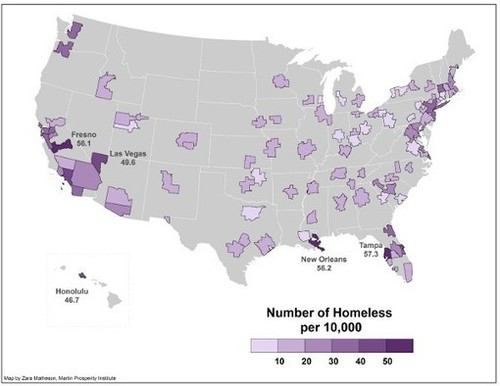
America’s Real Homeless Hotspots

Via Scoop.itGeography Education

“An estimated 600,000 Americans are homeless, but the spread isn’t uniform. Some cities have been hit harder than others.”

When I teach cultural geography, I discuss the idea that some thing are “in place” and others are “out of place” based on the cultural norms that change from place to place.  Homelessness is almost always “out of place.”   What parts of the built environment in your city are purposefully uninviting to the homeless?  What is the connection between the city (and urbanization) and homelessness?  What could (or should) be done in major metropolitan areas with high rates of homelessness?  What is the spatial patterns evident in the geography of homelessness?  What accounts for these patterns?  What surprises are in the data from the article?

Via www.theatlanticcities.com

MDG drinking water target being met is cause for celebration

Via Scoop.itGeography Education
Sanjay Wijesekera: This achievement shows that where there is a will, it is possible to truly transform the lives of hundreds of millions of people for the better.  

The MDG (Millennial Development Goal) to cut the global population that does not have access to clean drinking water was cut in half, and five years ahead of schedule. The World Health Organization and the United Nations are very pleased with this achievement, but it is a timely reminder of the developmental problems of poverty and access that still exist. For example, 783 million people still do not have access to clean drinking water.  3,000 children die each day from diarrheal diseases (usually from bad drinking water and poor sanitation). Although some success should be celebrated, the world, in the currently constituted social, economic and political framework, still does not provide the most basic of requirements for a sizable portion of humanity.
Via www.guardian.co.uk

Create a free website or blog at WordPress.com.

Up ↑