Search

GEOGRAPHY EDUCATION

Supporting geography educators everywhere with current digital resources.

Tag

supranationalism

Why the Ukraine Crisis Is the West’s Fault

Conventional wisdom in the West blames the Ukraine crisis on Russian aggression. But this account is wrong: Washington and its European allies actually share most of the responsibility, having spent decades pushing east into Russia’s natural sphere of interest.

Source: www.foreignaffairs.com

Ukraine is culturally, economically, and geographically connected with Russia. It is a territory that Russia cannot afford to lose as a part of their sphere of influence.  John Mearsheimer, in his article Why Ukraine Crisis is the West’s Fault, gives a detailed account of NATO expansion and how it effected the Russian demand for hegemony in East Europe. Ultimately it is his conclusion that it was this expansion that provoked the Russians, and the current crisis is on the hands of the West. The will of a majority of Ukrainians is be begin economically aligning more with EU/NATO countries.  Ukraine decided against Russia, and Russia responded with force.   Here is an article where scholars weigh in and mostly disagree with the author’s provocative assessment


Tags: op-ed, Ukrainesupranationalism, Russia, geopoliticspolitical.


Brexit: Reaction and the Aftermath

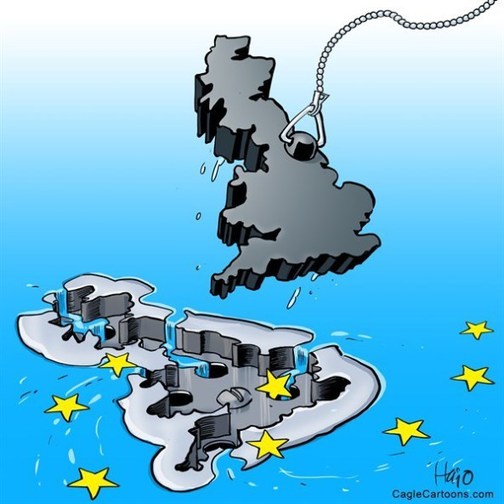
“The reactions to the Brexit have come in from all corners.  Since this was so shocking, newspapers articles that are insightful are using hyperbole in their titles to get our attention (Britain just killed globalization as we know it–Washington Post; Will Brexit mark the end of the age of globalization?–LA Times).  There have also been some excellent political cartoons and memes, so I wanted to archive a few of them here.”  


Tags: Europe, supranationalismglobalization, economic, political, images.

Source: geographyeducation.org

In stunning decision, Britain votes to leave the E.U.

The country opted to become the first ever to leave the 28-member bloc in a result that will send economic and political shockwaves across the globe.

Source: www.washingtonpost.com

The foundations of the European Union have their historical roots in World War II.  To ensure that European countries stop attacking each other, they knit their economies together and cooperated more on political and economic policies.   

The UK has narrowly voted to leave the European Union (52%-48%).  The Brexit (Britain + Exit) was expected to be close, but shows discontent with London.  The ‘Remain’ campaign dominated in London, Scotland and Northern Ireland while the ‘Leave’ campaign found its strength across England and Wales (see maps). 

The fallout of this vote is big and far-reaching.  The first global reaction was financial panic as numerous stock exchanges plummeted.  UK Prime Minister David Cameron will resign.  Already Spain is calling for joint control of Gibraltar (which they’ve wanted anyway) and using this as an opportunity to advance a Spanish agenda.  Many in Scotland chose to stay in the UK in part because they wanted Scotland to remain in the EU.  Another referendum on Scottish Independence feels eminent at this point.       

Still confused?  Here are answers to 9 frequently asked questions about the Brexit as well as a good overview from the Washington Post.


Tags: Europe, supranationalism, economic, political.

Can Europe Survive the Rise of the Rest?

The European Union will never manage to compete with China and other rising powers unless it unites politically, scales up and becomes a genuine giant.

This author argues that the main driving forces that led towards European unification in the decades after WWII are now gone or are diminished in importance.  As many of the economies of Europe, especially southern Europe are struggling, it is time for the European Union to rediscover and restructure it’s raison d’être–it’s reason for being–if it wants to continue to compete on a global level.

Tags: Supranationalism, Europe, political, unit 4 political and economic.

See on www.nytimes.com

What America Manufactures

Via Scoop.itGeography Education

“It’s a myth that the U.S. doesn’t make anything anymore.” 

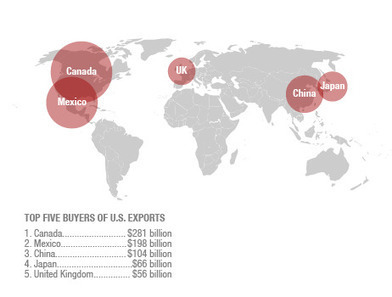
The U.S. economy still produces more through manufacturing tangible goods ($1.5 trillion) than it does in providing services ($600 billion) for the international market.  The maps and graphs in this article are great teaching materials.  The impact of NAFTA is shown powerfully in the regionalization of U.S. trade partners, making this salient material for a discussion on supranationalism as well.
Via www.npr.org

Blog at WordPress.com.

Up ↑