Happy Hanukkah from Brooklyn! Card design by Cheryl Berkowitz, via Subway Art Blog.
Tags: transportation, Judaism, religion, seasonal.
Source: nytransitmuseum.tumblr.com
Happy Hanukkah from Brooklyn! Card design by Cheryl Berkowitz, via Subway Art Blog.
Tags: transportation, Judaism, religion, seasonal.
Source: nytransitmuseum.tumblr.com
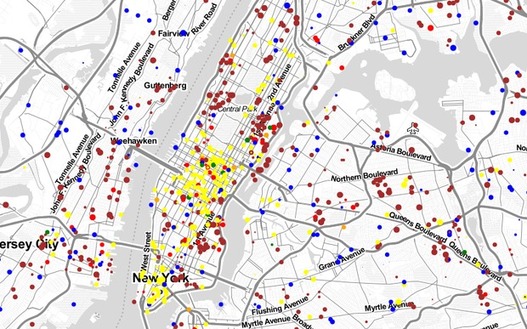
Watch the commuting patterns of New York, San Francisco and Los Angeles.
Source: www.citylab.com
This CityLab article and the embedded maps show the rhythms and patterns that make city life so beautifully complex. The Center for Advances Spatial Analysis has compiled numerous maps, time-lapse videos and other animations to show flows of urban life. These are great resources to visualize the ‘spaces of flows.’
Tags: mobility, mapping, visualization, urban, planning, unit 7 cities, transportation.
China has long depended on the U.S. breadbasket, importing up to $26 billion in U.S. agricultural products yearly. But increasingly, Chinese investors aren’t just buying from farms abroad. They’re buying the farms.
Source: www.mcclatchydc.com
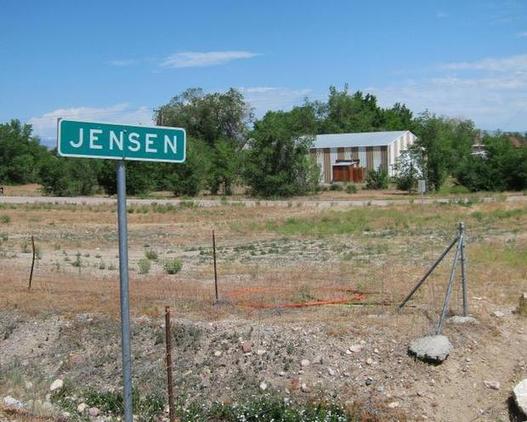
Globalization is often described as a homogenizing force, but is also pairs together odd bed fellows. A small Utah town near the Colorado border, Jensen is now home to the largest Chinese-owned hay farm in the United States. Utah’s climate is right for growing alfalfa, and China’s growing cattle industry make this a natural global partnership. Large container ships come to the United States from China, and return fairly empty, making the transportation price relatively affordable. Locally back in the United States though, water resources are scarce and many see this as a depletion of local water exported to China. Some states see this as a threat and are considering banning foreign ownership of farmland. This article shows the merging various geographic themes: the global and local, the industrial and the agricultural, the human and the physical.
Tags: agriculture, agribusiness, transportation, globalization, water, China, industry, economic, physical, Utah.
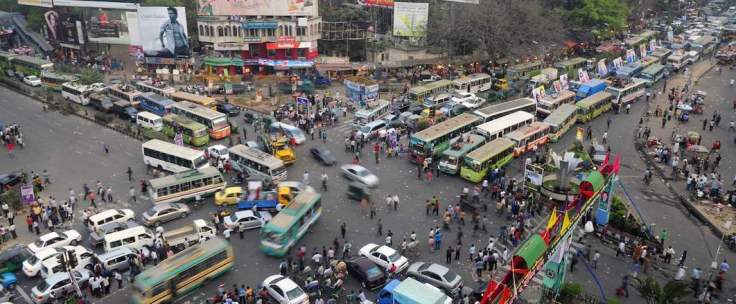
There are only 650 major intersections here—but somehow only 60 traffic lights.
Source: www.newrepublic.com
Dhaka is the capital of Bangladesh and (as I often tell my students) it is the biggest city that nobody has ever heard of. The infrastructure is so incredibly limited that traffic jams cost the city an estimated $3.8 billion in delays and air pollution. This is an excellent article to explore some of the problems confronting megacities.
Tags: Bangladesh, transportation, planning, density, South Asia, development, economic, megacities.
“When you combine a street and a road, you get a STROAD, one of the most dangerous and unproductive human environments. To get more for our transportation dollar, America needs an active policy of converting STROADs to productive streets or high capacity roadways.”
In this video, a road provides high connectivity between places, and a street is a diverse platform of social interactions that create a place. A ‘stroad’ can be likened unto a spork–it tries to do it everything but does nothing especially well. While you may debate the principle being shown, this video (found on Atlantic Cities) is a good way to show the spatial thinking that city planners need to utilize to improve the urban environment.
See on www.youtube.com