Search

GEOGRAPHY EDUCATION

Supporting geography educators everywhere with current digital resources.

Tag

water

China’s hungry cattle feasting on alfalfa grown on Utah farm

China has long depended on the U.S. breadbasket, importing up to $26 billion in U.S. agricultural products yearly. But increasingly, Chinese investors aren’t just buying from farms abroad. They’re buying the farms.

Source: www.mcclatchydc.com

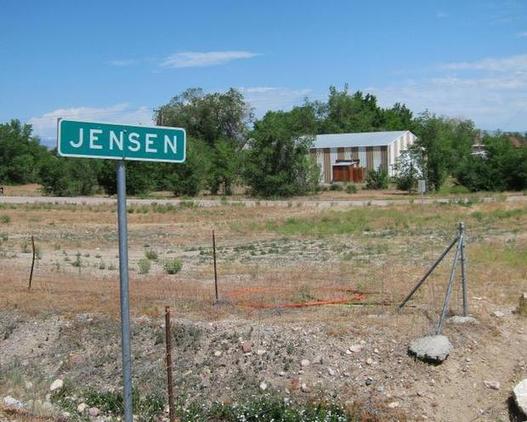
Globalization is often described as a homogenizing force, but is also pairs together odd bed fellows.  A small Utah town near the Colorado border, Jensen is now home to the largest Chinese-owned hay farm in the United States. Utah’s climate is right for growing alfalfa, and China’s growing cattle industry make this a natural global partnership.  Large container ships come to the United States from China, and return fairly empty, making the transportation price relatively affordable.  Locally back in the United States though, water resources are scarce and many see this as a depletion of local water exported to China.  Some states see this as a threat and are considering banning foreign ownership of farmland.  This article shows the merging various geographic themes: the global and local, the industrial and the agricultural, the human and the physical.         

Tags: agriculture, agribusinesstransportation, globalizationwaterChinaindustry, economic, physical, Utah.
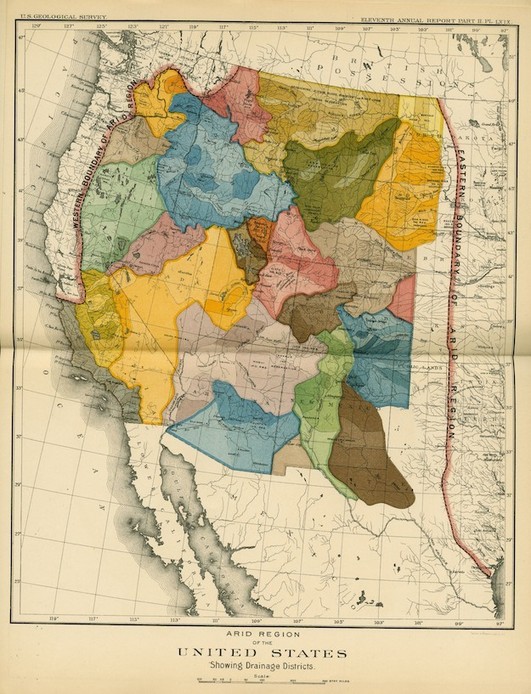
This 19th Century Map Could Have Transformed the West

Today’s drought-riven west would look very different if Congress had listened to John Wesley Powell

Source: www.newrepublic.com

Author of Mapping the Nation, Susan Schulten explains how western expansion failed to recognize the basic physical geographic reality of the United States–that the west is much drier than the east.  Given that much of the west, especially California, is in the midst of a severe drought, this article serves as a reminder to recognize that localized understandings of human and environmental actions are necessary.  Do you know what watershed you live in?  How does and should that impact us?   


Tags: physical, historical, California, water, environment.

America’s recent drought history, animated

“California’s drought just hit a new milestone: As of this week, 32.98 percent of the state is experiencing “exceptional” drought, making it the worst drought in the 14 years that the Department of Agriculture’s Drought Monitor has tracked data.”

Source: www.washingtonpost.com

The recent drought in California has only deepened and this Washington Post article shows an animated map that highlights the temporal and spatial patterns in the drought data (hint–it’s not pretty).  In a related note, May 2014 was the hottest May in recorded history.     

Questions to Consider: What are some reasons (both from human and physical geography) for this severe drought? What can be done in the short-term to lessen the problem? What can be done to make California’s water situation better for the next 50 years?

Tags: physical, weather and climate, consumptionCalifornia, water, environment, resources, environment dependurban ecology.

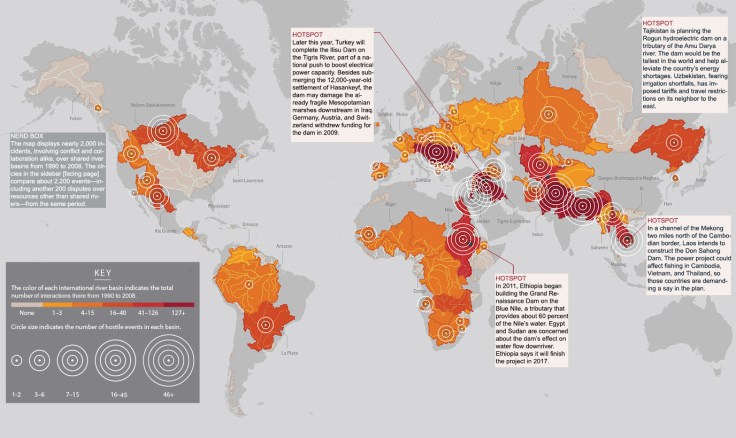
Where Will The World’s Water Conflicts Erupt?

As the climate shifts, rivers will both flood and dry up more often, according to the latest report from the Intergovernmental Panel on Climate Change. Shortages are especially likely in parts of the world already strapped for water, so political scientists expect feuds will become even more intense. To track disputes worldwide, researchers at Oregon State University spent a decade building a comprehensive database of international exchanges—-both conflicts and alliances—over shared water resources. They found that countries often begin disputes belligerently but ultimately reach peaceful agreements. Says Aaron Wolf, the geographer who leads the project, “For me the really interesting part is how even Arabs and Israelis, Indians and Pakistanis, are able to resolve their differences and find a solution.”

Source: www.popsci.com

Too often we think of political conflicts within the framework of state borders; this mapping project divides the world into watersheds and forces us to look at global politics through a different and enlightening lens (Hi-Res image).  Oil might be the most economically valuable liquid resource, but water is the most critical for human habitation.  This infographic is reminiscent of this one, asking where the next ‘water wars’ might take place.   


Tags: water, political, unit 4 political environment, conflict, infographic

U.S. Intelligence Says Water Shortages Threaten Stability

Via Scoop.itGeography Education

“Competition for increasingly scarce water in the next decade will fuel instability in regions such as South Asia and the Middle East that are important to U.S. national security, according to a U.S. intelligence report.”

Geographic thinking is about uncovering the spatial connections between issues that on the surface might not seem related.  Multinational river basins are a perfect example of environmental resources that demand international cooperation for successful management, and it regions of scarcity and population growth, it is easy to envision clashing viewpoints on how to fairly share such resources.

Discussion questions: What geographic themes are evident in this article? What geographic problems could exacerbate the problem? What could alleviate these issues in the future?

Via www.businessweek.com

Kiribati and Climate Change

Via Scoop.itGeography Education
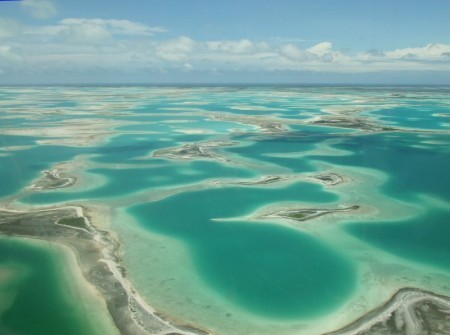
Fearing that climate change could wipe out their Pacific archipelago, the leaders of Kiribati are considering an unusual backup plan: moving the population to Fiji.  
How urgent is the issue of climate change?  That question is not only geographic in content, but the response might also be somewhat contingent on geography as well.  If your country literally has no higher ground to retreat to, the thought of even minimal sea level change would be totally devastating.
Via www.mercurynews.com

Water in -30C in Yellowknife, NWT

Via Scoop.itGeography Education
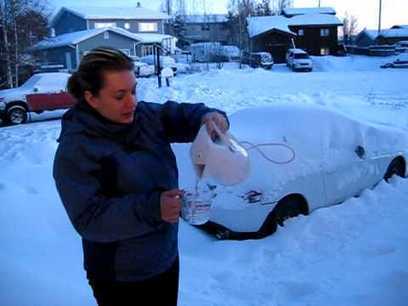
On a winter day in Yellowknife, Northwest Territories, Canada, I boiled water and threw it in the air where it “evaporated”…

Okay, the water did not actually ‘evaporate’ in -30C temperatures as stated in the video.  As mentioned on G+, “upon being dispersed into the air, the latent heat in the water’s mass dispersed more easily and thus more quickly, rapidly cooling it to the outside temperature and causing the droplets to become tiny crystalized ice, or plainly put, powdered snow, light enough to be carried away in the wind.”  What a great demonstration of the properties of water!
Via www.youtube.com

MDG drinking water target being met is cause for celebration

Via Scoop.itGeography Education
Sanjay Wijesekera: This achievement shows that where there is a will, it is possible to truly transform the lives of hundreds of millions of people for the better.  

The MDG (Millennial Development Goal) to cut the global population that does not have access to clean drinking water was cut in half, and five years ahead of schedule. The World Health Organization and the United Nations are very pleased with this achievement, but it is a timely reminder of the developmental problems of poverty and access that still exist. For example, 783 million people still do not have access to clean drinking water.  3,000 children die each day from diarrheal diseases (usually from bad drinking water and poor sanitation). Although some success should be celebrated, the world, in the currently constituted social, economic and political framework, still does not provide the most basic of requirements for a sizable portion of humanity.
Via www.guardian.co.uk

Create a free website or blog at WordPress.com.

Up ↑