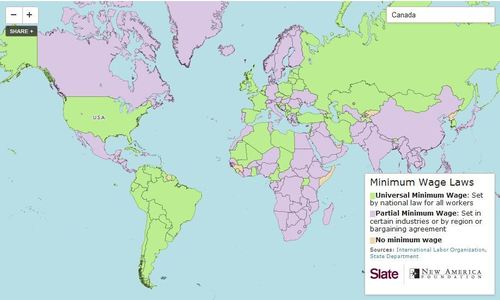
In a surprising move, President Obama proposed during the State of the Union address to increasing the federal minimum wage to $9 an hour.
This made many people ask the question “how many countries have minimum wages?”
See on www.slate.com
In a surprising move, President Obama proposed during the State of the Union address to increasing the federal minimum wage to $9 an hour.
This made many people ask the question “how many countries have minimum wages?”
See on www.slate.com
Given the recent meteor in Russia, interest has been high on the subject. Have you every wanted to simulate a the impact of a meteorite? Then this is just what you’ve always wanted. If you would rather to see an incredibly entertaining clip from the Daily Show, (disclaimer: it’s a VERY irreverant look at the the dash-cam footage from Russia that many just discovered after the meteor hit last week) then knock yourself out.
See on www.purdue.edu
Like a flag, can you represent? From the most famous flags to the more obscure, challenge your knowledge of flags from around the world in our fun Flags Quiz!
See on www.quizfortune.com
This is a rich and fascinating angle on history enhanced by a bounty of beautiful reproductions. Rare is a book this aesthetically pleasing and intellectually original.
“Maps are not merely distilled representations of geographic realities. Over time, they come to represent an organic bundling of history: reconstructed, imagined, and manipulated. Historically, they have been the tools with which expanding empires have legitimized their conquests, imposed identities, and created administrative order, and with which victims have constructed alternative narratives and salvaged their own national memories. Never was this truer than in the period in the eighteenth and nineteenth centuries when a burgeoning Romanov empire joined Austria and Prussia in wiping Poland-Lithuania from the map and absorbing it into their swelling realms. Seegel intricately analyzes the cartography of imperial Russia and Poland-Lithuania as the science evolved and historical demands were placed on it. This is a rich and fascinating angle on history enhanced by a bounty of beautiful reproductions. Rare is a book this aesthetically pleasing and intellectually original. Seegel should be congratulated for creating it, and the University of Chicago Press, for producing it.” You may also see this title on Amazon.
Tags: book reviews, Russia, cartography, historical.
See on www.foreignaffairs.com
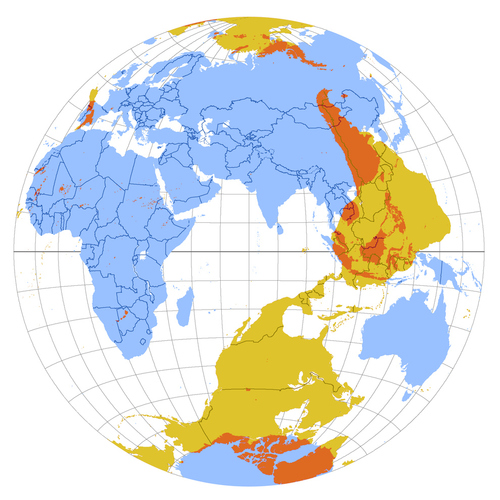
“Some prime examples of fascinating maps.”
This is a very entertaining collection of maps. Shown above is a map that displays what is on the other side of the Globe (see, it’s the Argentinians and Chileans that would “dig a hole to China”). Superimposed on every location is its antipod (location directly opposite on the other side of the Earth). The journal of radical leftist geography is entitled Antipode, implying that they see the world through a different perspective and plays off of this concept.
See on www.buzzfeed.com
Is there racism and discrimination in Japan? I was surprised to find out that almost all of my high school students (about 1000 students) were not aware of t…
This YouTube video has caused a tremendous amount of controversy in Japan, where most see discrimination as a problem in other societies. For some more context on the controversy, read this great Washington Post article on the subject.
See on www.youtube.com
The Road Map Project brings together experts in geography, education, and research to chart a course for the large-scale improvement of K-12 geography education in the U.S.
Some great educators and geographers have collaborated to design a “road map” for the future of geography education. This is their report.
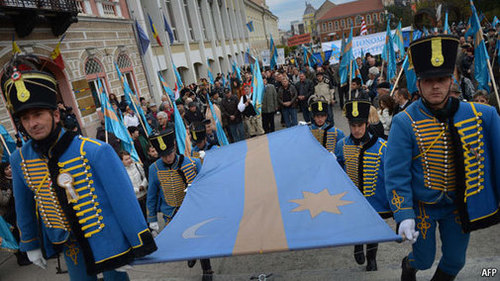
“Mr Füzes had voiced support for the Székler people, a group of ethnic Hungarians who live in Transylvania, after two Romanian counties banned the display of the Székler flag (pictured above with men in hussar uniform) on public buildings. Zsolt Nemeth, Hungary’s state secretary for foreign affairs, described the ban as an act of “symbolic aggression” and called for local councils in Hungary to show solidarity by flying the Székler flag from town halls. The Hungarian government then raised the Székler flag above Parliament, further enraging Bucharest…”
Flags are important symbols of cultural identity and displaying them can be a strong political statement. For Hungarians, displaying symbols of a “Greater Hungary” shows some desire to for irredentism–to redeem Hungarians of the ‘wrong’ side of the border. For those Hungarians in Romania this is an act of defiance that show that they want greater autonomy.
For sports fans, ESPN did a “30 for 30” documentary on the early 90’s Yugoslavian basketball team that was a major talent (1990 World Champions) but was torn apart as devolutionary forces fractured the countries and the once-teammates were estranged after what some perceived as disrespectful acts to the Croatian national flag. Vlade Divac (a Serbian) was pitted against some of his best friends from Croatia as the civil war was playing itself out on the court as well. This is a great way to get a sports fan to learn about ethnic conflict and cultural symbols (“Once Brothers”–$1.99, free for Amazon Prime users).
Tags: political, conflict, devolution, autonomy, Europe, culture.
See on www.economist.com
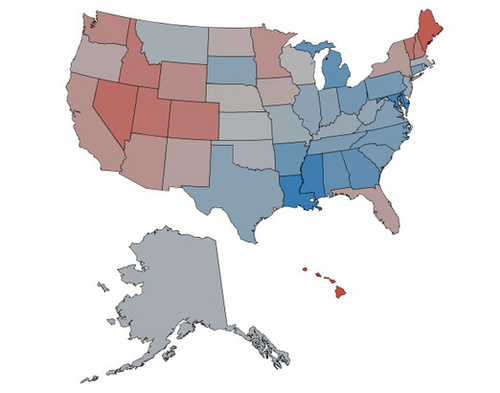
The happiest city in America is Napa, California — and the saddest all swear too much.
Hawaii, Maine, Nevada, Utah, Vermont–congratulations on being the happiest states according to a Twitter metric. Louisiana, I’m just sad typing that you are the saddest of all states.
See on www.theatlantic.com