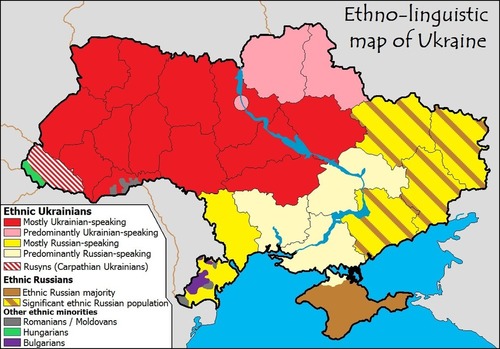
“This map illustrates the country’s deep division – and why the protests might not be what you think. Ukraine has been wracked by protests for two-plus weeks over President Viktor Yanukovych’s decision to reject a deal for closer integration with the European Union. Russian President Vladimir Putin had been pressuring Yanukovych to quit the EU deal and join with a Moscow-led trade union of former Soviet states instead. Will Ukraine’s future be with Russia or with Europe?”
The country of Ukraine is both ethnically and linguistically divided and since the fall of the Soviet Union, the partisan politics have mirrored these divisions. The northwestern portion of the country is primarily ethnic Ukrainian and with the majority speaking Ukrainian. This section of the country that is hoping to strengthen economic and political ties with the EU and face Europe; those that aren’t as bullish on the EU here at least want to explore other options so they aren’t overpowered by Moscow’s shadow. The southeastern portion of Ukraine primarily speaks Russian with sizeable ethnic Russian populations (although many ethnic Ukrainians speak Russian here); not surprisingly, this is the part of the country that would rather join in a economic union with Russia and other former Soviet Republics, or at least not turn their backs on Moscow.
Questions to Ponder: Why are language and ethnicity often tied to political orientation? Why might trading with all economic partners not be as viable an option?
See on www.washingtonpost.com


 GEOGRAPHY EDUCATION
Leave a comment