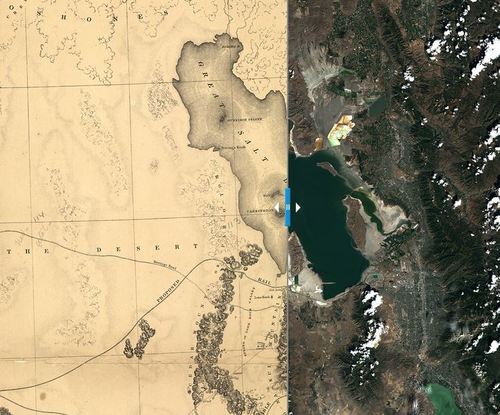
With imagination one can explore and understand how very different life was for people in the United States before the Golden Spike was hammered into the ground in Utah in 1869. That was a much-hailed event that knitted the country together by linking two railroad lines from the eastern and western ends of the continent. Just ten years earlier, when the map at left was made, life was more centered on local transactions. It was hard for families with children to visit friends because travel in this part of the country was slow and arduous, over bumpy dirt roads by horse and wagon. A life involving daily travel for several miles from home each day to work was not feasible. Yet change was in the air even then.
Engineers had put together the recently-invented steam engine with the practicality of a road made of rails and cross-ties, and businessmen and politicians were envisioning a national transportation network – a railroad system. What a difference that could make in the life of this still-young nation! The federal government began sending dozens of mapmakers across the country to identify and draw the best routes for a national railroad in an initiative called “the Great Reconnaissance.”
The national railroad system brought a revolution in commerce and mind-set to the United States in the 19th century. Landsat technology has fomented a revolution of its own, making hundreds of maps of landscapes around the globe daily and becoming an integral part of our national infrastructure just as the railway system and automobile Interstate Highway Systems did in previous eras. With Landsat we have our own 21st century Great Reconnaissance.
See on landsat.gsfc.nasa.gov



 GEOGRAPHY EDUCATION
Leave a comment