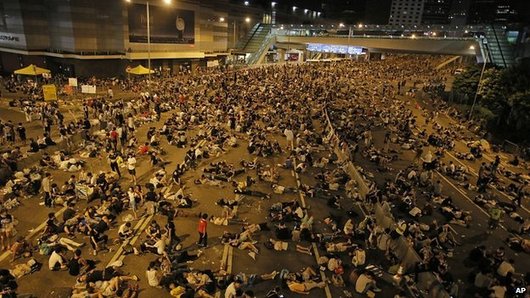
“Tensions escalated on Sunday when the broader Occupy Central protest movement threw its weight behind student-led protests, bringing forward a mass civil disobedience campaign due to start on Wednesday. China’s leaders must be sitting uncomfortably in Beijing. As long as the protests continue, there is a chance they will spread to the mainland, where many are unhappy with one-party rule. But if the protesters hold their ground, how far will Beijing allow events to spiral before getting directly involved?”
Source: www.bbc.com
Hong Kong is probably the only place under the control of the People’s Republic of China (PRC) where protests of this type against the government could have started. Hong Kong, once administered by the UK, was turned over to the PRC, but with special conditions that grant Hong Kong residents greater freedoms than those available the rest of the citizens of mainland China (One China, two systems). Hong Kong students are protesting for full universal suffrage and for the right to choose their own candidates–something that Beijing is not willing to concede; some autonomy yes, power to make further breaks with Beijing? No. In addition to political control, some students feel economically marginalized by Beijing’s policies. In 1997, when Hong Kong became a part of the PRC, it represented 18% of the GDP of the country; today it is only 3% of the PRC’s economic output. The Chinese govt. is currently blocking Instagram, trying to prevent the spread of viral images that show discontent. Still have questions? You are not the only one as the world turns it’s gaze to China wondering about the strength of the Communist Party and the collective will of the protestors.



 GEOGRAPHY EDUCATION
Leave a comment