Search

GEOGRAPHY EDUCATION

Supporting geography educators everywhere with current digital resources.

Month

February 2015

Is it all over for Greece in the EU?

Robert Peston crunches the numbers as finance ministers meet for vital loan talks.

Source: soundcloud.com

This audio clip shows how the Greek economic crisis is an issue on the national, regional, and global scales.  This BBC video and article also provide some nice context, asking the question, what would happen in Greece quits the Euro? 

Tags: Greece, Europe, supranationalism, currency, economic, podcast

Global Shipping Traffic Visualized

As stated in this NPR article: “The video shows satellite tracking of routes superimposed over Google Earth. It focuses on some of the main choke points for international shipping, such as the Strait of Malacca on the southern tip of Malaysia, Suez Canal, the Strait of Gibraltar and Panama Canal. It’s a good reminder that about 90 percent of all the goods traded globally spend at least some of their transit time on a ship.”

Tags: transportation, globalization, diffusion, industry, economic, mapping, video, visualization.

Source: www.youtube.com

Geographic data can be so beautiful…you’ve got to watch this.

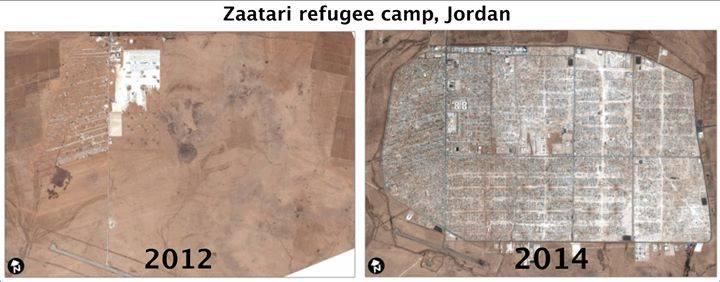
Can these satellite images save lives? The U.N. thinks so

Stunning images taken from space put the world’s crises into context.

U.N. satellite imagery has tracked the evolution of the camp since its creation. The exponential growth is remarkable.  The refugee camp is rapidly taking the shape of a real city — structured, planned and even separated into neighborhoods and subject to gentrification.

Tags: refugees, migration, conflict, political, warsquatter, urban, unit 7 cities, remote sensing, geospatial. 

Source: www.washingtonpost.com

The Dumbest Question You Can Ask a Scientist

The scientific discoveries that were made with no thought of making money often turn out to be the most profound science, and, ironically, often lead to a gold mine.

The dumbest question you can ask a scientist—or any other creator, inventor, or discoverer—about his or her work is, “What’s the economic value?”  The mistake at the heart of the dumbest question is this: confusing unknowable value with no value. History shows that basic science brings the greatest economic value of all—Hertz and Dobson are two of many examples.

Source: www.thedailybeast.com

Human Landscapes of Canada

Canada is a massive country, yet it has one of the lowest population densities in the world. Despite this, Canadians have made a wide impact on their land, much of it visible from aerial and satellite photography. Hydroelectric facilities, roads, mines, farms, ports, resource exploration, logging, canals, cities, and towns have altered much of the landscape over the years.

Source: www.theatlantic.com

This is a great set of images showing the human impact on the environment, with a special nod to our neighbors for the north.  These images have an artistic beauty and I hope every geographer maintains a sense of wonder at the details and beauty of the Earth. 

TagsCanada, images, art, remote sensing, land use, landscape

What is the oldest city in the world?

 Mark Twain declared that the Indian city of Varanasi was older than history, tradition and legend. He was, of course, wrong. So which exactly is the world’s most ancient continuously inhabited city?

Source: www.theguardian.com

This is a nice article that, on the surface, discusses which is the oldest city among competing claims.  However, it also serves as an entry point to explore the history of urbanization in the ancient world and the requirements for the earliest permanent settlements.

Tagshistorical, urban, urbanism, unit 7 cities.

With Porches And Parks, A Texas Community Aims For Urban Utopia

Austin’s Mueller neighborhood is a new-urbanist dream, designed to be convivial, walkable and energy-efficient. Every house has a porch or stoop, and all the cars are hidden away.

After moving here, respondents said, they spend an average of 90 fewer minutes a week in the car, and most reported higher levels of physical activity.  The poll results seem to validate new-urbanist gospel: good design, like sidewalks, street lighting, extensive trails and parkland, can improve social and physical health.  Part II: A Texas Community Takes on Racial Tensions Once Hidden Under The Surface.

Tagshousing, urban, planning, urbanism, unit 7 cities, neighborhoodpodcast.

Source: www.npr.org

Tourism in Belfast, Ireland

“Belfast has been coming into its own in the last few years, developing a vibrant restaurant scene, award-winning architecture and a new cosmopolitanism.”


TagsIreland, culture, architecture, tourism, Europe.

Source: www.youtube.com

Italy is a ‘dying country’ says minister as birth rate plummets

New figures show the lowest total number of births since the formation of the modern Italian state

Fewer babies were born in Italy in 2014 than in any other year since the modern Italian state was formed in 1861, new data show, highlighting the demographic challenge faced by the country’s chronically sluggish economy.  National statistics office ISTAT said on Thursday the number of live births last year was 509,000, or 5,000 fewer than in 2013, rounding off half a century of decline.  The number of babies born to both natives and foreigners living in Italy dropped as immigration, which used to support the overall birth rate, tumbled to its lowest level for five years.

TagItalyEurope, declining populations, population, demographic transition model.

Source: www.theguardian.com

Blog at WordPress.com.

Up ↑