Search

GEOGRAPHY EDUCATION

Supporting geography educators everywhere with current digital resources.

Month

March 2015

Egypt, Ethiopia and Sudan sign deal to end Nile dispute

Three African leaders sign an initial deal to end a long-running dispute over the sharing of Nile waters and the building of Africa’s biggest hydroelectric dam.

Source: www.bbc.com

85% of the Nile’s water comes from the Blue Nile that originates in the Ethiopian highlands–it is the Blue Nile that Ethiopia has been working on damming since 2011.  The Grand Ethiopia Renaissance Dam (GERD) will be located near the border with Sudan (see in Google Maps).  Prior to this trilateral agreement, Egypt and Sudan received the majority of the Nile’s waters because of outdated colonial-era treaties that ignored upstream riparian states.  This explains why in the past, Egypt was so adamantly opposed to Ethiopia’s plan fearing that their water supply with be threatened.  Today though, the Egyptian President said, “We have chosen cooperation, and to trust one another for the sake of development.”  


Tags: Ethiopia, Africasupranationalism, political, development, environment, water, energy, borders.
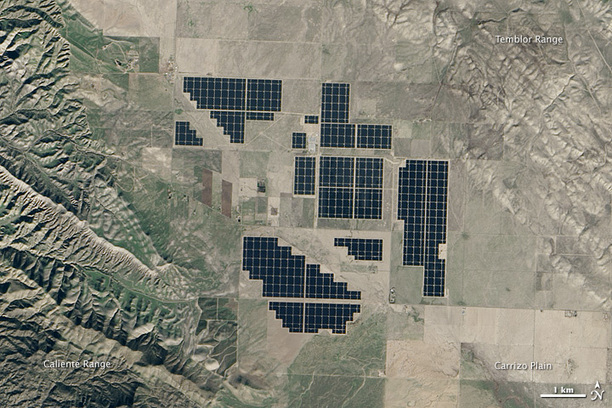
Topaz Solar Farm, California

The new 550 megawatt facility in California produces enough electricity to power 180,000 homes.

The modules are part of Topaz Solar Farm, one of the largest photovoltaic power plants in the world. At 9.5 square miles (25.6 square kilometers), the facility is about one-third the size of Manhattan island, or the equivalent of 4,600 football fields.

Construction at Topaz began in 2011. The plant was mostly complete by November 2014, when it was turned on and began to generate electricity.

Tagsenergy, resources, unit 6 industry, California, images, remote sensing.

Source: earthobservatory.nasa.gov

Quiz on the Differences Between Sunni and Shia Islam

Most of the world’s major religions are made up of multiple sects or denominations, and Islam is no different. Islam’s two major sects are the Sunnis and the Shiites, and the division and interplay between the two is a major factor in the geopolitics of the Middle East. How well do you understand Sunni and Shiite Islam? Take our quiz and find out!

Source: www.csmonitor.com

The ghosts of religious wars past are rattling in Iraq; The geography of the Sunni-Shiite division is incredibly important for a good understanding of world regional geography as well as modern geopolitics. This NPR podcast examines the  historical and religious aspects of this split to then analyze the political and cultural implications in the Middle East today.  Additionally this Pew Research article highlights the 5 countries where the the majority of Muslims are Shiite, with some good demographic data to add to the analysis.  Take this quiz to test your knowledge.  

Tags: MiddleEast, Islamreligionhistorical, culture.

Redrawing the map of Europe

“Fantasy cartography: An animated redrawing of the map of Europe.
Imagine a world in which countries could move as easily as people. A suggestion for a rearranged Europe.”

Source: www.youtube.com

What makes a region a region?  What criteria is being used?   This video could be used to ask questions on how they would create regions.  Which places will get split apart and which places will be lumped together? 

Tags: regions, Europe.

Roam the World in (Almost) Real Time

A groundbreaking Mapbox project ushers in a new era for online cartography.

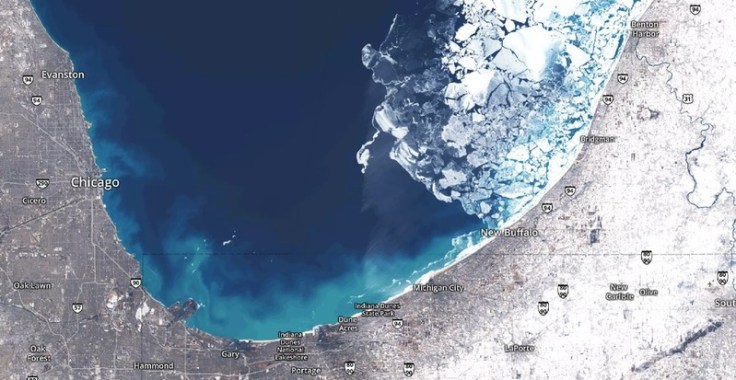
On Google Earth, the seasons rarely change. Most anywhere a digital traveler goes, the sky is cloudless and the grass is green. No snow on the ground in Iowa. No fire in Valparaiso. It’s a big gap between the world as it is and as it’s mapped.

Launched Thursday, a landmark project from Mapbox has changed the summertime paradigm for online cartography. Landsat-live reveals the planet’s surface in real time and in stunning resolution, fed by a constant stream of public-domain imagery from NASA’s Landsat 8 satellite.

Source: www.citylab.com

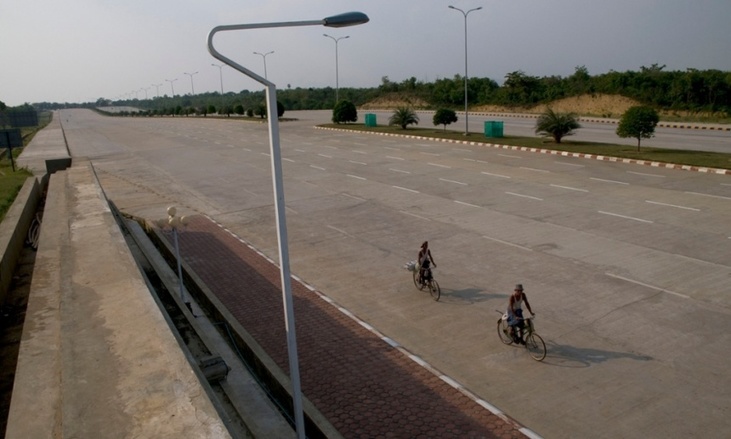
Burma’s bizarre capital: a super-sized slice of post-apocalypse suburbia

The purpose-built city of Naypyidaw – unveiled a decade ago this year – boasts 20-lane highways, golf courses, fast Wi-Fi and reliable electricity. The only thing it doesn’t seem to have is people, report Matt Kennard and Claire Provost

Tags: Burma, Southeast Asia, urban, urbanism.

Source: www.theguardian.com

Vintage Video of NYC

“Oldest and most incredible footage of New York City ever, including where the WTC would be built. With added maps carefully researched to show where the camera was. 28 shots of classic footage circa 1905.” http://tinyurl.com/ohsuobg

Tags: urban, historicalarchitecture, landscape, NYC.

Source: www.youtube.com

This Louisiana radio station likes their news ‘en Franglais’

For more than half a century, one small commercial radio station has been keeping French alive in the bayous of Louisiana.

Source: www.pri.org

This PRI podcast on Louisana’s cultural geography goes nicely with this NY Times article on the same topic.    

Tagslanguage, folk cultures, culture, podcast.

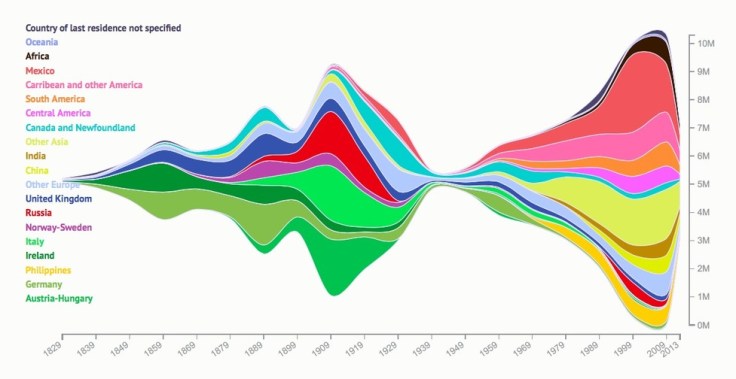
200 years of immigration to the U.S., visualized

“Where have immigrants to the U.S. come from? Natalia Bronshtein, a professor and consultant who runs the blog Insightful Interaction, created this fascinating visualization of the number of immigrants to the U.S. since 1829 by country of origin.  The graph hints at tragic events in world history. The first influx of Irish occurred during the potato famine in 1845, while the massive influx of Russians in the first decade of the 20th Century was driven by anti-Semitic violence of the Russian pogroms (riots). Meanwhile in the Austro-Hungarian Empire, army conscription and the forced assimilation of minority groups drove people to the U.S. in the early 1900s.  Since WWII, Central and South America and Asia have replaced Europe as the largest source of immigrants to the U.S. Immigration shrunk to almost nothing as restrictions tightened during WWII, and then gradually expanded to reach its largest extent ever in the first decade of the 21st Century.”

Tags: migration, historical, USAvisualization.

Source: knowmore.washingtonpost.com

Blog at WordPress.com.

Up ↑