Search

GEOGRAPHY EDUCATION

Supporting geography educators everywhere with current digital resources.

Author

sethdixon

I am a geography professor at Rhode Island College.

AP Human Geography FRQ and Exam Breakdown

Source: www.thehumanimprint.com

This outstanding infographic from the Human Imprint is an excellent summary of the AP Human Geography exam and gives some valuable insights to prepare students to pass the exam.  This is well worth the read for any APHG teacher.    


TagsAPHG, infographic.

The true size of …

This site is used to highlight the distortion issues caused by the Mercator map projection. It can be used to show the true size of countries

How it Works

1. Enter a country or state name

2. Hover over selection for size information

3. Click on selection to drag

4. Right-click on selection to delete

Tags: mapping, visualization, map projections, cartography, perspective.

Source: thetruesize.com

Map Projection Transitions

“In some ways, all 2D maps of Earth are interrupted at some point, even if it’s just along the antimeridian at 180°. Interruptions are often in areas of less interest e.g. oceans for a land-focused map.”

Source: www.jasondavies.com

No screenshot could do justice to this animation.  It transforms a map of the world from one map projection to another, and in the 5 second interval it ‘spins the globe’ to give you a sense of the the spatial distortions inherent in all projections.  This is but one of the many visualizations from Jason Davies mapping project.   

Tags: mapping, visualization, map projections, cartography, perspective, unit 1 Geoprinciples.

Lakes On A Glacier

“How deep is that icy blue water on Greenland’s ice sheet? Dr. Allen Pope, of the National Snow and Ice Data Center, is using data from the NASA/USGS Landsat 8 satellite to find out. In this video, Dr. Pope shares what he sees when he looks at a Landsat image of the Greenland ice sheet just south of the Jakobshavn Glacier.

Because the lakes are darker than the ice around them, they absorb more energy from the sun. A little bit of melt concentrates in one place, and then melts more, establishing a feedback mechanism accelerating the growth of the lake. When the lakes get big enough they can force open fractures that then drill all the way down to the bed of the glacier, transporting this water to the base where it can temporarily speed up the flow of the ice.”

Tags: physical, geomorphology, landforms, erosion, climate change, Greenland, remote sensing, geospatial.

Source: www.youtube.com

The Food Capitals of Instagram

Explore the popularity of some of the world’s favourite foods on Instagram. Discover Instagram’s capital of curry, which cities are big on burgers, and where pulled pork is most prolific.

Source: photoworld.com

I was talking to a good friend about the geographic distribution of poutine after watching the silliest YouTube video. (Montreal is famous for it’s poutine, but is in equally widespread throughout Quebec?  Canada?  Is there a core/domain/sphere areas to be mapped? These are the questions that plague geographers.).  True, this map has it’s limitations; Instagram hashtag data isn’t normalized so the biggest cities tend to pop out more easily, access/use of Instagram isn’t uniform, etc.  Still, what a great map to show some geographic applications of social media data.  This sort of map also nicely shows the spatial concepts of region, diffusion, concentration and distribution.  


Tags: visualizationsocial media, mapping, culturediffusion, popular culture, regions, food.

Tourists Vs Locals: Cities Based On Where People Take Photos

“Tourists and locals experience cities in strikingly different ways. To see just how different these two worlds are, have a look at the map of Washington D.C. above based on where people take photos. The red bits indicate photos taken by tourists, while the blue bits indicate photos taken by locals and the yellow bits might be either.”

Source: brilliantmaps.com

It amazes me how the same city can provide such diverse experiences to so many people.  Growing up in San Diego, going to the zoo was only our family’s radar when company was over and they wanted to “see San Diego.”  Their vision of the place, what is iconic and what is quintessentially symbolic of that place, was different from my own. 


Questions to Ponder: What are some other ways (besides local/tourist) that a place can be experienced by other groups?  How many of these 136 cities can you identify from these tourist/local patterns? 

Tagsmapping, social media, urban, placeculture, landscape, tourism

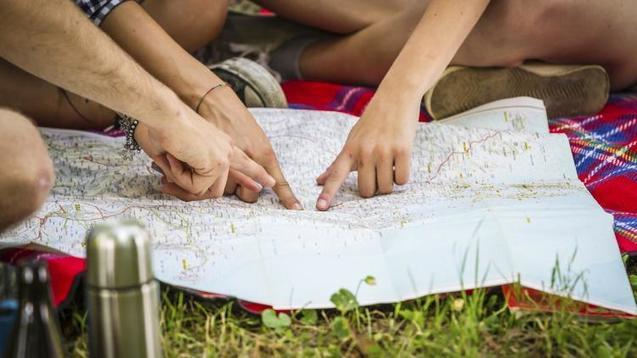
Paper maps still relevant even with computers, GPS

“The president and owner of Mapping Specialists, David Knipfer, said maps are more prevalent in society now than they’ve ever been, from turn-by-turn direction apps, to restaurant searches, to social networks that pinpoint users’ locations. Maps aren’t going away, but people are learning to use them in a different way, Knipfer said.”

Source: host.madison.com

Organizing APHG content

“Digital resources to strengthen the quality and quantity of geography education in classrooms the world over.”

Source: www.scoop.it

Since this site is updated daily and organized chronically, finding some of the best posts from the past can be difficult for someone new to the site.  Some of the posts are on current events and not as relevant several years after the fact, but I want to make it easier to find the older posts that are still relevant today more easily accessible.  I’ve organized some of more ‘evergreen’ posts by the AP Human Geography curriculum unit headings as well as ‘shortlist’ for each unit.  Additionally, this Story Map will also guide you on how to get more out of this website.         

  1. Geography: It’s Nature and Perspectives (shortlist)
  2. Population and Migration (shortlist)
  3. Cultural Patterns and Processes (shortlist)
  4. The Political Organization of Space (shortlist)
  5. Agriculture, Food Production and Rural Land Use (shortlist)
  6. Industrialization and Economic Development (shortlist)
  7. Cities and Urban Land Use (shortlist)

Forget Sykes-Picot. It’s the Treaty of Sèvres That Explains the Modern Middle East.

Ninety-five years ago today, European diplomats gathered at a porcelain factory in the Paris suburb of Sèvres and signed a treaty to remake the Middle East from the ashes of the Ottoman empire. The plan collapsed so quickly we barely remember it anymore, but the short-lived Treaty of Sèvres, no less than the endlessly discussed Sykes-Picot agreement, had consequences that can still be seen today. We might do well to consider a few of them as the anniversary of this forgotten treaty quietly passes by.

Tags: devolutionhistorical, political, states, borders, political, Turkey.

Source: foreignpolicy.com

Create a free website or blog at WordPress.com.

Up ↑