Search

GEOGRAPHY EDUCATION

Supporting geography educators everywhere with current digital resources.

Author

sethdixon

I am a geography professor at Rhode Island College.

What is the future of the world’s religions?

According to new Pew Research demographic projections, by 2050 there will be near parity between Muslims (2.8 billion, or 30% of the population) and Christians (2.9 billion, or 31%), possibly for the first time in history. Read more at http://pewrsr.ch/projections.

Source: www.youtube.com

This video is a sneak peak at some of the statistical projections from the Pew Research Center on what the world of religion will look like in 2050.  Here are the other highlights: 

  • The number of Muslims will nearly equal the number of Christians around the world.
  • Atheists, agnostics and other people who do not affiliate with any religion – though increasing in countries such as the United States and France – will make up a declining share of the world’s total population.
  • The global Buddhist population will be about the same size it was in 2010, while the Hindu and Jewish populations will be larger than they are today.
  • In Europe, Muslims will make up 10% of the overall population.
  • India will retain a Hindu majority but also will have the largest Muslim population of any country in the world, surpassing Indonesia.
  • In the United States, Christians will decline from more than three-quarters of the population in 2010 to two-thirds in 2050, and Judaism will no longer be the largest non-Christian religion. Muslims will be more numerous in the U.S. than people who identify as Jewish on the basis of religion.
  • Four out of every 10 Christians in the world will live in sub-Saharan Africa.

Tags: religionpopulation, culture, unit 3 culture.

If all the Ice melted: National Geographic’s Interactive map on Rising Seas

What if all the ice melted in the world? Now whether you believe global warming happens because of human activities or naturally is another debate. The questions “How would the world look if ALL the ice melted?” How much would the sea rise by? What would be the average temperature on Earth? are of interest to everyone.

Trust National Geographic not only to capture such questions in the best manner possible but also to visualize it in such geoawesome manner! Here’s the super interesting map by National Geographic “IF ALL THE ICE MELTED“!

Tags: physical, weather and climateNational Geographic, climate change, water, visualization.

Source: geoawesomeness.com

Non-Native American Nations Control over North America

Source: upload.wikimedia.org

Above is a still image of this intriguing animated GIF; it is a great teaching resource on the colonial claims in North America and the current political alignment on the continent. 


Tags: North Americahistorical, colonialism, borders, political.

Over population, over consumption – in pictures

“How do you raise awareness about population explosion? One group thought that the simplest way would be to show people in pictures the impact of population, pollution and consumption.”

Source: www.theguardian.com

This gallery is filled with excellent “teaching images” on human and environmental interactions and all aspects of geography–the one picture above shows how Mexico City has enveloped even the rolling hills as a part of its urban expansion.  


Tags: environmentlandscape, images environment depend, environment adapt, environment modify, pollution, resourcessustainability.

49 Maps That Explain The U.S.

“49 Maps That Explain The U.S. For Dumb Foreigners–The United States is mind-boggling. Right?!”

Source: www.buzzfeed.com

Some of these maps are goofy and intellectually uninspiring (granted, it is from Buzzfeed so that comes with the territory).  However, some of these maps are absolutely fantastic and I think that it’s worth searching through this list to find some maps that are solid teaching resources.  Which ones are your favorites?  

Tags: historical, USA, map, map archives

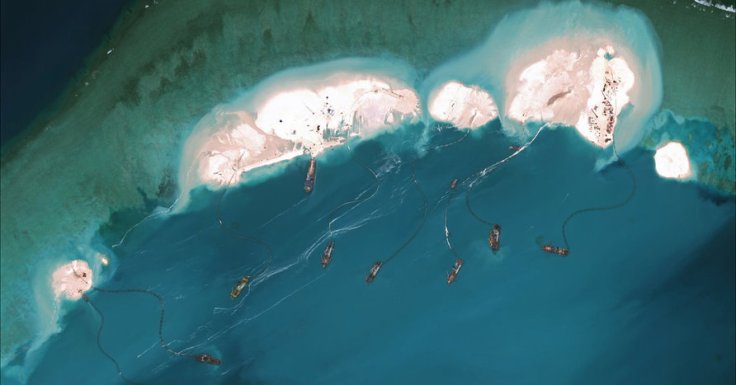
China building ‘great wall of sand’ in South China Sea

The scale of China’s land reclamation in the South China Sea is leading to “serious questions” on its intentions, a top US official says.

China is building artificial land by pumping sand on to live coral reefs – some of them submerged – and paving over them with concrete. China has now created over 4sq/km (1.5 sq miles) of artificial landmass.  China is creating a great wall of sand with dredges and bulldozers over the course of months.

Tags: borders, political, conflict, waterChina, East Asia.

Source: www.bbc.com

UPDATE: In addition to the original BBC article, here is another article from the Telegraph with some aerial imagery showing the extent of this geo-engineering project that has plenty of geopolitical implications and this has the United States “concerned.” 

MOOC: The Location Advantage

“Business graduates, students, and professionals can sign up today for a free online course to get the Location Advantage.”

Source: www.youtube.com

The Location Advantage is a free MOOC that will be offered by Esri in May 2015. It will last six weeks (2-3 hours of study per week).  Registered students will learn how to collect, analyze, and visualize business datasets.  You can register online for The Location Advantage.

Tagsmappingspatial, training, GIS,  ESRI, edtech, geospatial, location.

Syrian Journey: Choose your own route

Put yourself in the shoes of a Syrian migrant and see whether you could make the right choices on the journey to Europe.

Source: www.bbc.com

This BBC interactive tries to get the user to empathize with the plight and the geographic circumstances of Syrian refugees that are fleeing a land a strife.  The choices are not easy and there is no certain path.  This is an interesting interactive that is designed to build geographic empathy.

Tags: refugees, Syria, migration, conflict, political, MiddleEast, war.

Coffee Bellwethers

“For many in higher education, coffee is a vital fuel for learning and creativity. How a campus relates to coffee can reveal a lot about where the campus really stands in relation to social justice and sustainability. Geographer and James Hayes-Bohanan describes a future in which Bridgewater State University lives its values with campus cafes that are national models for the just treatment of producers and healthy relationships with the Earth.  Known as the Coffee Maven, he has come to view our relationship to coffee as a strong indicator of our relationships with the wider world.”

Tags: pollutionsustainability, environment, resources, economic, laborglobalization.

Source: www.youtube.com

Blog at WordPress.com.

Up ↑