Search

GEOGRAPHY EDUCATION

Supporting geography educators everywhere with current digital resources.

Author

sethdixon

I am a geography professor at Rhode Island College.

Europe gas level high as prices rise

Gas and oil prices have risen amid fears the Ukraine crisis could have a damaging effect on one of Europe’s main energy supply routes.  But analysts say high European gas stocks will limit the turbulence.

Seth Dixon‘s insight:

Russia is Europe’s biggest supplier of natural gas, but Ukraine is the key to their distribution network.  

See on www.bbc.com

An Atlas of Poverty

We think we know what poverty looks like. But how do we accurately account for it? How do we know where to look?

Poverty maps are one place to begin. Technological advances of the past decade—the increased capability to both collect and process improved data—make it possible to reveal the face of the poor in finer detail than ever before. By translating data into the visual accessibility of a map, we can locate poverty more precisely, understand its sources more comprehensively—and attack it more effectively. Such maps can even be used to monitor the results of anti-poverty efforts. Poverty maps can be part of a strong, new foundation for building and tailoring policies and programs, to reach those people that will benefit the most.

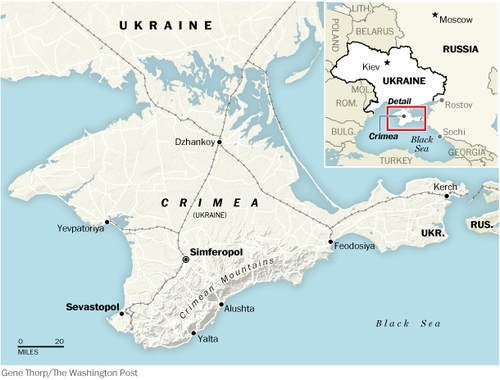
Ukraine’s leader urges Putin to pull back troops

Ukraine’s interim prime minister says the country is “on the brink of disaster.”

Seth Dixon‘s insight:

Many observers fear that Russia’s military control of the Crimea could lead to more centrifugal forces in the region.  This is troubling news indeed.  

See on www.washingtonpost.com

The End of the ‘Developing World’

The old labels no longer apply. Rich countries need to learn from poor ones.

BILL GATES, in his foundation’s annual letter, declared that “the terms ‘developing countries’ and ‘developed countries’ have outlived their usefulness.” He’s right. If we want to understand the modern global economy, we need a better vocabulary.

Mr. Gates was making a point about improvements in income and gross domestic product; unfortunately, these formal measures generate categories that tend to obscure obvious distinctions. Only when employing a crude “development” binary could anyone lump Mozambique and Mexico together.

It’s tough to pick a satisfying replacement. Talk of first, second and third worlds is passé, and it’s hard to bear the Dickensian awkwardness of “industrialized nations.” Forget, too, the more recent jargon about the “global south” and “global north.” It makes little sense to counterpose poor countries with “the West” when many of the biggest economic success stories in the past few decades have come from the East.

All of these antiquated terms imply that any given country is “developing” toward something, and that there is only one way to get there.

It’s time that we start describing the world as “fat” or “lean.”

See on www.nytimes.com

The Invention Of ‘The Economy’

“Until the Great Depression, nobody talked about ‘the economy.’ In a sense, it hadn’t been invented yet.”

Seth Dixon‘s insight:

This podcast is a great discussion on historical evolution of some standard economic measures; it is also a nice reminder that statistics such as GDP don’t represent a tangible thing, but are a shaped by how we think about the world around us.  

See on www.npr.org

Why the Plan to Dig a Canal Across Nicaragua Could Be a Very Bad Idea

“By the end of this year, digging could begin on a waterway that would stretch roughly 180 miles across Nicaragua to unite the Atlantic and Pacific oceans.”

Seth Dixon‘s insight:

Today, the largest of the massive cargo ships are simply too big to get through the Panama Canal and have to travel down around the tip of South America; China is strategically working on strengthening their geopolitical position in the South China Sea and all international waters.  This is one reason why a Chinese firms are planning to construct a canal to rival Panama’s.  This article highlights the reasons for concern (Maps 101 readers can read more about the geographic implications of Nicaragua’s plans in this article co-authored by myself and Julie Dixon or you can sign up for a free trial subscription to see what else Maps 101 has to offer). 

Tags: transportation, Nicaragua, globalization, diffusion, industry, economic.

See on www.wired.com

West warns Russia amid Crimea threat

“Western nations have called on Russia to ease tensions in Ukraine’s Crimea region after armed men seized the local parliament and raised the Russian flag.”

See on www.bbc.com

Geo-Literacy

Seth Dixon‘s insight:

I enjoy the sentiment of this quote; it embraces creative pedagogy while empowering students to be creative agents that can reshape the world.  I love the idea of geography enabling young minds to be inspired to imagine a better world and giving them the tools to so.  While I love the ethos that is embedded in this quote, I feel that it also underestimates our students and their ability to see past some of the limitations of the educational process.  They are not simply passive recipients of learning that is transmitted to them; students can actively shape what they learn.  However, if we can create an environment that promotes and encourages higher-order thinking, we can help our students see their role in shaping a new world–that is our goal in promoting geo-literacy.

See on rigea.org

Walmart Slumber Party

Who wants to spend the night in a Walmart parking lot?

There are a few generally accepted principles when it comes to the etiquette of spending the night in a vehicle in a Walmart parking lot. One night only. No chairs or barbecue grills outside an R.V. Shop at the store for gas, food or supplies, if you can, as a way of saying thanks. Walmart, the country’s largest discount retailer, says you’re welcome: its Web site says that R.V. travelers are “among our best customers.” The photographer Nolan Conway has been taking pictures of Walmart’s resident guests at several stores in central Arizona. Sophia Stauffer, a 20-year-old who travels the country in a van with her boyfriend and their dog, describes their lots, which usually feel quiet and safe, as their best option for most nights. “We really don’t want to work or live in a house,” she says.

Seth Dixon‘s insight:

Mobility studies and movement are key elements within geography.  This photo gallery is an intriguing glimpse into a distinct way of experiencing the United States that highlights a hyper-mobile subculture.  When discussing place we often think of the residents and workers, and think of those that use the place with some degree of permanence.  However, many people’s personal geographies are much more ephemeral, and some places are defined by their impermanence and flows.  Wanderlust can strike those in all socioeconomic sectors, and this is a great preview of those on the road.  Fittingly, the dog in this image is named Kerouc.   

See on www.nytimes.com

Blog at WordPress.com.

Up ↑