Who has the oil? pic.twitter.com/7Njc7OD8rw
Seth Dixon‘s insight:
See on www.energybulletin.net
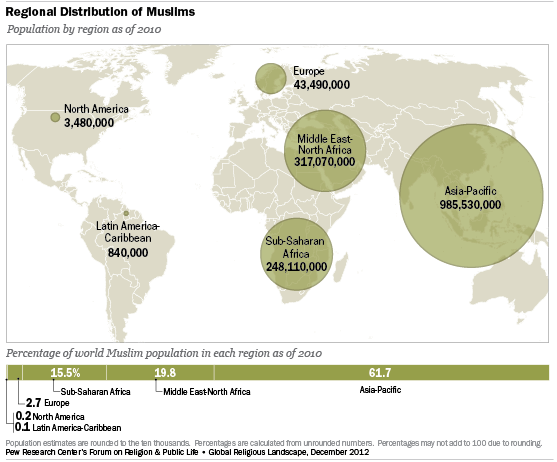
There are about 1.6 billion Muslims, or 23% of the world’s population, making Islam the second-largest religion.
Did you think that most of the world’s Muslim population lived in the Middle East and North Africa? If so you are not alone, but the Middle East and North Africa account for only 19.8% of the global Muslim population. In fact there are more Muslims in India and Pakistan than the Middle East and North Africa.
Tags: Islam, perspective, religion, culture, Middle East.
See on www.pewresearch.org
Once thought to be symbols of prosperity, innercity highways are now just eyesores — and sources of civic dysfunction — to some new urbanists.
This TED Talk also explores what cities should be with old freeways, suggesting that they should be dismantled and the spaces revitalized (and yes, my inner-Californian linguistic roots demands that I call them freeways).
Tags: transportation, urban, planning.
See on www.npr.org
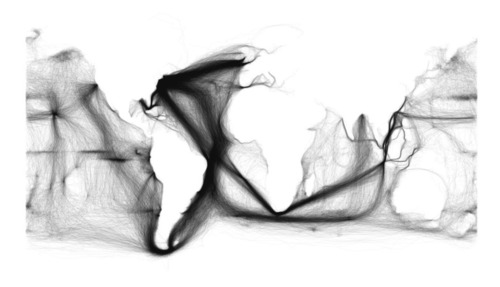
“Ben Schmidt, assistant professor of history at Northeastern University, has visualized the routes of 19th Century ships using publicly available data set from NOAA (National Oceanic and Atmospheric Administration). The resulting image is a hauntingly beautiful image that outlines the continents and highlights the trade winds. It shows major ports, and even makes a strong visual case for the need for the Panama and Suez Canals.”
See on unifiedpoptheory.com
President’s decision to shift official language from English to local language comes months after its decision to withdraw from the Commonwealth
The Gambia has been showing signs that they want to remove neo-colonial influences. Last year the President withdrew the Gambia from the Commonwealth (a collection of 54 countries, mainly former British colonies), tired of being ‘lectured’ about human rights. Now they have rejected English as the official language. Mandingo (38%), Fula (21%) and Wolof (18%) are the three most widely spoken languages but it is currently unclear if one of these will become the new official language or if several will receive that status.
Questions to Ponder: What are the advantages and disadvantages of using the old colonial language as the official language in multilingual African countries? What are the advantages and disadvantages of using a local language/languages as the official language?
Tags: language, governance, Africa, colonialism.
See on www.telegraph.co.uk
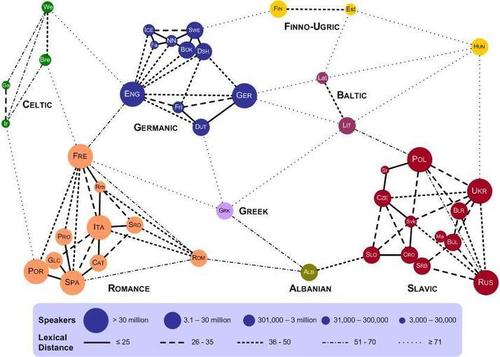
This chart shows the lexical distance — that is, the degree of overall vocabulary divergence — among the major languages of Europe. The size of each circle represents the number of speakers …
And yes, English has its deepest roots in German…the French aspects were tacked on after the Norman Conquest.
See on elms.wordpress.com
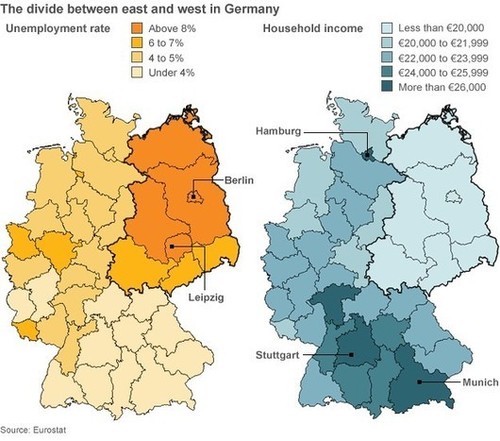
“Germany, which holds federal elections on 22 September, is Europe’s dominant country. Its large and strong economy has allowed it to bankroll the bailouts that have kept some of its neighbours – and the euro – afloat. The graphics below help explain why it is so dominant, and powerful – and also some of the problems it faces.”
See on www.bbc.com
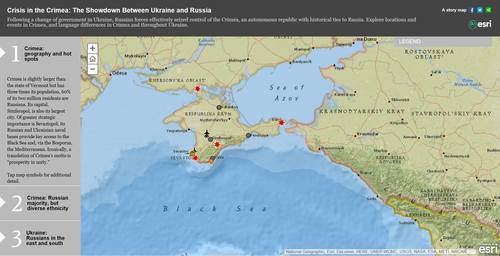
This StoryMap from ESRI is a nice way to explore Crimean historical geography, as is this set of maps from National Geographic.
See on storymaps.esri.com
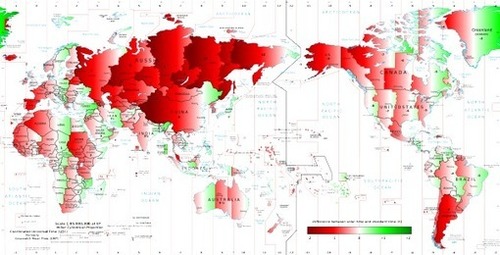
Why Spaniards have dinner so late? A map of the difference between solar time and clock time around the world.
I edited a world map from Wikipedia to show the difference between solar and standard time. It turns out, there are many places where the sun rises and sets late in the day, like in Spain, but not a lot where it is very early (highlighted in red and green in the map, respectively). Most of Russia is heavily red, but mostly in zones with very scarce population; the exception is St. Petersburg, with a discrepancy of two hours, but the effect on time is mitigated by the high latitude. The most extreme example of Spain-like time is western China: the difference reaches three hours against solar time. For example, today the sun rises there at 10:15 and sets at 19:45, and solar noon is at 15:01.
See on poisson.phc.unipi.it