Search

GEOGRAPHY EDUCATION

Supporting geography educators everywhere with current digital resources.

Author

sethdixon

I am a geography professor at Rhode Island College.

How the British (literally) Landscaped the World

“Did you hear about the Five Pillars of British Landscaping Empire during your religion classes? To sort them by order of importance within the Holy Book of Grass: First is Grass. Second is pasture grass (this one comes with fences). Third is leisure grass. Forth is golf grass. Fifth is: you never have enough flowers & cute little benches on your grass.”

Seth Dixon‘s insight:

I’ve written in the past about the aesthetics of the an ideal British landscape (as embodied in the anthem Jerusalem).  The British ideal was to tame nature; the Canadians on the other hand, embraced the wildness of the natural landscapeThose difference normative views of landscape helped to shape national identity and inform land use decision-making processes.     

See on pickmeuptonic.wordpress.com

Get Out, Get Active

Bring geography to life inside the classroom and out.

Seth Dixon‘s insight:

It is now Geography Awareness Week!  Geography isn’t just something to study, it’s something to do.  Make geography active and engaging.  Here are some resources that we are using in Rhode Island for #GeoWeek.  What is your local Geographic Alliance doing?  If you don’t know, now is a great time to join. 

See on education.nationalgeographic.com

The Forgotten Giant Arrows that Guide you Across America

“Giant 70-foot concrete arrows that point your way across the country, left behind by a forgotten age of US mail delivery.  Long before the days of radio (and those convenient little smartphone applications), the US Postal service began a cross-country air mail service using army war surplus planes from World War I.  The federal government funded enormous concrete arrows to be built every 10 miles or so along established airmail routes they were each built alongside a 50 foot tall tower with a rotating gas-powered light. These airway beacons are said to have been visible from a distance of 10 miles high.”

Seth Dixon‘s insight:

This is fascinating…just because a technology is old and outdated in modern society doesn’t mean it wasn’t ingenious.  The original mathmeticans who calcuated angles and distances study geometry so they could navigate and ‘measure the Earth.’ These giant arrows are but one of those links in the geneological strands of navigational technology.    

See on www.messynessychic.com

Thanksgiving Resources

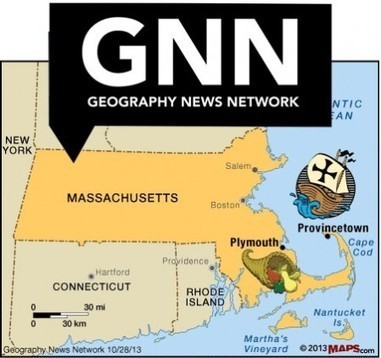
Thanksgiving has some fascinating spatial components to it.  My wife and I prepared an article for the Geography News Network on Maps101.com that shows the historical and geographic context of the first Thanksgiving and in the memorialization of Thanksgiving as a national holiday (if you don’t subscribe to Maps 101, it is also freely available as a podcast on Stitcher Radio or iTunes).

One of my favorite combinations of maps for Thanksgiving involves the geography of food production and food consumption.  When we start looking at the regional dishes on the Thanksgiving plates we can see some great patterns.  This ESRI storymap asks the simple question, where did your Thanksgiving Dinner come From?

TDinner

This StoryMap is a great resource to combine with this New York Times article that shows the regional preferences for the most popular Thanksgiving recipes.  Where are sweet potatoes grown?  Where do people make sweet potato pie for Thanksgiving?

SweetPotato

Plymouth County, MA is one of only 3 cranberry producing regions and is was also home to the first Thanksgiving.  How has this New England local ecology and traditional food patterns influenced national traditions?

CranII

For these and more Thanksgiving resources on scoop.it, click here.

See on geographyeducation.org

China to ease one-child policy, abolish labor camps, report says

China announces it will relax its one-child policy and abolish labor camps, the state-run Xinhua news agency reports.

See on www.cnn.com

HDI Map

“Our mission is to provide easy-to-use, yet methodologically sound tools for understanding well being and opportunity in America and to simulate fact-based dialogue about issues we all care about: health, education and income. “

Seth Dixon‘s insight:

Usually we think about levels of development at the national scale and compare 1 country to another.  However, there is great unevenness in development markers within a country and this mapping tool helps us visualize those uneven patterns. 

See on www.measureofamerica.org

So you want to form your own state? It may take a while

Voters in five Colorado counties said on Tuesday they want to form their own state.  But the breakaway regions face almost impossible constitutional and political obstacles. The North Colorado movement supporters claim that their counties have little in common with more urbanized parts of the state, and they are unhappy with state-wide laws about gun control and energy standards. 

Seth Dixon‘s insight:

There are other secessionist movements, and other ways the states might have formed, but these are all very unlikely.  There’s that little document called the Constitution that makes these movements impractical.  

See on blog.constitutioncenter.org

Geography Awareness Week

Launched in 1987 by presidential proclamation, Geography Awareness Week is an annual opportunity for families and schools to engage in fun, educational experiences that draw attention to geo-literacy and the importance of geographic understanding.


Seth Dixon‘s insight:

Geography Awareness Week is right around the corner (Nov. 18-22)!  The Theme is GEOGRAPHY AND THE NEW AGE OF EXPLORATION.  Here are some resources that we are using in Rhode Island.  What is your local Geographic Alliance doing?  If you don’t know, now is a great time to join.  

See on education.nationalgeographic.com

The Philippines’ Geography Makes Aid Response Difficult

Seth Dixon‘s insight:

Typhoon Haiyan was enormous and hit a 400-mile swath on the Philippines.  The Philippines is a single country, but it is composed of over 7,000 islands; hundreds of islands are in need of relief aid, if not more.  The islands are in an archipelago which naturally fragments the land mass and isolates the residents making transportation, utilities and communications logistically difficult even in the best of times.  If the first few days after the typhoon, supply chains were cut off and many desperate people looted the sparse food resources available. The necessities to sustain life—food, water, shelter, medication and basic sanitation—are the all major concerns in the aftermath of the typhoon.      

While the police are saying that order is being restored, the effects of flooding pollute water resources and increase the spread of infectious diseases because of the poor sanitation.  The Philippines is gripping for an impending medical crisis from the spread of diseases in addition to the medical trauma that people suffered during the actual typhoon.  Richard Brennen of the World Health Organization (WHO) believes that these geographic difficulties make the relief efforts in the Philippines more difficult than the 2010 relief efforts to help Haiti after the massive earthquake.   

Tags: water, disasters, Philippines, medical, development, diffusion.

See on www.npr.org

Create a free website or blog at WordPress.com.

Up ↑