Search

GEOGRAPHY EDUCATION

Supporting geography educators everywhere with current digital resources.

Author

sethdixon

I am a geography professor at Rhode Island College.

Rapes Cases Show Clash Between Old and New India

A boom and social change are pitting young working women in the city against men from conservative villages.

Seth Dixon, Ph.D.‘s insight:

The recent resurgence of this issue had me looking through the archives and stumbled upon this 2011 article.  As urban expansion is booming in many Indian cities, the modern city expands into the countryside.  The cultural values of these two demographic groups are quite distinct.  Young, educated women are part of the modern cities’ workforce but in many conservative, traditional Indian villages, women working outside the home are seen as “lacking in virtue.”  In many of the recent gang rape cases, the perpetrators are less educated young men from surrounding villages and the victims are well-educated young working women that are a part of the new city.    

Public spaces, especially at night, are seen as masculine spaces in most traditional societies.  One of the mothers of an accused rapist succinctly explained this mindset thusly: “If these girls roam around openly like this, then the boys will make mistakes.”  This is seen as ‘Eve teasing,’ where women are perceived as responsible for the violence committed against them to maintain social order

This other NY Times article op-ed states, “India must work on changing a culture in which women are routinely devalued. Many are betrothed against their will as child brides, and many suffer cruelly, including acid attacks and burning, at the hands of husbands and family members.  India, a rising economic power and the world’s largest democracy, can never reach its full potential if half its population lives in fear of unspeakable violence.”

Tags: India, migration, South Asia, culture, urban, folk culture, megacities.

See on www.nytimes.com

The Best Posts for 2012

Global news with a spatial perspective: resources for educators and the inherently inquisitive. http://geographyeducation.org

Seth Dixon, Ph.D.‘s insight:

This list is a combination of two types of posts.  Some represent the best posts of Geography Education during 2012 as voted by you the viewers (measured by page views) and I’ve added a few that I feel where my ‘favorite finds’ of the year.  For more favorites, you can see the best of 2011.


Tags: best of 2012, zbestofzbest, geo-inspiration.

See on www.scoop.it

Best

Top 10 “Nat Geo Talks” of 2012

Live presentations have been a part of National Geographic since the 1800s, and today more than 140 are viewable online. See this year’s best.

Seth Dixon, Ph.D.‘s insight:

These talks are always quality presentations and this set of 10 videos is a part of the Explorers Journal sponsored by the National Geographic Society. 

See on newswatch.nationalgeographic.com

Spatial Patterns of the Gun Lobby

The National Rifle Association gives members of Congress a grade ranging from A to F.

Seth Dixon, Ph.D.‘s insight:

Since the Newtown CT tragedy, gun control and second amendment rights have been prominent in the minds on many Americans.  Your ideological position on what should be done in th future might be in part a product of geography.  How do most people feel about the second amendment where you live?  What about your local geography might influence those opinions? 

See on www.nytimes.com

At Year’s End, News of a Global Health Success

The stunning drop in global child mortality is proof that poor countries are not doomed to eternal misery. Here’s how it happened.

Seth Dixon, Ph.D.‘s insight:

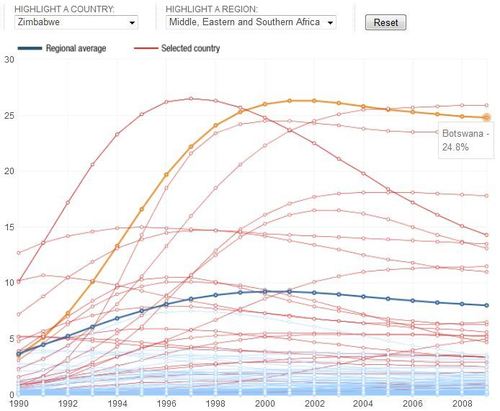
Global health has substantially improved in the last two decades.  This article explores the improvements in global health that have been made this year, and the attached interactive feature allows users to explore the changes in global health risks.  

Tags: medical, historical, spatial.

See on opinionator.blogs.nytimes.com

Place and Flash Mobs

The idea of flash mobs has spread quickly, diffusing at a time when online video sharing can immortalize the moment in time and social media can amplify the audience beyond just one place.

Seth Dixon, Ph.D.‘s insight:

I LOVE this particular flashmob (as a bonus, ‘read’ the cultural landscape to try to identify where this took place).  While there are many types of successful flash mobs, all share one characteristic: place matters.  The place where a flash mob performs is not simply a stage; place is a crucial part of the meaning of the flash mob.  An incredibly prominent place with open spaces and many sight lines is a prime location for a flash mob.  Beyond these tangible characteristics, if a site has some importance cultural significance, those qualities can be meshed with the meanings of the flash mob.  For more of my musings on flashmobs (and extra clips) you can continue reading here: https://geographyeducation.org/whats-new/articles/place-and-flash-mobs/


Tags: place, space, diffusion, popular culture.

See on www.youtube.com

The Global Religious Landscape

A country-by-country analysis of data from more than 2,500 censuses, surveys and population registers finds that 84% of adults and children around the globe are religiously affiliated.

Seth Dixon, Ph.D.‘s insight:

The Pew Forum on Religion and Public Life is one of the best sources for information of culture and religion.  This is a great data set of global religions, complete with maps, charts and graphs.

Tags: religion, culture, unit 3 culture.

See on www.pewforum.org

Visualizing Seismic Waves

Movie showing ground motion of four earthquakes propagating across a high density seismic array in Long Beach, California. Data was recorded by NodalSeismic,…

Seth Dixon, Ph.D.‘s insight:

Seismic activity is to be expected in the Los Angeles region as the major hazard threat in the area.  This area has a great number of sensors which now allows us to visualize seismic waves better than ever before.  This video show 4 earthquakes (starting at 0:45, 2:20, 6:00, and 8:35).  For more information on the science behind this clip, read the adptly named blog, The Trembling Earth.

Tags: visualization, disasters, physical, Los Angeles.

See on www.youtube.com

Geography game: how well do you know the world?

Play the Global development game: identify the world’s countries and territories, rank them according to GDP then fingers at the ready for the picture round


Seth Dixon, Ph.D.‘s insight:

This game is not as simple as it may appear.  The first round challenges you to be able to recall basic facts, the second has you comparing countries while the third asks you about global current events.  Hopefully geography education around the world can get past that ‘1st round’ and into deeper content.  Good luck (Hint: use a computer with a mouse since locating the countries on the map is a timed activity).

Tags: games, K12.

See on www.guardian.co.uk

Blog at WordPress.com.

Up ↑