Search

GEOGRAPHY EDUCATION

Supporting geography educators everywhere with current digital resources.

Author

sethdixon

I am a geography professor at Rhode Island College.

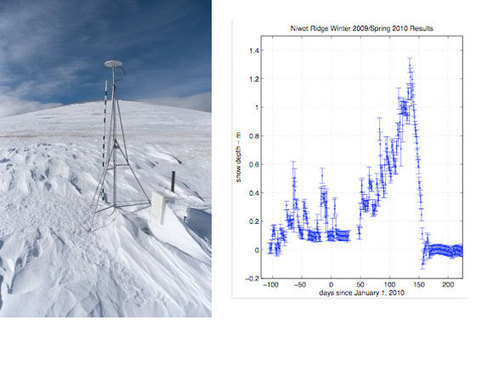
Bounces in GPS signals reveal snow depth

UNAVCO, a non-profit university-governed consortium, facilitates geoscience research and education using geodesy.

“Researchers at the University of Colorado Boulder and the University Corporation for Atmospheric Research have been using what is typically considered an error in the GPS signal to measure snow depth around GPS receivers. A GPS receiver records both direct and reflected signals from a satellite. A reflected signal bounces off of whatever is around the GPS station before being recorded, and therefore can contain information about the ground surface close to the station.

Traditionally snow depth has been measured by hand. In other words, someone had to go out with a measuring stick to whatever location they were interested in.  GPS snow depth measurements solve both of these problems: once a GPS unit is installed, it can function on its own throughout the winter, and will make a measurement every two hours, which is then averaged for a daily position, or in this case, snow depth.”

Tags: GPS, climatechange, water, technology,

See on unavco.org

Global Closet Calculator

Interactive. The Global Closet Calculator aggregates the contents of your own closet by origin to generate a map showing your unique global footprint, and puts you in charge of the global journey your stuff takes to get to you.

As I’ve worked now with the Rhode Island Geography Education Alliance, I’ve had the good fortune to interact with the folks at National Geographic.  They are preparing for Geography Awareness Week (Nov 11-17th) with the theme “Declare your Interdependence!”  This newly released interactive feature allows students of all ages to see the global interconnections in their lives.   By analyzing the items in our closets (or any of the items that we consume), we can easily see that  our own personal geographies create a web of global interconnectedness.

Tags: NationalGeographic, GeographyEducation, K12, consumption, globalization.

See on education.nationalgeographic.com

GPS or Maps?

We are a society that is reliant on modern navigational devices.  This is an interesting article that argues for keeping modern equipment, but asks us not to eliminate older technologies in our haste to embrace the shiny and new.  “Technology as great as it is should never be a replacement for skills, but a tool used to assist you.”

Tags: GPS, technology, spatial.

See on www.spirit917fm.com

Burning Man

This annual arts festival with a strong counter-cultural ethos literally is an experiment in producing alternative urban and cultural geographies that reject normative regulations embedded within societies.  These geographies created last only about a week, as an escape from the regular strictures of society and the ephemeral alternative geographies fade back into the desert.  The images of the event are quite striking.

I’ll let the producer of the video explain: “It is an 8-day event which takes place annually in late August in the temporary city of Black Rock City located in a dry lakebed in northwestern Nevada, USA.  The radial streets are laid out like a clock face, from 2:00 to 10:00. I have marked some of these streets as well as some of the prominent and favorite theme camps and villages.  The attendees are all participants in a sense and are themselves the attraction. There is no corporate sponsorship or presence of any sort. Only ice and coffee are sold. Everything else is brought in under the concept of ‘radical self-reliance’ or gifted by others. Most ‘burners’ participate by finding the creative or artistic thing that they enjoy most and do best, do it to the fullest extent, and share it as much as possible.”

Tags: art, culture, unit 3 culture, popular culture.

See on www.youtube.com

NASA animation of temperature data from 1880-2011

Tags: video, environmentvisualization, climatechange, environment modify.

See on www.youtube.com

Harvest

Harvest is a time of plenty, when the season’s hard work is rewarded by bounty. Many of the rhythms of our lives are shaped by the gathering of crops, even if most of us now live in cities.

This photo essay shows people from around the world harvesting their crops and taking them to the market. Pictured above, farmers who were waiting for customers gathered alongside corn-laden trucks at the market in Lahore, Pakistan earlier this month.

Questions to Ponder: What is similar in these images? What is different? How do those similarities and differences shape the geography of a given region?

Tags: Food, agriculture, unit 5 agriculture, worldwide, comparison, images.

See on www.boston.com

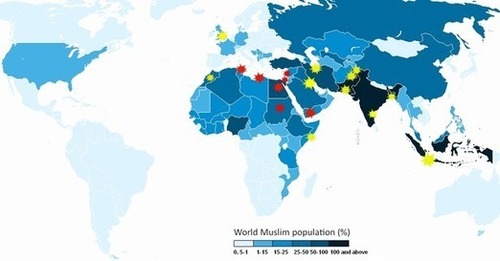
Anger Over Film Fuels Anti-American Attacks in Libya and Egypt

Protesters upset over an American-made video denouncing Islam attacked the United States Consulate in Libya, while Egyptian demonstrators stormed over the walls of the United States Embassy in Cairo.

The idea of anti-U.S. protests in the Middle East and Northa Africa on the 11th anniversary of the terrorist attacks of Sept. 11 was initially quite shocking.  As always, a greater understanding of the cultural context and timing helps explain (not necessarily justify) the situation.  

See on www.nytimes.com

Younger Africa

Across Africa, a continent where the average age is about 19, protests have flared against leaders who may have outstayed their welcome.

This interactive mapping feature compares two distinct data sets in an attempt to show that the two are correlated on the continent of Africa.  The base layer of this thematic map is demographic, noting how much of the overall population in a given country is under the age of 16.  The interactive feature with point data describes the political unrest or instability in that particular country. 

Questions to ponder: Does the cartographer ‘convince’ you that Africa’s having a very young (globally speaking) demographic cohort led towards greater political instability?  Are there other factors worth considering?  What does this map and it’s embedded data tell us?    

Tags: Africa, political, conflict, unit 4 political, states, governance, population, demographics, unit 2 population

See on online.wsj.com

As time passes, how should the nation mark Sept. 11?

How will the nation mark Sept. 11, 2001, as the horrors of that day — as well as the victims and heroes — fade from our collective memories?


SM: One thing that really stood out to me in this article was that “Nearly 70% of Americans say they somewhat or strongly agree with this statement: “I have moved on from (the events of) Sept. 11,” according to a new American Pulse Survey.  Maybe it is becuase I was so young I didn’t quite understand what was going on at the time, but in all honesty did anyone really know what exactly was happening?  Because of this I try to watch as many documentaries and read about the tragic 9/11 attacks as much as I can.  


We can all tell the story “I remember where I was when the towers were hit…”  I think this is somehting that needs to live through American History just as the JFK assasination does.  How can people just simply go about there business without even taking the time realize that today is indeed September 11th?  The 11th year anniversary of an evil attack that killed thousands of innocent people. As a future educator I hope that I’m able to teach a unit on 9/11.  Currently teachers are teaching about the assasination of JFK so why should 9/11 be any different?  


Regardless of what the future has in store I will forever be interested in 9/11.  I will never forget being in the fifth grade and watching the television the janitor brought into the room.  I turned to my friends and said “this will change America”.  I didn’t know much about the attacks at the time but I was right.  Thus, 9/11 is something that needs to be remembered in schools and within society.  We, as Americans cannot simply ignore the evil plot that claimed the lives of almost 3000 innocent people 11 years ago.

See on www.usatoday.com

Create a free website or blog at WordPress.com.

Up ↑