Search

GEOGRAPHY EDUCATION

Supporting geography educators everywhere with current digital resources.

Author

sethdixon

I am a geography professor at Rhode Island College.

How Geospatial Analytics Are Changing Habitat Conservation

“The BirdReturns program is an effort to provide ‘pop-up habitats’ for some of the millions of shorebirds, such as sandpipers and plovers that migrate along the Pacific Flyway, a route that spans from Alaska to South America. Birds flying on this journey seek out the increasingly rare wetlands teeming with tasty insects to fuel their long-distance flights.  Over the last century, California’s Central Valley has lost 95% of the wetlands habitat to development, agriculture, and other land use changes. As a solution, scientists use big data, binoculars, and rice paddies.”

Source: www.youtube.com

This project combines data from satellite imagery to map surface water in California’s Central Valley, and individual bird observations to select locations that can be temporarily converted into wetlands to aid the migratory birds (for more information than the video provides about this project, read this article). 


This is a great example of using both ‘big’ geospatial data as represented by the satellite imagery and combining it with field data and actual observations to make the world a better place.  We need more decision makers that can think spatially and use geographic skills.  


Tags: physicalCalifornia, water, environmentbiogeography, remote sensing.

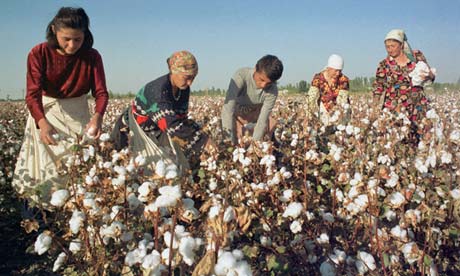
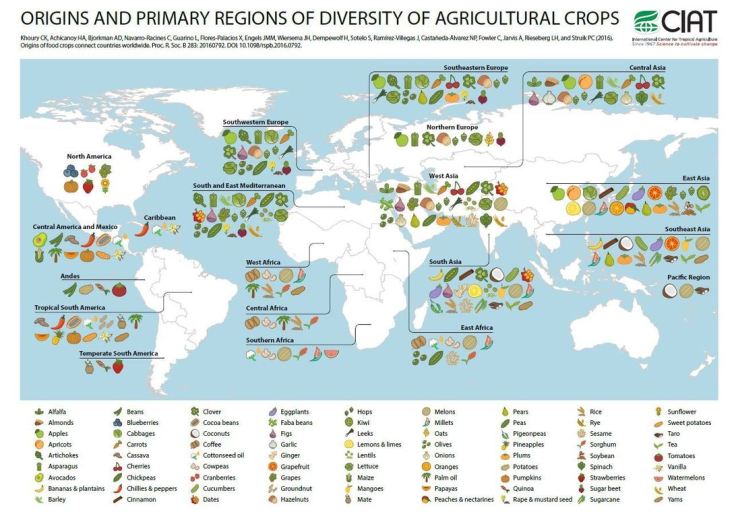
Where our food came from

“Explore the geographic origins of our food crops – where they were initially domesticated and evolved over time – and discover how important these ‘primary regions of diversity’ are to our current diets and agricultural production areas.”

Source: blog.ciat.cgiar.org

This is an incredibly rich website with great interactive maps, dynamic charts, and text with rich citations.  This is one of those resources that an entire class could use as a starting point to create 30+ distinct project.  This is definitely one of the most important and best resources that I’ve shared recently, one that I’m going to use in my class.  Where did a particular crop originally come from?  Where is it produced today?   How do these historic and current agricultural geographies change local diets and economies around the world?  All these issues can be explored with this interactive that includes, but goes beyond the Columbian Exchange


Tags: foodeconomicfood production, agribusiness, agriculture, APHG, unit 5 agriculture, globalizationbiogeography, ecology, diffusion.

Coast Lines

In the next century, sea levels are predicted to rise at unprecedented rates, causing flooding around the world, from the islands of Malaysia and the canals of Venice to the coasts of Florida and California. These rising water levels pose serious challenges to all aspects of coastal existence—chiefly economic, residential, and environmental—as well as to the cartographic definition and mapping of coasts. It is this facet of coastal life that Mark Monmonier tackles in Coast Lines. Setting sail on a journey across shifting landscapes, cartographic technology, and climate change, Monmonier reveals that coastlines are as much a set of ideas, assumptions, and societal beliefs as they are solid black lines on maps.

Source: www.press.uchicago.edu

I haven’t yet had the chance to look at this book, but it is currently being offered as a free e-book; I’m very excited to look it over.   


Tagsmappingcoastal, cartography, textbook.

NOAA’s GFS model visualized on NOAA’s Science on a Sphere

NOAA’s powerful Global Forecast System model was upgraded on May 11, 2016, providing forecasters with a more accurate 4-D picture of how a weather system will evolve. The upgrade is the latest of a number of model improvements rolling out this spring and summer, thanks to increased supercomputing power NOAA acquired earlier this year.

Source: www.youtube.com

There’s some good science with practical applications underneath this very artistic rendering of the planet’s atmosphere…it is more fluvial that we give it credit for if we only think of air as empty space.  This video also reminds me or the words of one pilot and his perspective on both the atmosphere and Earth from above: “Geographically speaking, the sky is like a whole other planet encasing our own.”


Tagsweather and climate, atmosphere, space, video, physical, fluvialremote sensing.

How Islam Created Europe

“For centuries in early and middle antiquity, Europe meant the world surrounding the Mediterranean. It included North Africa, but the swift advance of Islam across North Africa in the seventh and eighth centuries virtually extinguished Christianity there, thus severing the Mediterranean region into two civilizational halves, with the ‘Middle Sea’ a hard border between them rather than a unifying force. Islam is now helping to undo what it once helped to create. A classical geography is organically reasserting itself, as the forces of terrorism and human migration reunite the Mediterranean Basin, including North Africa and the Levant, with Europe.” 

Source: www.theatlantic.com

The title is a bit overstated (aren’t they all in this click-bait driven media age?), but the article shows nicely how regions are cultural constructs that change over time. 


Tags: op-edregions, Europe, historical, Islamreligionhistorical, culture, Christianity.

GeoInquiries – Grade 4 Interdisciplinary

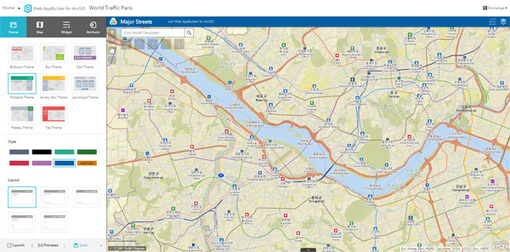
“GeoInquiries are designed to be fast and easy-to-use instructional resources that incorporate advanced web mapping technology. Each 15-minute activity in a collection is intended to be presented by the instructor from a single computer/projector classroom arrangement. No installation, fees, or logins are necessary to use these materials and software.

The Elementary, Grade 4 GeoInquiry collection is under-development.

Source: edcommunity.esri.com

ESRI has produced GeoInquires for Earth Science, US History, Environmental Science, AP Human Geography, and has just recently released an interdisciplinary set of GeoInquiries designed for fourth graders.     These include:

TagsmappinggeospatialESRI, K12, edtech.

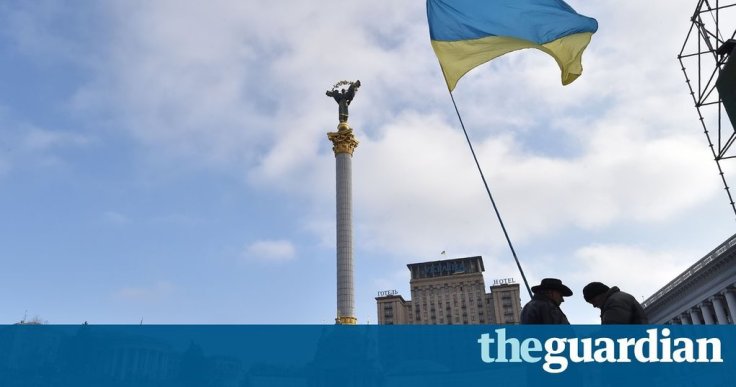
Why Germany’s recognition of Armenian genocide is such a big deal

Armenian American journalist Liana Aghajanian says the German parliament’s decision is all the more groundbreaking because it was a politician of Turkish descent who pushed it through.


The German Bundestag’s overwhelming vote last week in favor of this resolution, with just one vote against and one abstention, brought both gratitude and anger. Armenian communities, many of them descendants of genocide survivors who are dispersed across the world, are grateful. Turkey, however, was incensed and recalled its ambassador to Germany. Many Turks see the vote as not just a threat to longstanding German-Turkish relations, but to Turkish national identity.

Source: www.pri.org

I’ve posted in about the Armenian genocide in the past, and until Turkey acknowledges that it was a genocide, this issue will continue to fester.  Considering that Germany has a large Turkish population and an obvious historical connection to genocide, this recognition is far more important some other random country taking this stance. 


TagsArmenia, genocidepolitical, conflict, TurkeyGermanywar, historical.  

Break Dancing, NGOs, and Global Lives

Deported to Cambodia, Former Gang Member Gets A Second Chance. When Tuy Sobil was deported to Cambodia from the U.S., it was the first time he had ever stepped foot in the Southeast Asian country.

Source: www.nbcnews.com

My students have enjoyed this video about a break-dancing NGO that was created by a former refugee from the United States who was subsequently deported to Cambodia (this article serves as some added background and a follow-up to the story).  This story shows the influence of urban youth culture and various strands of geography in this young man’s global life.


Tags: Cambodia, diffusion, cultureNGOs, globalization.

Keynote Address at the AP Human Geography Reading

“I gave the keynote at the AP Human Geography reading, entitled The Age of Geotechnologies:  Five Converging Forces, available here.  The keynote was given as an Esri storymap!  It was a great honor to give this presentation and interact with some of the world’s finest geography educators!”


TagsAPHG, storymapgeography education, teacher training, ESRI.

Source: www.josephkerski.com

Blog at WordPress.com.

Up ↑