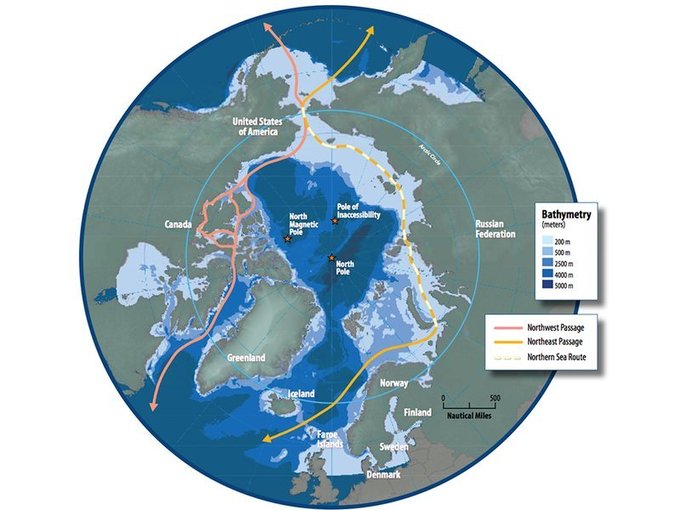
While the Arctic ice melt is opening up east to west shipping lanes, some 75 animals species might also make the journey
Tags: physical, weather and climate, Arctic, biogeography, climate change.
Source: www.smithsonianmag.com
While the Arctic ice melt is opening up east to west shipping lanes, some 75 animals species might also make the journey
Tags: physical, weather and climate, Arctic, biogeography, climate change.
Source: www.smithsonianmag.com

According to the U.S. Agriculture Department, the number of women-operated farms increased from 5 percent to 14 percent between 1978 and 2007. Today, counting principal operators and secondary operators, women account for 30 percent of all farmers in the United States, or just under 1 million.Some women regard themselves less as entrepreneurs and more as gentle stewards of the land, or bulwarks against corporations overtaking family farms and developers sweeping in with seductive offers. Others are drawn to the farm-to-fork movement, where locally grown produce and meat hold much greater appeal. Also, more women are inheriting farms and ranches.
Source: www.washingtonpost.com
When we discusss gender in an agricultural context, it is usually to point out that around the world, women are approximately half of the agricultural workforce, and in less developed countries they often comprise the majority of the the agricultural sector. U.S. students find this shocking, given that traditional cultural norms often perceive farm work as a very masculine domain. However, that has slowing been changing in the last 30 years as more women in the U.S. are owning and operating farms. There isn’t one simple reason to explain this shift, but it is indicative of broader social changes.
Tags: gender in agriculture, cultural norms, gender, agriculture, labor.
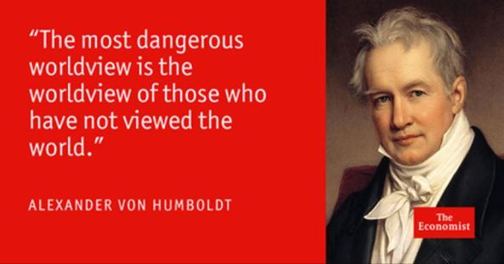
On why a Prussian scientific visionary should be studied afresh…In a superb biography, Andrea Wulf makes an inspired case for Alexander von Humboldt to be considered the greatest scientist of the 19th century. Certainly he was the last great polymath in a scientific world which, by the time he died in Berlin in 1859, aged 89, was fast hardening into the narrow specializations that typify science to this day. Yet in the English-speaking world, Humboldt is strangely little-known.
Source: geographyeducation.org
Alexander von Humboldt has been described as the last great ancient geographer concerned with understanding an eclectic cosmography as well as the first modern geographer. He is honored far and wide throughout Europe and especially Latin America for his explorations, but given that people are confused as how to categorize him and classify his contributions, today he is under-appreciated. Geographers need to reclaim his memory and call his extensive, globetrotting work on a wide range of subjects ‘geography.’ Here is another article and TED-ED video on the most influential scientist that you might not have heard of (at least until today).
Tags: historical, biogeography.
“A deadly fungus, known as Panama disease, is decimating banana plantations around the world and threatens to wipe out the most common species, the Cavendish banana. Scientists in Honduras are working to create a resistant banana before the disease hits Latin America, where the majority of the fruit is grown. NewsHour’s Mori Rothman reports.”
Source: www.youtube.com
Questions to Ponder: How is this a geographic issue? What are the spatial and regional implications?
Tags: physical, food production, agribusiness, agriculture, diffusion, medical.

“Every city has a picturesque spot or two where the probability of a photo being taken at any given time is pretty high. Now there’s a world atlas of maps showing the routes people follow while taking these pictures in every city around the world:Mapbox’s Eric Fischer has been working on the “Geotaggers’ World Atlas” for five years, using locations of photos uploaded on Flickr over a decade. In his city maps, which now span the world, he connects the dots between subsequent photos taken by a photographer—representing their path in sketchy lines that criss-cross across the city.”
Tags: mapping, visualization, social media, tourism.
Source: www.citylab.com

“A geographic perspective is a way of looking at and understanding our world. When you view the world through the lens of geography, you are asking who, what, where, when, and how people, places, and things are distributed across the surface of the earth, and why/how they got there. In other words, it means that you are analyzing something with a geographic perspective. The understanding and use of a geographic perspective is critical for decision making skills in the 21st century. Using spatial concepts such as location, region, movement, and scale to help us understand:
—@natgeo, Geography as a Primary Source
Source: www.instagram.com
This is a field guide designed by National Geographic to help students strengthen their geographic skills.
Tags: National Geographic, perspective.

A new project from U.S. News & World Report has an ambitious goal: Ranking the world.
Source: www.washingtonpost.com
I’m not endorsing the ratings or the methodology behind the ratings, but they are certainly fodder for discussion.
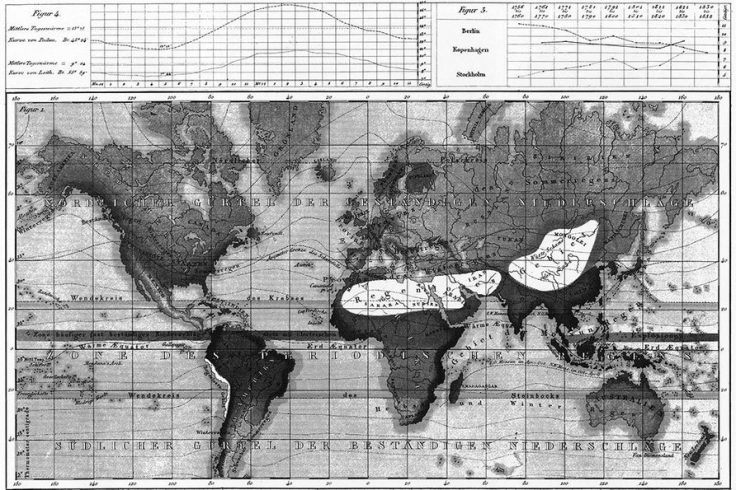
Early meteorology helped farmers predict yield, transforming the agricultural industry.
Complaining over the weather is not new, but the science of studying the weather, and its effects on business, is fairly recent. Around [1920], economists were also starting to use statistical methods to predict yield. Although cotton’s price, as shown on the New York Cotton Exchange, fluctuated daily, a “well-known American economist” discovered that he could make the most accurate total yield predictions—more accurate than those of the government crop reports—by analyzing the average weather conditions from May to August. It was now possible to predict when the crops would have a bumper year or a poor one.
Tags: physical, weather and climate, food production, agribusiness, agriculture.
Source: daily.jstor.org
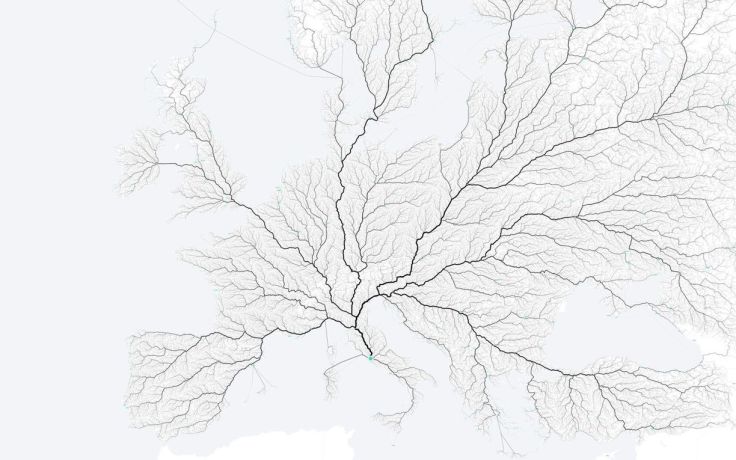
“As the saying goes, ‘All roads lead to Rome.’ Folks at the moovel lab were curious about how true this statement is, so they tested it out. They laid a grid on top of Europe, and then algorithmically found a route from each cell in the grid to Rome, resulting in about half a million routes total. Yep, there seems to be a way from Rome from every point.”
Tags: fluvial, mobility, transportation, mapping.
Source: flowingdata.com




