This is just for fun…but it is a way to start some conversations about modern agricultural practices, especially the local and organic movements.
See on www.youtube.com
This is just for fun…but it is a way to start some conversations about modern agricultural practices, especially the local and organic movements.
See on www.youtube.com
A Human Geography Resource; Especially for Teachers
The Human Imprint is home to everything Human Geography related for the student, educator, and the every day Joe/Jane. This site includes geographic related stories, lesson plans, and other links that bring us closer to understanding the “why of where.”
Have you already seen this resource produced by a Chicago AP Human Geography teacher? If not, there’s no time like the present!
See on thehumanimprint.com
Elmhurst College’s Skills for the Digital Earth MOOC is a 4-week, online course designed to introduce how location technologies are used in society.
Ever stop to think about how important location is when using your smart phone? This educational MOOC begins with an elementary explanation of how society uses location in a myriad of disciplines. Geography, or rather, “where?” is important to all of us from various perspectives.
Within this MOOC, participants will learn what location technologies are used for, how the discipline developed and learn by doing via a series of scaffolded practical exercises. Online spatial software will be employed for any device using a browser which takes users through exercises and real world examples. It is appropriate for those with no prior experience with geographic information systems (GIS) software all the way to advanced users.
Skills for the Digital Earth will incorporate video lectures, interaction opportunities and discussion forums. Each module will feature a quiz and activities, and participants will receive a badge after each completed module to be used to demonstrate skills mastered.
I am very excited about this free MOOC offered through the Elmhurst College Online Center (they also offer the Graduate Certificate Program for AP Human Geography teachers). The instructor, Dr. Rich Schultz is the Associate Director of the National Geospatial Technologies Center of Excellence.
See on opencourses.desire2learn.com
The Netherlands is well known for its excellent cycling infrastructure. How did the Dutch get this network of bicycle paths? Read more: http://bicycledutch.w...
See on www.youtube.com
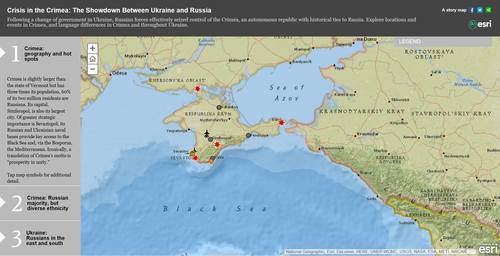
“As was the case 160 years ago, Crimea has once again become ‘the tinderbox’, potentially ready to ignite a pan-European conflict. Precipitous events in Crimea once again draws public attention to that often-forgotten triangular peninsula jutting into the Black Sea off the underbelly of Ukraine. While the news reports from Russian, Ukrainian, and Western sources have been generally confusing and conflicting, some interesting analysis has appeared in several media outlets.”
See on www.geocurrents.info
Gas and oil prices have risen amid fears the Ukraine crisis could have a damaging effect on one of Europe’s main energy supply routes. But analysts say high European gas stocks will limit the turbulence.
Russia is Europe’s biggest supplier of natural gas, but Ukraine is the key to their distribution network.
See on www.bbc.com
Ukraine’s interim prime minister says the country is “on the brink of disaster.”
Many observers fear that Russia’s military control of the Crimea could lead to more centrifugal forces in the region. This is troubling news indeed.
See on www.washingtonpost.com
The old labels no longer apply. Rich countries need to learn from poor ones.
BILL GATES, in his foundation’s annual letter, declared that “the terms ‘developing countries’ and ‘developed countries’ have outlived their usefulness.” He’s right. If we want to understand the modern global economy, we need a better vocabulary.
Mr. Gates was making a point about improvements in income and gross domestic product; unfortunately, these formal measures generate categories that tend to obscure obvious distinctions. Only when employing a crude “development” binary could anyone lump Mozambique and Mexico together.
It’s tough to pick a satisfying replacement. Talk of first, second and third worlds is passé, and it’s hard to bear the Dickensian awkwardness of “industrialized nations.” Forget, too, the more recent jargon about the “global south” and “global north.” It makes little sense to counterpose poor countries with “the West” when many of the biggest economic success stories in the past few decades have come from the East.
All of these antiquated terms imply that any given country is “developing” toward something, and that there is only one way to get there.
It’s time that we start describing the world as “fat” or “lean.”
See on www.nytimes.com