Search

GEOGRAPHY EDUCATION

Supporting geography educators everywhere with current digital resources.

Category

Uncategorized

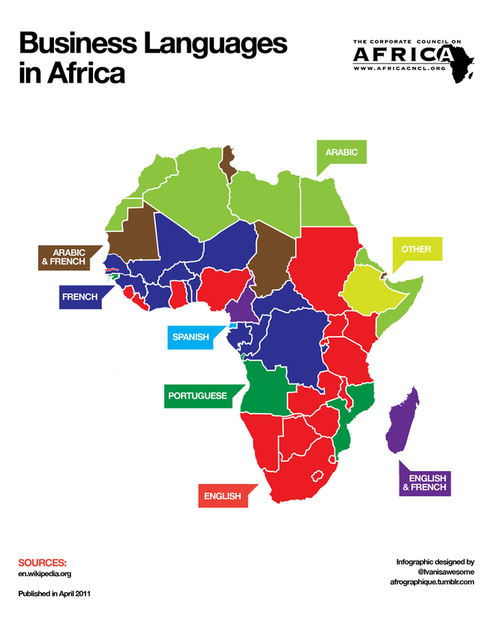
Gambia president rejects English language

President’s decision to shift official language from English to local language comes months after its decision to withdraw from the Commonwealth

Seth Dixon‘s insight:

The Gambia has been showing signs that they want to remove neo-colonial influences.  Last year the President withdrew the Gambia from the Commonwealth (a collection of 54 countries, mainly former British colonies), tired of being ‘lectured’ about human rights.  Now they have rejected English as the official language.  Mandingo (38%), Fula (21%) and Wolof (18%) are the three most widely spoken languages but it is currently unclear if one of these will become the new official language or if several will receive that status. 

Questions to Ponder: What are the advantages and disadvantages of using the old colonial language as the official language in multilingual African countries?  What are the advantages and disadvantages of using a local language/languages as the official language?    

Tags: languagegovernance, Africa, colonialism.

See on www.telegraph.co.uk

Lexical Distance Among the Languages of Europe

  This chart shows the lexical distance — that is, the degree of overall vocabulary divergence — among the major languages of Europe. The size of each circle represents the number of speakers …


And yes, English has its deepest roots in German…the French aspects were tacked on after the Norman Conquest.

See on elms.wordpress.com

Germany in figures

“Germany, which holds federal elections on 22 September, is Europe’s dominant country.  Its large and strong economy has allowed it to bankroll the bailouts that have kept some of its neighbours – and the euro – afloat.  The graphics below help explain why it is so dominant, and powerful – and also some of the problems it faces.”

See on www.bbc.com

Crisis in the Crimea: The Showdown Between Ukraine and Russia

Seth Dixon‘s insight:

This StoryMap from ESRI is a nice way to explore Crimean historical geography, as is this set of maps from National Geographic

See on storymaps.esri.com

How much is time wrong around the world?

Why Spaniards have dinner so late? A map of the difference between solar time and clock time around the world.

I edited a world map from Wikipedia to show the difference between solar and standard time. It turns out, there are many places where the sun rises and sets late in the day, like in Spain, but not a lot where it is very early (highlighted in red and green in the map, respectively). Most of Russia is heavily red, but mostly in zones with very scarce population; the exception is St. Petersburg, with a discrepancy of two hours, but the effect on time is mitigated by the high latitude. The most extreme example of Spain-like time is western China: the difference reaches three hours against solar time. For example, today the sun rises there at 10:15 and sets at 19:45, and solar noon is at 15:01.

See on poisson.phc.unipi.it

How much is time wrong around the world?

Why Spaniards have dinner so late? A map of the difference between solar time and clock time around the world.

I edited a world map from Wikipedia to show the difference between solar and standard time. It turns out, there are many places where the sun rises and sets late in the day, like in Spain, but not a lot where it is very early (highlighted in red and green in the map, respectively). Most of Russia is heavily red, but mostly in zones with very scarce population; the exception is St. Petersburg, with a discrepancy of two hours, but the effect on time is mitigated by the high latitude. The most extreme example of Spain-like time is western China: the difference reaches three hours against solar time. For example, today the sun rises there at 10:15 and sets at 19:45, and solar noon is at 15:01.

See on poisson.phc.unipi.it

Gaping hole to mark Breivik victims

“A slice of rock removed from the mainland near the island of Utoeya is the winning design for a memorial to commemorate the victims of Norwegian mass killer Anders Behring Breivik.”

Seth Dixon‘s insight:

Monument are not just in a place…they can create place and place can infuse added meaning to a memorial.  This is a great example of the interplay between memorials, place, artistic and cultural meanings. 

See on www.bbc.com

Global Ascendance

Reuters photographer Carlos Barria recently spent time in Shanghai, China, the fastest-growing city in the world. A week ago, he took this amazing shot, recreating the same framing and perspective as a photograph taken in 1987, showing what a difference 26 years can make. The setting is Shanghai’s financial district of Pudong, dominated by the Oriental Pearl Tower at left, and the new 125-story Shanghai Tower, China’s tallest building and the world’s second tallest skyscraper, at 632 meters (2,073 ft) high, scheduled to finish by the end of 2014. Shanghai, the largest city by population in the world, has been growing at a rate of about 10 percent a year the past 20 years, and now is home to 23.5 million people — nearly double what it was back in 1987. This entry is focused on this single photo pairing, with several ways to compare the two.

Seth Dixon‘s insight:

In the Atlantic, there was an article that highlighted some incredible comparisons of Shanghai’s Pudong district that show the impact globalization.  This image is my rendering of the two images as a composite image.  Globalization has hit…hard and fast.  Today, we shouldn’t think of Shanghai as a major city in China, but as as one of the major cities in the world..

See on geographyeducationdotorg.files.wordpress.com

Shanghai wasn’t the only city to grow tremendously during a globalization boom…Here is Dubai.

Dubai

▶ Countries inside Countries: Bizarre Borders

Seth Dixon‘s insight:

If you haven’t discovered CGP Grey yet, his YouTube channel is a veritable fountain of geographic tidbits.  His distinctive style helps to contextualizes some of the more odd and complicated parts of the Earth (but some find the rush of facts disorienting). If you want another example, watch Bizarre Borders, part 2 which focuses on the complexities of the US/Canadian border. 


Tags: borders, political, territoriality, sovereignty, CGP Grey.

See on www.youtube.com

Create a free website or blog at WordPress.com.

Up ↑